 Nidhi Gupta
Aug 6, 2026
2,513 views
16 min read
Nidhi Gupta
Aug 6, 2026
2,513 views
16 min read
French Slang is a vital component of conversations in France. Textbooks help students learn proper grammar and vocabulary; however, natives tend to employ casual vocabulary that makes the conversation sound authentic. Having observed native French speakers in Paris, watched modern French movies, and surfed the Web, one may be sure that the language from the textbook gets a person just halfway through. True conversations in France are full of vivid and colourful vocabulary that grammar textbooks do not cover. From a simple conversation in a local café to some playful teasing among acquaintances, French language’s Slang is the key to real fluency.
If you are going to visit the beautiful country of France for vacation or study, or even if you simply want to dazzle your French-speaking friends, getting to know how the natives speak will increase your listening skills right away. This complete guide will provide you with a complete list of over 80 important terms. We will explain everything about the common expressions, the context of the words, and their exact definitions so that you will be able to deal with any situation with ease. With the help of these everyday terms in your vocabulary, you will effortlessly overcome your textbook dialogues.
What Is French Slang (Argot) and Verlan?
Argot is slang in the French language that is used when speaking informally. Some terms have existed for many years, while some became popular very quickly due to rap and the Internet.
Verlan is a funny way to reverse syllables in a word. For example:
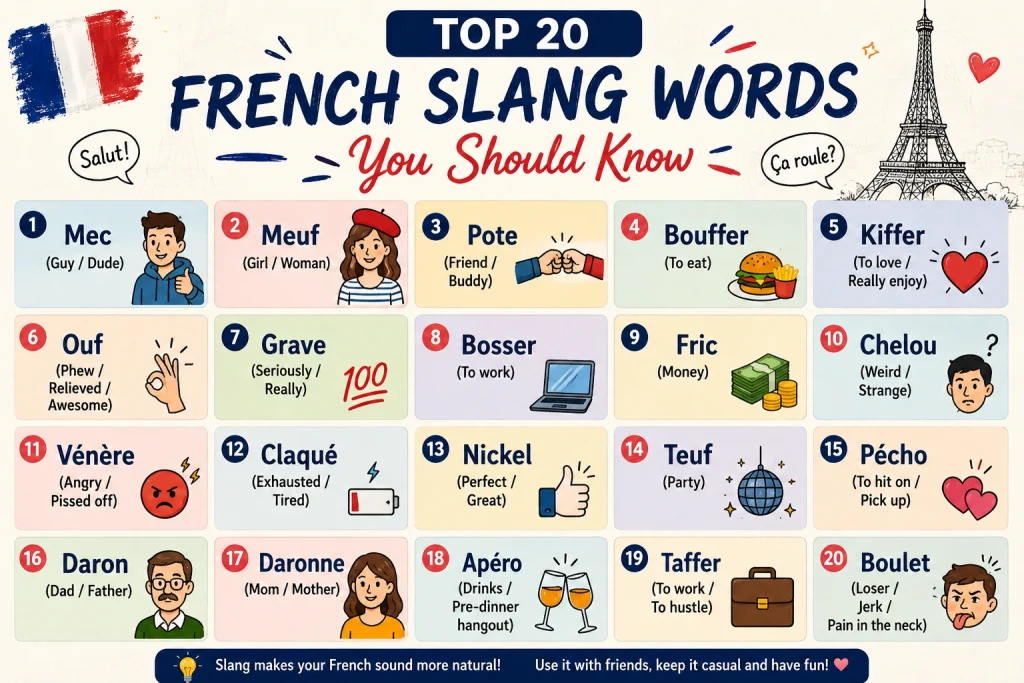
- Femme → meuf
- Fou → ouf
- Louche → chelou
- Lourd → relou
- Mec → keum
A lot of verlan expressions are so widely used today that even those who do not speak “street French” can understand them.
Important thing about the level of language: All these words can be used among friends and in class, but not in job interviews and other formal occasions.
Why Should You Learn Slang in French?
There are many benefits to learning slang.
- Understanding native speakers
- Watching French films without getting lost
- Enjoying French music and podcasts
- Developing better relations with locals
- Being more credible and fluent
- Improving listening comprehension
While most language learners just concentrate on grammar, learning slang can help you sound more authentic in French. A French Language Course – A1 Level, by Eduwatts will help you learn French Language in a very effective way.
French Slang vs Formal French
The French language has different styles of communication. French, which is formal, can be applied in formal settings, such as at work, in an academic environment, in documents and when communicating with people that you are not familiar with. However, common slang words in french can be used while conversing with friends, classmates, family members and colleagues in informal settings.
Formal French | French Slang Words for Friend | Meaning (English) | When to Use |
Bonjour | Salut | Hello | Friends and casual greetings |
Au revoir | À plus / Tchao | Goodbye | Informal farewells |
Comment allez-vous ? | Ça roule? | How are you? | Friends and peers |
Oui | Ouais | Yes | Casual conversations |
Je ne sais pas | Chais pas | I don’t know | Informal speech |
Manger | Bouffer | To eat | Casual conversations |
Travailler | Bosser / Taffer | To work | Among friends or coworkers |
Argent | Fric / Oseille | Money | Informal discussions |
Ami | Pote / Poto | Friend | Everyday conversations |
Homme | Mec | Guy / Dude | Casual speech |
Femme | Meuf | Girl / Woman | Informal speech |
Très bien | Nickel | Perfect / Great | Casual compliments |
Fatigué | Claqué / Crevé | Tired | Everyday conversations |
What are Common French Slang Words with Meaning and Examples?
Below is the complete list with meaning and example sentences.
| Slang in French Language | Meaning | French Slang Words Examples |
Salut | Hi | Salut, ça va ? |
Mec | Guy, dude | C’est un mec sympa. |
Meuf | Girl | Cette meuf est drôle. |
Frangin | Brother, bro | Salut frangin! |
Frangine | Sister | Ma frangine arrive. |
Pote | Friend | C’est mon pote. |
Poto | Best friend | Merci poto ! |
Bouffer | To eat | On va bouffer? |
Bagnole | Car | Belle bagnole! |
Bosser | To work | Je dois bosser demain. |
Kiffer | To love, enjoy | Je kiffe cette chanson. |
Ouf | Crazy | C’est ouf ! |
Dingue | Insane | C’est dingue ! |
Flipper | To panic | Je flippe avant l’examen. |
Choper | To catch, get | J’ai chopé un rhume. |
Galérer | To struggle | Je galère aujourd’hui. |
Crevé | Exhausted | Je suis crevé. |
Nickel | Perfect | Tout est nickel. |
Bof | So-so | Bof, pas vraiment. |
Grave | Totally | Grave ! |
Carrément | Absolutely | Carrément ! |
Taffer | To work | Je dois taffer. |
Baraque | House | Belle baraque. |
Flic | Police officer | Les flics arrivent. |
Fric | Money | Je n’ai plus de fric. |
Piaule | Room | Va dans ta piaule. |
Gosse | Kid | Ce gosse est adorable. |
Gamin | Child | Le gamin joue dehors. |
Truc | Thing | Passe-moi ce truc. |
Machin | Thingamajig | Donne-moi ce machin. |
Bidule | Object | Où est ce bidule ? |
Relou | Annoying | Il est relou. |
Chelou | Weird | C’est chelou. |
Lourd | Embarrassing | Cette blague est lourde. |
Vénère | Angry | Je suis vénère. |
Claqué | Broke or exhausted | Je suis claqué. |
Cramer | To burn | Le toast a cramé. |
Dég | Disappointed | Je suis dég. |
Daron | Dad | Mon daron travaille. |
Daronne | Mom | Ma daronne cuisine. |
Gaffe | Be careful | Fais gaffe ! |
Blague | Joke | Bonne blague ! |
Chouette | Cool | C’est chouette. |
Canon | Gorgeous | Elle est canon. |
Moche | Ugly | Ce pull est moche. |
Bouquin | Book | J’adore ce bouquin. |
Rencard | Date | J’ai un rencard. |
Plan | Arrangement | Bon plan ! |
Boum | Party | On va à une boum. |
Apéro | Drinks before dinner | On prend un apéro ? |
Clope | Cigarette | Une clope ? |
Boulot | Job | Je vais au boulot. |
80+ French Slang Words List every learner should know
1. Terms for Friends, Family, and Social Circles
Knowing how to address people in a friendly manner when interacting socially in France involves learning some of these words for “friend”. The following are some of the words for friend and family which you will hear all the time.
- Un pote – A mate, pal or buddy. This one is used commonly daily.
- Un mec – A dude, guy or man. Can be used by everyone at any age.
- Une meuf — a girl, woman, or girlfriend (Verlan for femme).
- Un frérot – Bro or little brother. Used between close friends.
- Un reuf – Brother (Verlan for frère).
- Une reus – Sister (Verlan for sœur).
- La mifa – Family or close crew (Verlan for famille).
- Un sang – A very close friend, a blood brother.
- Un gamin / Une gamine – Kid or young person.
- Un copain / Une copine – Boyfriend/girlfriend or close pal.
Using french language’s slang words for friend will make you seem friendly while hanging out with friends.
2. Food, Drinks, and Expenses
In France, socialising usually happens over meals, coffee, or drinks in the evening. Being able to understand and use French language’s Slang Words Examples about dining and costs is going to make life in such situations easier for you.
Money Words
- La thune – Money or cash.
- Le fric – Money, dough, or cash.
- L’oseille – Money (the translation literally means “sorrel”, which is an herb).
- Les sous – Coins or just money.
- Une balle – One euro (for example, dix balles means 10 euros).
- Rauquer – To pay for something, to shell out the money for it.
Words About Food and Drinks
- La bouffe – Food or grub.
- Bouffer – To eat, to eat up, or to gorge on.
- La flotte – Water or hard rain.
- Un canon – A glass of wine for sharing with friends.
- Un demi – A draught beer (that is, a half-pint glass).
- Avoir la dalle – To be hungry to death.
- Se rincer la dalle – To take a drink of water.
- Se prendre une cuite – To get drunk at a night out.
Learning French Slang Experssions with examples about the above-listed words is going to make dining and ordering food easier for you.
3. Expressing Feelings, Reactions, and Opinions
Expressing yourself accurately in terms of your reactions and emotions is essential to a lively conversation. French culture has expressive communication, and learning popular French language’s Slang Words is useful when you want to express excitement, frustration, or agreement.
- Kiffer – Means to like, love, or enjoy something.
- Un Kiff – Major pleasure, passion, or enjoyment.
- Avoir le Seum – To be gutted, disappointed, annoyed, or bitter.
- Avoir la Flemme – To feel too lazy to do something.
- Grave – Totally, big time, or fully agree.
- Trop – Super, extreme, or totally (e.g., C’est Trop Bien).
- Ouf – Incredible, mind-blowing, or crazy (Verlan for Fou).
- Chanmé – Great, wicked, or awesome (Verlan for Méchant).
- Zarbi – Bizarre or weird (Verlan for Bizarre).
- Chelou – Shady, sketchy, or strange (Verlan for Louche).
- Relou – Annoying, tedious, or heavy (Verlan for Lourd).
- Vachement – Really, extremely, or very much.
- Péter un câble – To blow a fuse, lose temper, or snap.
- C’est n’importe quoi – That is total nonsense or ridiculous.
- C’est blindé – It is completely packed or crowded.
- Sans déconner – For real, no joke, or seriously.
Authentic French language’s Slang Words will bring out your personality in your speaking.
4. Daily Routines, Work, and Lifestyle
No matter whether you talk about your routine job, your pastimes, or your travelling, these commonly used slang terms are highly utilised in daily life.
- Le boulot – Work, job, or workplace.
- Le taf – Work or labor.
- Tafer – To do a lot of work.
- Bousiller – To damage or to spoil something.
- Glander – To relax idly.
- Pioncer – To sleep.
- Sécher – To cut a class or meeting.
- Se casser – To get on the move or to leave.
- Se barrer – To take off hurriedly or to bolt.
- Foutre le camp – To scram or to bugger off.
- Roupiller – To sleep lightly or to doze.
- La caisse – car or automobile.
- La bagnole – A car or ride.
- Un bouquin – A book.
- Bouquiner – To read a book.
Learning these common slang terms in french will help your description of everyday happenings become much smoother.
5. Comprehensive Slang Words List for Everyday Situations
Here follows the rest of our exhaustive list of French language’s Slang Words with useful nouns, adjectives, fillers, and casual interjections.
- Un truc – A thing, object, or stuff.
- Un machin – A thingamajig or what-cha-call-it.
- Un bidule – A gizmo or gadget.
- Un boloss – A fool, loser, or naive person.
- Stylé – Classy, cool, or fashionable.
- Naze – Lame, broken, or useless.
- Ringard – Dated, corny, or uncool.
- Un flic – A cop or police officer.
- Un poulet – A police officer (slang).
- Un mytho – A liar or storyteller (short for mythomane).
- Kiffer la vibe – To like the mood.
- C’est nickel – It’s clean or perfect.
- C’est top – That’s great or awesome.
- Un p’tit déj – Short for petit-déjeuner (breakfast).
- L’apéro – Aperitif (drinks and appetisers before a meal).
- Un bobo – A little boo-boo or a bourgeois bohemian hipster.
- Faire la fête – Partying and celebrating.
- Faire la teuf – Partying (from Verlan).
- Faire dodo – Go to sleep (infantile expression).
- Chouette – Nice, neat, or pleasant.
- Piger – Understand and catch on.
- Capter – To understand and catch on (for example: je n’ai rien capté).
- Laisse tomber – Forget about it.
- Genre – Kind of like, like as if.
- Du coup – So, thus.
- Carrément – Absolutely.
- Gros – Dude (literally “big” used as an address).
- La classe – Stylish and classy.
- Broyer du noir – Feel depressed.
- Avoir un coup de foudre – Love at first sight.
Having this complete list of French language’s Slang Words always by hand will help you to have an easy reference point while you’re training in listening and speaking. Enrol in a Post Graduate Diploma in French Language and become an expert in French.
When Should I Use French Slang (and When Should I Avoid It)?
Slang in French Language is to be employed in informal contexts where the environment is laid-back and cosy. Slang can be used while you talk with your friends, classmates, colleagues who you know well, or while having casual chats on social networks or on messengers. Besides, Slang in French Language will help you to better comprehend French films, TV series, music and conversations with French native speakers. Learning and applying some basic slang phrases will give your French a much more authentic flavour.
Nevertheless, one should not use slang in formal contexts such as job interviews, business meetings, scientific reports, emails and conversations with professors, elders, and strangers. Moreover, sometimes slang may be regional, obsolete or inappropriate.
Therefore, you have to know the context first in order to use it. When you are not sure whether to use slang in a particular context, then go for the formal French.
Practical Advice on Memorising Slang in French Language with Meanings
Learning Slang in French Language becomes easier with the practical application of techniques rather than mere memorisation of extensive vocabulary lists. Given the conversational nature of slang, the most effective way of learning it is through seeing it being used in a context. Here are some useful tips that will allow you to learn Slang in French with meaning.
1. Learning Slang in a Context
Rather than memorising words one by one, make sure you understand the context of each slang word.
Example:
- Kiffer – To love or to really enjoy something
- Je kiffe cette chanson. (I love this song.)
Contextualising helps you remember the meanings and usage of slang words easily.
2. Classification of Words
Classify your slang words according to categories such as greetings, food, emotions, work, travel, friends, etc. It becomes easy to recall these words as your mind links the concepts together.
For example:
- Greetings – Salut, À plus, Tchao
- Friends – Pote, Poto, Mec
- Work – Bosser, Taffer
- Money – Fric, Oseille
3. Make Flash Cards
Write the slang word in French on one side and the definition and an example sentence of it in English on the other. Study them every day with the method of spaced repetition.
4. Watch French Films and TV Shows
The movies, web series, and YouTube videos are great sources for exposure to real conversations where native French speakers use slang expressions naturally.
5. Listen to French Songs and Podcasts
Modern slang is quite common in the songs and podcasts of France. They help you to learn proper pronunciation and rhythm as well as enrich vocabulary.
6. Practice Speaking Every Day
Try to use some new slang words in your daily communication or practice with another person who speaks the same language.
7. Use Language Learning Applications
Language learning applications come with quizzes, pronunciation training, and vocabulary reviews, which will aid in learning the meaning of slang words in French. Combine language applications with actual practice in speaking the language.
8. Practice Conversations with French Native Speakers
The best way to learn slang words is by listening to them in natural conversation. Joining language discussion forums online and practising with native speakers will assist in learning how different slang is used.
Learn French Language and Slang with Eduwatts
Rating- 4.8/5

However, learning French is not only about knowing the grammar and vocabulary. In order to be able to communicate fluently with the locals, one needs to know idiomatic expressions and even Slang in French Language, which are essential in real-life communication. The French language courses provided by Eduwatts cover all aspects of learning French for beginners and advanced students. These are the Best French Language Course in India.
The courses teach everything, starting from basic grammar and pronunciation, listening, reading, writing and speaking, up to real-life French conversations, which include Slang in French Language and other modern conversational phrases.
Eduwatts: What Makes It Special?
| Details of the Course | Information |
| Name of the Course | Post Graduate Diploma in French Language |
| Duration of the Course | 244+ Hours |
| French Levels Covered | A1, A2, B1 & B2 |
| Course Fee | ₹54,500 (Was ₹91,000) |
| Certificate | Yes(Globally Recognized Swiss Certification by Dunster Business School ) |
| Assessment | Yes, assessment by Dunster Business School |
| Mode of Learning | Live Online Interactive Classes |
| Access to Learn | 24×7 Lifetime Access to LMS and Class Recording |
| Internship | Hands on Internship Experience |
| Job Placement | Yes, Premium Job Portal Access and Placement |
| Exam Preparation | Includes Exam Prep of DILF, DELF, DALF, DCL & TCF Exams |
French Language Courses at Eduwatts
- Master’s (MS) in French Language
- French Language Course for Kids
- French Language Course- A2 Level
- French Language Course- B1 Level
- and many more
No matter if you have opted for further studies, career prospects, travel needs, or just to learn French for your personal satisfaction, Eduwatts helps you acquire all the language skills for practical communication. With lessons including standard French and common slang, you get to communicate confidently in any scenario.
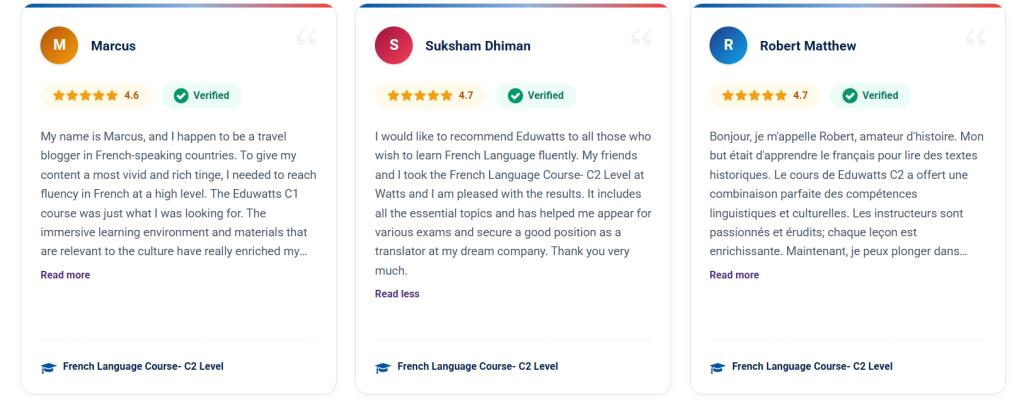
French Course Reviews by Students
Check out the French Course Reviews for Eduwatts-
1. Zehel Malik- Rating 4.7 /5
Zehel here, translator by profession. I came to Eduwatts for improving my language skills. Everything has been transformed by this institute for all the language learners out there. It is through these lessons that I was able to assimilate French quite easily and in a better way. The vocabulary flashcards were the best part about it. It was fun learning like this. The progress report always helped in staying on track, and I have been quite excited with the progress being made.
2. Aaliya Habib Rating 4.5/5
For me, learning the French language was a necessity because when I went to France, I discovered that I needed to have better fluency and knowledge of the language and culture. I searched for many different online platforms to learn from and finally selected Eduwatts, which was one of the best-ranked. I must say learning French with Eduwatts has been great. Culture insights were helpful to gain an in-depth knowledge of the language.
Final Thoughts
Building up your vocabulary so that it includes the slang language is the most exhilarating experience that you can have while learning the language. By breaking away from the constraints of the textbooks and diving into Slang in French Language, you will be able to connect culturally and communicatively with the French language even better. Having an intuitive knowledge of Slang in French Language will enable you to interact with the French culture with more authenticity. Lastly, using Slang in French Language will make you right at home in any French-speaking environment!
Recommended Reads
- How to Learn a New Language Online: A Complete Guide
- Most Spoken Language in the World: Facts, Rankings & Native Speakers
- 9 Best Languages to Learn in the Upcoming Years for Your Career Growth
- Speak Like a Native: Fast-Track Your Foreign Language Learning
- How to Stay Motivated While Learning a New Language?
FAQs
Slang in French Language consists of words and expressions used by native French people instead of standard French in daily speech.
Knowledge of slang will help you better understand native speakers, movies, songs, etc.
Yes, it is possible to learn some common slang words such as salut, mec, pote, and kiffer.
Verlan is a special kind of Slang in French Language where the syllables of words are reversed.
No. Most slang expressions are informal, and it is not appropriate to use them in business conversations.
There are many commonly used French slang words, such as mec, meuf, pote, bouffer, kiffer, grave, chelou, ouf, fric, and bosser.
Remembering Slang in French Language is possible via daily conversation, French movies, podcasts, flash cards, and speaking practices with natives.
These slang words may be widely comprehended in France but not the same for all other French-speaking countries, such as Belgium, Switzerland, Quebec, and others.
Slang in French Language is easy to master within a few weeks.
It is possible to learn French pronunciation, grammar, and slang at Eduwatts with regular speaking practices.
Ready to Start Your Learning Journey?
Join thousands of learners and build your future with expert-led courses and 100% practical training.

Nidhi Gupta
I am an experienced content writer who knows how to create compelling, clear, and search engine optimized content for different digital channels. My specialization includes blogging, article, website content, and other types of content that will be useful for you in terms of improving your company’s online presence. All my work is based on extensive research, attention to details, and knowledge of various industries. Apart from content creation, I have knowledge about Medical Coding and SAP principles, and this allows me to create relevant and valuable content for the health care and enterprise technology industries. In addition, I know several foreign languages such as German, French, and Chinese, and this is beneficial in order to create global-oriented content. I like making complicated information more understandable.
View all articles

Recent Comments (15)
Great resource to anyone that is learning French. Excited to read more articles like this!
This was a fun read. It found how native French speakers really speak.
I love that the meaning of each and every slang term is contextualized. That helps make remembering them much simpler.
This is quite easily the best article on French slang I have ever come across online. Clear, useful, and enjoyable.
Fantastic guide! I can already see myself using some of these phrases in conversation.
The examples are sound and the writing carries you from beginning to end.
The writing is accessible and friendly, like someone speaking to you rather than textbook material.
Who knew that could be the most fascinating seeming French slang! Appreciate you compiling such a useful guide.
Added this page to my bookmarks as I will surely return here to refresh my memory on these slang words.
Very well written! This article helped boost my confidence when I tried to get a grasp of casual French conversations.
Thanks for sharing this. It demystified French slang to a far greater extent than I would have thought.
Very informative and well organized. I like the real-life examples sprinkled in throughout the post.
Great article! I head some new French phrases that I haven’t read on any other blogs.
Once again a perfect match for what I was looking for. The explanations are easy and practical for beginner.
Really enjoyed reading this! These slang examples are easily comprehended, there is never a dull moment to learn french.