 Nidhi Gupta
Jul 6, 2026
2,083 views
18 min read
Nidhi Gupta
Jul 6, 2026
2,083 views
18 min read
Indeed, SAP Interview Questions play a crucial role in simply preparing candidates to attend Technical and Functional roles across the SAP space. SAP Interview Questions is the most searched topic among IT professionals on the way to ERP designations in 2027. The right SAP interview questions and answers could reduce the gap either way if you are a fresher in search of your first job or an experienced consultant who has climbed up the ladder in pursuit of a senior position.
As SAP (Systems, Applications and Products in Data Processing) is used by any way more than 400000 organisations across the globe, the need for trained professionals are in high demand. Therefore, to navigate through enterprise resource planning, one needs to have a clear understanding of the integrated systems.
Here is a rundown of the SAP Interview Questions that would determine your career trajectory for 2027 and beyond, to ensure you get it right. Certainly, the SAP interview questions in this guide are meant to strike the perfect balance between theory and practice that an interviewer expects. Keep this as a reference cheat sheet before the SAP Interview.
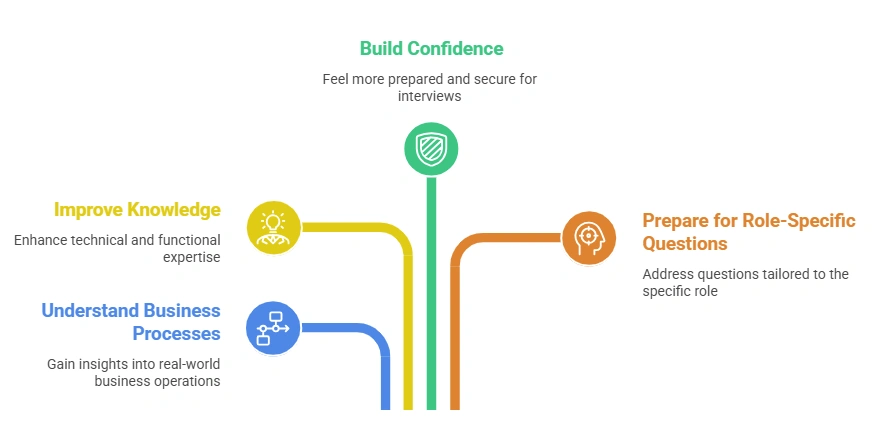
Why Prepare SAP Interview Questions?
List of 45+ SAP Interview Questions and Answers
SAP Basics- Common SAP Interview Questions
Firstly, here are the most common SAP interview questions for round one. Surely, it is expected of every candidate to respond to this with fluency.
Q1. SAP — What does it mean?
Ans- SAP is short for System Applications and Products in data processing. Moreover, they are a German multinational software corporation that makes enterprise resource planning (ERP) software to manage business operations and customer relations. SAP is one of the largest software companies in the world, founded in 1972 and headquartered in Walldorf, Germany.
Q2. What are the main components of SAP ERP?
Ans- For the SAP ERP system, its core components are as follows —
- FI – Financial Accounting
- CO – Controlling
- SD – Sales and Distribution
- MM – Materials Management
- PP – Production Planning
- HR/HCM – Human Capital Management
- PS – Project Systems
- PM – Plant Maintenance
Q3. Explain the term ‘Client’ in SAP?
Answer: Client is the highest organisational unit in SAP. It is also an independent organisational unit having its own data, master record sets, and table sets.
Q4. What Is The Difference Between SAP ECC And SAP S/4HANA?
Ans: SAP ECC is a next-generation ERP system that operates on the legacy database system. SAP S/4HANA, on the other hand, is the next high-performing ERP system that runs exclusively on the SAP HANA in-memory database system. The S/4HANA system can help customers meet their business requirements with its simplified data architecture, real-time analysis, and modern Fiori user interface (UI).
Q5: What is the role of Transport Request (TR)?
Ans: TR are used to transport the configurations and developments done in one SAP system to another (from DEV → QAS → PRD). Workbench and customising are maintained through transaction codes SE09 (Workbench Organiser) and SE10 (Customising Organiser). The TRs provide capability for version control and landscape consistency.
Pro Tip: Whenever you answer any common SAP interview questions, always link your answer to the real business cases. The interviewers prefer candidates who connect the dots between technical concepts and real-life results.
Q6. What is a Transport Request in SAP?
Ans: It is used to move configuration changes between SAP systems.
Q7- Explain the SAP R/3 Architecture.
The “R” stands for Real-time, and “3” represents the three tiers:
- Presentation Layer: User interface or SAP GUI (or Fiori)
- Application Layer: Responsible for processing business logic
Database Layer: all the data is kept there (HANA, Oracle DB, SQL Server, etc.)
Q8- What is the difference between Master Data and Transaction Data
Ans- Master Data: More or less static data that lives in the system for a long time (e.g., Customer Master, Material Master, Vendor Master)
Transaction Data: Short-term day-to-day operational data (e.g., a particular Sales Order, Purchase Order or an Individual Invoice).
Q9- Define “Metadata.
Metadata is “data about data.” It describes the schema of data/objects in SAP system, such as table definitions or field lengths.
SAP Basis Interview Questions
SAP Basis is basically the administrative layer in SAP. You often see these questions in the top SAP Interview question lists in Infrastructure and Basis consultant profiles.
Q10. What is SAP Basis?
SAP Basis is the set of middleware programs and tools that allows SAP applications to function with os and db. Serves as the technical basis that allows system administration, performance tuning, user management, client management and operation of the system landscape.
Q11- What are the layers of SAP’s three-tier architecture?
Following is the structure of the three-tier architecture that SAP follows:
- SAP GUI (front-end interface) — Presentation Layer
- Application Layer – Application Servers for business logic
- Database layer: RDBMS where all SAP data is stored.(e.g., Oracle, HANA, DB2)
Q12. What do SM50 and SM66 transactions do?
Ans- SM50 shows the work processes running on your current application server — it is used to view active, waiting, or stopped processes in real time. SM66Provides a global overview of the work processes, and this command also gives us a view of work processes across all application servers in the landscape simultaneously.
Q13- What is the work process in SAP?
A: Work Processes are the basic execution units on the Application Server. I. Types of (D) Dialogue, (B) Background, (U) Update, (E) Enqueue Job,(S)Spool and(M). Each manages a certain type of SAP request, and they run as an independent OS process.
Q14- Explain the SAP system landscape?
A: The structured arrangement of SAP systems is called the SAP system landscape. Figure 2: Typical three-system landscape development (DEV) system where changes are made, quality assurance (QAS) system that tests the changes, and production (PRD), which is the live business environment. The transport layer: DEV —> QAS —> PRD, i.e. Transport Requests move through these layers respectively.
SAP ABAP Interview Questions
SAP ABAP (Advanced Business Application Programming) is SAP’s proprietary programming language. Indeed, these SAP interview questions and answers cover essential ABAP concepts.
Q15. What is ABAP? Mention the important data types in ABAP.
Ans: ABAP stands for Advanced Business Application Programming, which is SAP’s 4GL programming language to build SAP applications. Data types in ABAP: Character (C), Numeric Text (N), Integer (I), Floating Point (F), Date (D), Time (T), Packed Decimal (P), Hexadecimal (X), and String.
Q16. What do you understand about the Internal Table in ABAP?
Ans: Internal tables are run-time data objects that represent multiple data records having the same structure (similar to tables of databases). Types of Internal Tables: Standard, Sorted, and Hashed Table.
Q17. Explain CALL FUNCTION and PERFORM about ABAP.
Ans: CALL FUNCTION calls a function module – which is a reusable block of code with predefined import/ export parameters and exceptions. The function modules can even be accessed remotely through RFC. PERFORM calls a form – routine defined as FORM… ENDFORM in ABAP.
Q18-. For what purpose are BAPI, BDC, and LSMW used?
Answer: They are data integration tools.
- BAPI – Business API – Standardised, object-oriented interfaces to program SAP systems.
- BDC – Batch Data Communication – An older data transfer method that repeats the screen transaction.
- LSMW – Legacy System Migration Workbench – A one-time process to migrate data from the legacy system into SAP.
Q19- What do you understand about the enhancement framework in SAP ABAP?
Ans- The enhancement framework allows for modification-free behavior in SAP systems. It includes: Badis, Explicit/Implicit Enhancements, Customer Exit and Business Transaction Event (BTE).
SAP SD (Sales & Distribution) Questions
Furthermore, here are some of the best SAP interview questions related to the Order to Cash process in SAP SD.
Q20- What is the Order to Cash (O2C) Process in SAP SD?
Answer: Order to Cash process in SAP SD – Inquiry>Quotation>Sales Order>Delivery>Post Goods Issue(PGI)>Billing>Accounting Document. Each of these steps is interconnected through documentation to ensure complete tracing till billing and subsequent payment postings in FI.
Q21- What are the important Organisational units in SAP SD?
Answer: Some of the important organisational units in SAP SD are:
Sales organisation (Sales), Distribution channel (Product delivery method), Division(Product grouping), Sales area (All above), Sales office, Sales group, Plant/shipping point.
Q22. What is a Pricing Procedure in SAP SD?
Ans: A pricing procedure is used to determine the method of calculating the price of products/services within a sales document. The process defines a sequence of conditions (for example, base price, discount/surcharge/tax, etc.) with their corresponding calculation procedures, account key, and prerequisites, which can be created using transaction code V/08.
Q23. How does a Return Order differ from a Credit Memo in SD?
Ans: In a return order (order type RE), there will be actual return of goods, leading to a goods receipt in the system. However, in a credit memo (order type CR), there will only be an adjustment of the customer’s payment due without any change in inventory.
SAP MM (Materials Management) Questions
These SAP interview questions and answers cover the Procure-to-Pay process and core MM functionality.
Q24. Describe the Procure-to-Pay (P2P) process in SAP MM.
Answer: P2P Process in SAP MM: Purchase Requisition (PR) → Request for Quotation (RFQ) → Quotation → Purchase Order (PO) → Goods Receipt (GR) → Invoice Verification (IV) → Payment.
Q25. Explain what the Material Master in SAP is?
Answer: Material Master in SAP refers to the central database of all material data. There are views maintained in it by various departments, such as Basic Data, Purchasing, MRP, Storage, Accounting, Sales, etc. Each of these views relates to a particular organisational level and department.
Q26. What is the difference between PO, PR, and Outline Agreement?
Ans: They are procurement documents:
- PR – Purchase Requisition – Internal procurement requirement
- PO – Purchase Order – External procurement order to vendor
- Outline Agreement – Long-term contract or scheduling agreement with vendor for material delivery over time
Q27. What is the GR/IR clearing account?
Ans: GR/IR is the Goods Receipt / Invoice Receipt account, which is used to bridge the time gap between the arrival of goods and the arrival of the vendor’s invoice. Upon receipt of goods, the GR/IR account is credited. Upon receipt of the vendor’s invoice, the GR/IR account is debited.
SAP FICO (Finance & Controlling) Questions
Here are typical questions that are asked during a SAP FI Consultant Interview:
Q 28. What is the difference between ‘Company’ and ‘Company Code’ in SAP?
Answer: ‘Company’ is the topmost hierarchy in SAP, which is used for consolidations. ‘Company Code’ is the smallest hierarchy, where books of account can be prepared for financial statements. It is also the basic entity used for financial reporting purposes.
Q29. What is a Chart of Accounts (COA) in SAP FI?
Answer: A Chart of Accounts is a list of all G/L accounts that a particular Company Code uses. There are three types of COAs, i.e., Operating COA, Group COA, and Country COA.
Q30. What is the difference between a Profit Centre and a Cost Centre?
A: A Cost Centre (CO module) is concerned with cost accounting only and thus is purely a cost center without any revenue accounting. On the other hand, the Profit Centre (EC-PCA module) takes care of both revenue and cost accounting and thus facilitates profitability calculations for the business segment.
Q31. What do you mean by Document Splitting in SAP FICO?
A: Document splitting in SAP FI (new GL) facilitates segment accounting. Document splitting distributes lines in the document to characteristics such as Profit Center/Segment, etc., automatically according to splitting rules.
SAP HR / HCM Interview Questions
This set of SAP interview questions relates to Human Capital Management basics for HR functional consultants.
Q32. What is an Infotype in SAP HCM?
A: An Infotype is the grouping of HR attributes on the screen in one unit. Moreover, Infotypes have time-dependent validity, enabling record keeping for history, present, and future for all employees.
Q33. Explain the difference between Personnel Area and Personnel Subarea.
A: Personnel Area is the subdivision of the Company Code that represents a geographic/organisational entity (for example, city or region). Personnel Subarea is the further division of the Personnel Area (for example, department or plant).
SAP S/4HANA & Advanced Interview Questions
Furthermore, these SAP interview questions are related to advanced topics in recent technology and are asked for SAP consultant/architect positions.
Q34. What is Universal Journal in SAP S/4HANA?
Answer: The Universal Journal (ACDOCA) is the core document of SAP S/4HANA, which combines postings from Financial Accounting (FI) and Controlling (CO) in one line item table. This helps eliminate data duplication in FI, CO, Material Ledger, Profit Center Accounting, and reports in real time based on one source of truth.
Q35. What is SAP Fiori?
Answer: SAP Fiori is the latest user experience design approach provided by SAP, which enables a role-based and simple interface to be used for SAP applications.
Q36. What is SAP BTP (Business Technology Platform)?
Ans: SAP BTP provides application development, data management, integration, analytics, and artificial intelligence services through its suite of solutions. BTP comes with various capabilities such as SAP Integration Suite, SAP Build, SAP HANA Cloud, and SAP Analytics Cloud.
Q37. Explain SAP HANA? How does it differ from other databases?
Ans: SAP HANA is an in-memory relational database management system. It works on in-memory technology. While other databases work on row store technology, SAP HANA works on column store technology, where data is stored directly in memory and not the full row from disk needs to be scanned for processing purposes. It enables high-speed HTAP processing.
Q38. What is CDS (Core Data Services) in SAP ABAP?
A: CDS views are a technical framework that allows us to create and utilize semantic models in SAP systems. They are written in SQL-like language and then sent to the HANA level for optimum performance. CDS views enable the creation of VDM in S/4HANA and form the basis of OData services in Fiori applications.
Q39. What is SAP Activate Methodology?
A: SAP Activate is an implementation methodology developed by SAP itself for S/4HANA projects. The SAP Activate methodology has six stages, namely: Discover > Prepare > Explore > Realize > Deploy > Run.
More Top SAP Interview Questions
Moreover, these extra SAP Interview Questions & Answers deal with some common Cross Module Concepts that may come during the technical interview round.
Q40. How does Customising differ from Development in SAP?
Answer: Customisation means configuring the SAP standard features using the Implementation Guide (SPRO). No coding is involved. On the other hand, developing in SAP involves ABAP coding and developing new objects, extending SAP functionality, etc.
Q41. What are Batch Jobs in SAP, and how can you monitor them?
Answer: Batch Jobs (background jobs) refer to those programs which execute without any user intervention and are mostly used for background processing, e.g., payroll runs, billing runs, data extracts, etc. They are scheduled through SM36 and can be monitored through SM37 (Jobs Display). Batch job statuses include:
- Scheduled
- Released
- Active
- Finished
- Cancelled
Q42. What does the acronym IDoc mean in SAP?
Ans: IDocs are standard SAP documents that are exchanged electronically between SAP and external applications (EDI). IDocs have three components, namely Control Record (sender & receiver details), Data Record (segments containing business information), and Status Record (IDoc processing history). We use transaction code WE19 to test IDocs.
Q43- What is SAP Solution Manager?
Ans: SAP Solution Manager is a centralised ALM (Application Lifecycle Management) solution used for implementing and operating SAP solutions.
Q44. How does SAP manage authorisations?
A: In SAP, authorisations are carried out using the Role-Based Access Control (RBAC) concept. Authorisation objects have fields with allowable values. They are classified into Authorisation Profiles, Roles, and assigned to users. Users are managed by transaction SU01, roles by transaction PFCG, and failed authorisations by transaction SU53.
Q45. What is SAP MDG (Master Data Governance)?
A: The SAP Master Data Governance (MDG) is an application used to centrally create, change, and distribute master data in SAP landscapes with governance processes and data quality. This applies to domains like Customers, Vendor/Supplier, Materials, Finance (G/L Account/Cost Centre), and other domains.
Q46. What is SAP PI/PO, and what are its differences with SAP Integration Suite?
A: SAP PI/PO is the process integration and orchestration platform for SAP on-premises systems. SAP Integration Suite is the cloud-based alternative, providing integration services, API management, and event mesh technologies – the future direction of SAP for all new integrations.
Q47. Explain the purpose of SAP SE16 and SE16N transactions.
A: SE16 is the SAP Data Browser that allows viewing data in SAP tables. SE16N is the enhanced version, providing improved functionality such as filters and column selection with support for up to 200 fields in each table. These SAP tools are utilised by developers and consultants for debugging purposes only, not for editing production data.
Q48. What is SAP APO / IBP?
A: SAP APO stands for Advanced Planner and Optimiser. Surely, it is SAP’s previous generation solution for supply chain planning, which is now replaced by SAP IBP. Moreover, SAP IBP runs on HANA Cloud and provides integrated functionalities like demand planning, supply planning, inventory optimisation, S&OP (Sales and Operations Planning), and response planning.
Q49. What is meant by Badi in SAP?
A: The BadI stands for Business Add-In. It is an enhancement possibility in SAP that helps the developer to insert additional logic into the program without actually changing the standard SAP software. BAdIs are created by SAP, but they can be implemented by the customers.
Tips to Crack SAP Interviews
Prepare smartly to answer SAP Interview Questions with confidence:
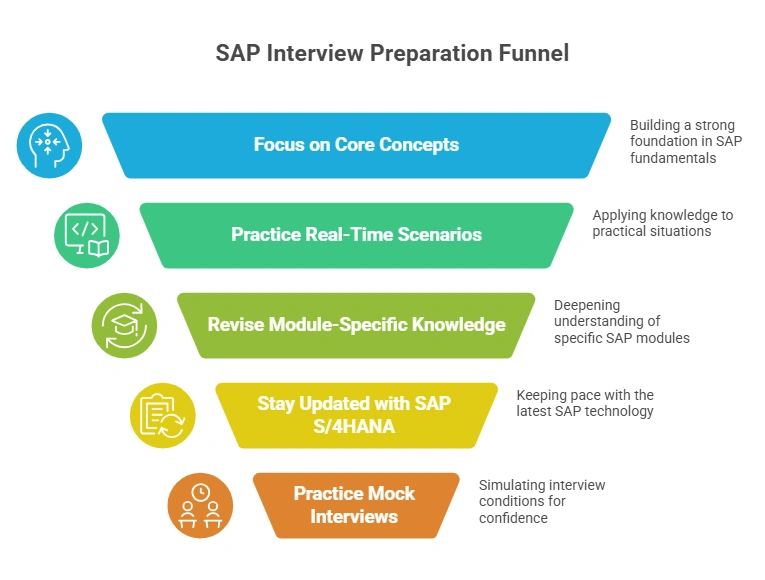
Prepare For SAP Interview Questions With Eduwatts

Indeed, Eduwatts is the best SAP training institute across the globe. If you want to move from a Beginner-level education into a SAP Consultant, then Eduwatts is the first option you must look for. Certainly, Eduwatts is affiliated with multiple national and international education bodies like Dunster Business School, MSME, AAEFL, TEFL Canada, ISO and many more.
Features of SAP Training
Just handing you a course is not enough for Eduwatts, so they give you a great career-ready package that consists of:
- Instructor-Led Live Interactive SAP Training: 44+ hours of training by subject-matter experts.
- Projects: Real-world simulations and case studies.
- Internships Guaranteed: Surely, a 100% Internship Guarantee. Apply Stuff In The Real World.
- Global Certification Assistance: Help for you to clear your official SAP Global Certification exams.
- 100% Placement Support for 1 Year: Connect with 2,100+ hiring partners–Deloitte, IBM and Microsoft.
- Certainly, you will get an Industry-Aligned Curriculum
- Flexible & Continuous Access
- And a Gold Membership for one year
- Along with 24/7 LMS Access
- Moreover, Eduwatts have a Proven Career ROI
Specialised Interview Preparation With Eduwatts
- Mock Interviews — Simulated technical rounds with industry experts
- Resume & LinkedIn Building: Optimise your profile so it even goes beyond ATS filters.
- Soft Skills Modules: Additional training on communication formalities.
Conclusion
Certainly, from basic SAP principles to sophisticated HANA integrations, these 45+ SAP interview questions and answers provide an exhaustive list for candidates of any level of expertise. Indeed, the depth of knowledge and experience demonstrated by being ready for all topics in every module indicates cross-functional thinking, which employers seek in candidates. So, save this guide as a bookmark and go through each topic one by one. Reviewing the best SAP interview questions before the day of your interview will help you pass any SAP test in 2027 and beyond.
Recommended Reads
- SAP Course: Details, Syllabus, Eligibility, Career, Scope, Fees and More
- SAP Basis Consultant Salary in India
- SAP Course Fees & Certification Costs in India
- Top SAP Modules for a High-Paying Career in 2027
- SAP Consultant: Roles, Types, Skills & Salary Guide
FAQs
SAP Interview Questions preparation will give you confidence as well as help you clear the interview.
Usually, the best SAP Interview Questions for freshers revolve around fundamental things like SAP modules and ERP.
The SAP Interview Questions that are asked of professionals are generally based on scenario-based questions and more advanced stuff.
To practice SAP Interview Questions, you may use mock tests and other online platforms, as well as case studies.
Yes, it is possible to clear SAP interviews as a fresher by preparing for the Common SAP Interview Questions.
Ready to Start Your Learning Journey?
Join thousands of learners and build your future with expert-led courses and 100% practical training.

Nidhi Gupta
I am an experienced content writer who knows how to create compelling, clear, and search engine optimized content for different digital channels. My specialization includes blogging, article, website content, and other types of content that will be useful for you in terms of improving your company’s online presence. All my work is based on extensive research, attention to details, and knowledge of various industries. Apart from content creation, I have knowledge about Medical Coding and SAP principles, and this allows me to create relevant and valuable content for the health care and enterprise technology industries. In addition, I know several foreign languages such as German, French, and Chinese, and this is beneficial in order to create global-oriented content. I like making complicated information more understandable.
View all articles

Recent Comments (9)
Very informative and well written blog.
After reading this blog I got to know about SAP.
And I got the information in details
After reading this blog now I am feel motivated.
Very useful content for anyone preparing for SAP interviews. The questions are updated and relevant to current industry needs. Most Important SAP Interview Questions and Answers is worth reading.
The SAP interview questions and answers are explained in a very simple and clear way. It’s very useful for anyone preparing for interviews and makes the concepts easy to understand.
Nice information
After reading this blog on SAP interview question, I’ve gained enough confidence to crack interview
Really useful post, This makes SAP interview prep much easier.
Very useful and easy perfect for quick SAP interview