 Nidhi Gupta
Aug 12, 2026
2,077 views
13 min read
Nidhi Gupta
Aug 12, 2026
2,077 views
13 min read
French Numbers are among the first things that you must know when learning French as they can assist you in stating your age, discussing prices, sharing phone numbers, understanding dates, etc. The process of learning numbers in French from 1 to 100 will become very easy for you once you are familiar with their pronunciation pattern.
No matter whether you are a beginner in learning French or are trying to revise your French vocabulary, this article will prove to be helpful for you in learning french numbers 1 To 100 with English pronunciation and examples.
Why Learn French Numbers?
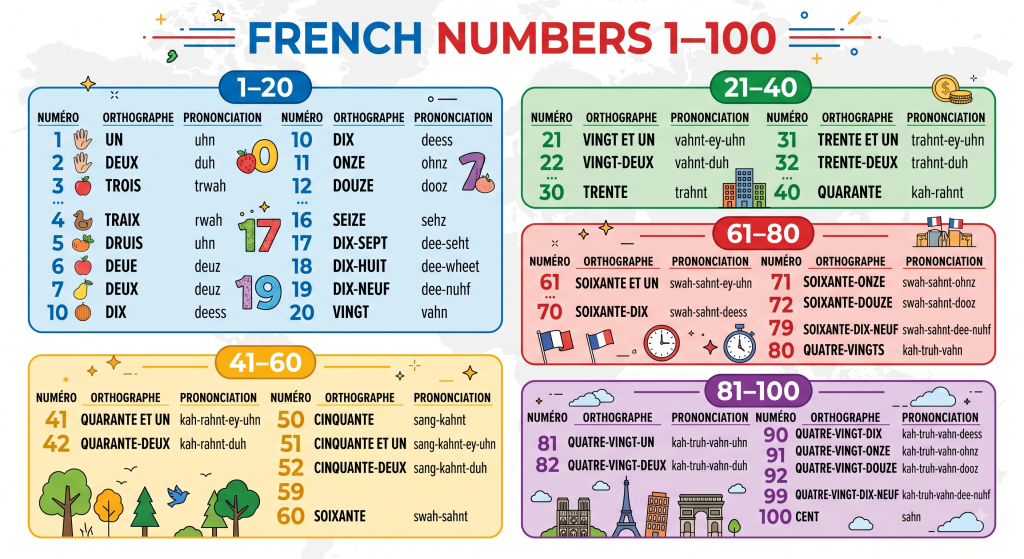
Numbers are ubiquitous in everyday French dialogue. These might be required when shopping, ordering food, checking into a hotel, telling the time, talking about money, or providing your address.
Knowledge of numbers will enable you to lay a good groundwork in French since bigger numbers are formulated using a pattern that is related to numbers from 1 to 100.
For instance:
- 21 = vingt et un
- 32 = trente-deux
- 45 = quarante-cinq
- 68 = soixante-huit
- 99 = quatre-vingt-dix-neuf
Once you understand these patterns, you can quickly recognise and form many other numbers. Indeed, you can learn these numbers with the help of the French Language Course – A1 Level.
List of French Numbers 1 To 100
Numbers in French 1–10: The Foundation
The numbers one through twenty are the building blocks of French numerals. Learn these numbers first, since they occur repeatedly in higher numbers.
|
Number |
French |
Pronunciation |
|
1 |
un |
uhn |
|
2 |
deux |
duh |
|
3 |
trois |
trwah |
|
4 |
quatre |
KAT-ruh |
|
5 |
cinq |
sank |
|
6 |
six |
seess |
|
7 |
sept |
set |
|
8 |
huit |
weet |
|
9 |
neuf |
nuhf |
|
10 |
dix |
deess |
Example sentence: J’ai deux chats. (I have two cats.)
The pronunciation provided above is a rough guide for English pronunciation. There may be some slight variations in French pronunciation.
French Numbers 11–20
While Numbers 11 to 16 use words exclusively for themselves, 17 to 19 will use words that combine “ten” and the other number in sequence.
|
Number |
French |
Pronunciation |
|
11 |
onze |
onz |
|
12 |
douze |
dooz |
|
13 |
treize |
trehz |
|
14 |
quatorze |
ka-TORZ |
|
15 |
quinze |
kanz |
|
16 |
seize |
sehz |
|
17 |
dix-sept |
dee-SET |
|
18 |
dix-huit |
deez-WEET |
|
19 |
dix-neuf |
deez-NUHF |
|
20 |
vingt |
van |
Example sentence: Elle a quinze ans. (She is fifteen years old.)
21–30 Numbers in French
However, starting with 21, French number system follows a simple pattern: ten’s place + “et” + one, but for those that end with 1, up to 71. For all others it is ten’s place + hyphen + the other number.
|
Number |
French |
Pronunciation |
|
21 |
vingt et un |
van-tay-UHN |
|
22 |
vingt-deux |
van-DUH |
|
23 |
vingt-trois |
van-TRWAH |
|
24 |
vingt-quatre |
van-KAT-ruh |
|
25 |
vingt-cinq |
van-SANK |
|
26 |
vingt-six |
van-SEESS |
|
27 |
vingt-sept |
van-SET |
|
28 |
vingt-huit |
van-WEET |
|
29 |
vingt-neuf |
van-NUHF |
|
30 |
trente |
tront |
French Numbers 31–40
The number 30 in French is trente. In order to make numbers 31 to 39, just use trente and the corresponding number.
|
Number |
French |
Pronunciation |
|
31 |
trente et un |
tront-ay-UHN |
|
32 |
trente-deux |
tront-DUH |
|
33 |
trente-trois |
tront-TRWAH |
|
34 |
trente-quatre |
tront-KAT-ruh |
|
35 |
trente-cinq |
tront-SANK |
|
36 |
trente-six |
tront-SEESS |
|
37 |
trente-sept |
tront-SET |
|
38 |
trente-huit |
tront-WEET |
|
39 |
trente-neuf |
tront-NUHF |
|
40 |
quarante |
ka-RONT |
41–50 Numbers in French
In the same way, the number 40 is …
|
Number |
French |
Pronunciation |
|
41 |
quarante et un |
ka-ront-ay-UHN |
|
42 |
quarante-deux |
ka-ront-DUH |
|
43 |
quarante-trois |
ka-ront-TRWAH |
|
44 |
quarante-quatre |
ka-ront-KAT-ruh |
|
45 |
quarante-cinq |
ka-ront-SANK |
|
46 |
quarante-six |
ka-ront-SEESS |
|
47 |
quarante-sept |
ka-ront-SET |
|
48 |
quarante-huit |
ka-ront-WEET |
|
49 |
quarante-neuf |
ka-ront-NUHF |
|
50 |
cinquante |
sank-ONT |
Example
Le livre coûte quarante-cinq euros.
The book costs 45 euros.
French Numbers 51–60
The number 50 in French is cinquante. Numbers 51 to 59 also follow a similar pattern.
|
Number |
French |
Pronunciation |
|
51 |
cinquante et un |
sank-ont-ay-UHN |
|
52 |
cinquante-deux |
sank-ont-DUH |
|
53 |
cinquante-trois |
sank-ont-TRWAH |
|
54 |
cinquante-quatre |
sank-ont-KAT-ruh |
|
55 |
cinquante-cinq |
sank-ont-SANK |
|
56 |
cinquante-six |
sank-ont-SEESS |
|
57 |
cinquante-sept |
sank-ont-SET |
|
58 |
cinquante-huit |
sank-ont-WEET |
|
59 |
cinquante-neuf |
sank-ont-NUHF |
|
60 |
soixante |
swa-SONT |
Example
Il a cinquante-deux ans.
He is 52 years old.
61–70 Numbers in French
The number 60 is soixante. The numbers 61 through 69 are constructed like other numbers.
|
Number |
French |
Pronunciation |
|
61 |
soixante et un |
swa-sont-ay-UHN |
|
62 |
soixante-deux |
swa-sont-DUH |
|
63 |
soixante-trois |
swa-sont-TRWAH |
|
64 |
soixante-quatre |
swa-sont-KAT-ruh |
|
65 |
soixante-cinq |
swa-sont-SANK |
|
66 |
soixante-six |
swa-sont-SEESS |
|
67 |
soixante-sept |
swa-sont-SET |
|
68 |
soixante-huit |
swa-sont-WEET |
|
69 |
soixante-neuf |
swa-sont-NUHF |
|
70 |
soixante-dix |
swa-sont-DEESS |
The crucial thing to remember is that in French, the number 70 is soixante-dix, literally “sixty-ten.”
French Numbers 71–80: Where It Gets Interesting
These are the numbers that tend to be problematic for students. The French language does not create a new word for “seventy” but counts on from sixty: soixante-dix means “sixty-ten.”
|
Number |
French |
Pronunciation |
|
71 |
soixante et onze |
swa-sont-ay-ONZ |
|
72 |
soixante-douze |
swa-sont-DOOZ |
|
73 |
soixante-treize |
swa-sont-TREHZ |
|
74 |
soixante-quatorze |
swa-sont-ka-TORZ |
|
75 |
soixante-quinze |
swa-sont-KANZ |
|
76 |
soixante-seize |
swa-sont-SEHZ |
|
77 |
soixante-dix-sept |
swa-sont-dee-SET |
|
78 |
soixante-dix-huit |
swa-sont-deez-WEET |
|
79 |
soixante-dix-neuf |
swa-sont-deez-NUHF |
|
80 |
quatre-vingts |
KAT-ruh-van |
Tip: Quatre-vingts literally means “four twenties” (4 x 20 = 80).
Example
J’ai soixante et onze livres.
I have 71 books.
81–90 Numbers in French
The number 80 introduces another important pattern. Quatre-vingts literally means “four twenties.”
For 81, the final s in vingts disappears, and French uses quatre-vingt-un.
|
Number |
French |
Pronunciation |
|
81 |
quatre-vingt-un |
kat-ruh-van-UHN |
|
82 |
quatre-vingt-deux |
kat-ruh-van-DUH |
|
83 |
quatre-vingt-trois |
kat-ruh-van-TRWAH |
|
84 |
quatre-vingt-quatre |
kat-ruh-van-KAT-ruh |
|
85 |
quatre-vingt-cinq |
kat-ruh-van-SANK |
|
86 |
quatre-vingt-six |
kat-ruh-van-SEESS |
|
87 |
quatre-vingt-sept |
kat-ruh-van-SET |
|
88 |
quatre-vingt-huit |
kat-ruh-van-WEET |
|
89 |
quatre-vingt-neuf |
kat-ruh-van-NUHF |
|
90 |
quatre-vingt-dix |
kat-ruh-van-DEESS |
French Numbers 91–100
From 91 to 99, French combines quatre-vingt with numbers from 11 to 19.
|
Number |
French |
Pronunciation |
|
91 |
quatre-vingt-onze |
kat-ruh-van-ONZ |
|
92 |
quatre-vingt-douze |
kat-ruh-van-DOOZ |
|
93 |
quatre-vingt-treize |
kat-ruh-van-TREHZ |
|
94 |
quatre-vingt-quatorze |
kat-ruh-van-ka-TORZ |
|
95 |
quatre-vingt-quinze |
kat-ruh-van-KANZ |
|
96 |
quatre-vingt-seize |
kat-ruh-van-SEHZ |
|
97 |
quatre-vingt-dix-sept |
kat-ruh-van-dee-SET |
|
98 |
quatre-vingt-dix-huit |
kat-ruh-van-deez-WEET |
|
99 |
quatre-vingt-dix-neuf |
kat-ruh-van-deez-NUHF |
|
100 |
cent |
son |
Example
Il y a quatre-vingt-dix-neuf étudiants.
There are 99 students.
Cent personnes sont présentes.
One hundred people are present.
What Are the Basic French Numbers for Beginners?
Basic French numbers are fundamental for those starting to learn the French language. First, you need to memorize numbers from 1 to 20 since they form a basis for counting in the French language.
These are the numbers that beginners should learn first:
- 1-5: un, deux, trois, quatre, cinq
- 6-10: six, sept, huit, neuf, dix
- 11-15: onze, douze, treize, quatorze, quinze
- 16-20: seize, dix-sept, dix-huit, dix-neuf, vingt
After memorizing 1-20, it is necessary to learn some tens: trente (30), quarante (40), cinquante (50), soixante (60), soixante-dix (70), quatre-vingts (80), and quatre-vingt-dix (90). At last, memorise cent (100).
Numbers in French get easier starting from 20 as there are many numbers which consist of tens’ words and smaller numbers. For instance, vingt-deux is 22, and quarante-cinq is 45.
Beginners need to pay attention to 70, 80, and 90, as these numbers have different structures than English ones.
Understanding the French Counting Pattern
Learning French Counting becomes easier when you divide numbers into groups.
- 1-16 : Mémorisez chaque nombre séparément. Chaque nombre de 1 à 16 est formé individuellement.
- 17-19 : Les nombres utilisant « dix »
Les nombres 17,18 et 19 sont formés de « dix » et des nombres 7,8 et 9.
17 = dix-sept
18 = dix-huit
19 = dix-neuf
- 20-69 : Les nombres utilisant « dizaines + unités »
C’est un schéma régulier : dizaines + unités. Des exemples sont :
- 22 = vingt-deux
- 34 = trente-quatre
- 47 = quarante-sept
- 58 = cinquante-huit
- 63 = soixante-trois
Pour les nombres qui se terminent par 1 , la construction « et un » est généralement utilisée en français :
- 21 = vingt et un
- 31 = trente et un
- 41 = quarante et un
- 51 = cinquante et un
- 61 = soixante et un
- 70-79 : Pensez « 60 + 10-19 »
En français 70 est construit ainsi : soixante-dix puis :
- 71 = soixante et onze
- 72 = soixante-douze
- 75 = soixante-quinze
- 78 = soixante-dix-huit
- 80-89 : Pensez « 4 x 2 »
Common Examples Using Numbers in French
- J’ai vingt-cinq ans. — I am twenty-five years old.
- Ça coûte dix euros. — That costs ten euros.
- Il est trois heures. — It is three o’clock.
- Nous sommes cent personnes. — We are a hundred people.
Why Are French Numbers 70, 80, and 90 Different?
70, 80, and 90 Numbers in French might seem peculiar since French utilizes different number systems for these figures. Unlike English where every decade is denoted by unique words, in French these numbers are formed using smaller numbers.
- The number 70, for instance, is soixante-dix, which quite accurately reflects the “sixty-ten” concept. Also, seventy-one is soixante et onze, that is sixty and eleven, whereas seventy-nine is soixante-dix-neuf, that is sixty-nineteen.
- 80 in French is quatre-vingts which means “four twenties,” as the word quatre stands for four, and vingt is twenty. Thus, 4 x 20 = 80. Following the same system, eighty-one is quatre-vingt-un, eighty-two is quatre-vingt-deux, and so on.
- The number 90 is quatre-vingt-dix, meaning “four twenties-ten,” or 80 + 10. The numbers ninety-one through ninety-nine are formed following the same rule, as in ninety-one – quatre-vingt-onze, and ninety-nine – quatre-vingt-dix-neuf.
It should be noted that these numerical patterns were formed due to traditional number systems such as the vigesimal one.
How do you pronounce Numbers in French?
Knowledge of Numbers in French with Pronunciation is quite helpful in speaking, yet the pronunciation guide in English gives you just an approximate result.
Pronounce sounds, not letters.
- Don’t pronounce all final consonants
In many cases, Numbers in French end with letters that are not pronounced. So don’t pronounce the final consonant in deux, for instance.
- Learn nasal sounds
Un, cinq, and cent include the sounds which don’t exist in English at all.
So listen carefully to French speakers and try to repeat after them.
- Learn about liaison
Sometimes, French speakers link sounds from one word to another.
This may alter the way of saying the number in the context.
- Learn 70, 80 and 90 separately
These numbers are usually hard for beginners to pronounce since their structures are different from those in English.
Don’t forget:
- 70 – soixante-dix
- 80 – quatre-vingts
- 90 – quatre-vingt-dix
What Is the Difference Between Vingt, Vingts, and Quatre-Vingt?
However, Vingt, vingts, and quatre-vingt may be somewhat confusing at first when one studies the Numbers in French, yet the rule is quite easy once one knows about the spelling in French.
Vingt is 20. Vingt does not have an s when it stands alone or when it is followed by other numbers. For instance, vingt means 20, and vingt-deux means 22.
Vingts should be used when vingt means 80 precisely in the phrase quatre-vingts. S is added because vingt is multiplied by four, and there are no numbers following it. So, quatre-vingts = 80.
But when there is a number following 80, s is omitted. Such as quatre-vingt-un = 81; quatre-vingt-cinq = 85.
Therefore, the main rule is:
- 20 = vingt
- 80 = quatre-vingts
- 81-99 = quatre-vingt + number
And note that quatre-vingts has an s only when it finishes the number. This is a simple spelling rule that simplifies French counting from 80 to 99 greatly.
How to Learn French Numbers Quickly?
If your intention is to learn numbers in French correctly, it would be unwise to try and memorize all one hundred numbers at once.
Follow these easy steps:
Step 1: Learn 1–20
Practise speaking them out loud daily.
Step 2: Learn the numbers from 20 to 90
Memorize:
- 20 = vingt
- 30 = trente
- 40 = quarante
- 50 = cinquante
- 60 = soixante
- 70 = soixante-dix
- 80 = quatre-vingts
- 90 = quatre-vingt-dix
- 100 = cent
Step 3: Learn the combinations
After learning the tens, just add the needed units.
Step 4: Learn random numbers
Ask yourself:
“What number does 47 equal in French?”
And give an answer:
quarante-sept
Step 5: Practise using the numbers in sentences
Rather than merely reciting the vocabulary, say:
J’ai trente ans. — I am 30 years old.
Il coûte vingt euros. — It costs 20 euros.
Nous sommes quarante. — There are 40 of us.
This method makes it easier to remember numbers through their usage.
Numbers in French Used in Everyday Conversations
Numbers are crucial to the French language on a daily basis.
1. Discussing One’s Age
J’ai vingt-cinq ans.
I am 25 years old.
2. Discussing Prices
Ça coûte trente euros.
It costs 30 euros.
3. Discussing Dates
Nous sommes le vingt août.
It is August 20.
4. Discussions About Time
Il est huit heures.
It is eight o’clock.
5. Quantification
Je voudrais deux cafés.
I would like two coffees.
6. Discussing Phone Numbers
French phone numbers can be read in pairs of digits:
06 12 34 56 78
This could be said as:
zéro six, douze, trente-quatre, cinquante-six, soixante-dix-huit.
In other words, learning numbers is useful to conduct many discussions in French.
Common Mistakes When Learning Numbers in French
There are some common mistakes that people make when first learning French.
Error 1: Mixing up quatre-vingts and quatre-vingt
80 = quatre-vingts
But if there is another number after it, the s drops off:
81 = quatre-vingt-un
Error 2: Not using “et” at the end of certain numbers
Use:
- 21 = vingt et un
- 31 = trente et un
- 41 = quarante et un
Note that not all numbers ending in 1 use et:
- 81 = quatre-vingt-un
Error 3: Direct translation of English constructions
80 is not formed as “eighty” in French; it uses quatre-vingts, which means four times twenty.
Error 4: Concentrating only on spelling
There may be considerable difference between what you expect it to sound like in English and how it sounds in French.
A Simple French Numbers Practice Exercise
Challenge yourself to do this without referring to the answers.
Convert these numbers to French:
- 7
- 14
- 21
- 36
- 48
- 55
- 67
- 72
- 84
- 99
Answers
- sept
- quatorze
- vingt et un
- trente-six
- quarante-huit
- cinquante-cinq
- soixante-sept
- soixante-douze
- quatre-vingt-quatre
- quatre-vingt
Eduwatts French Language Course

The Post Graduate Diploma in French Language by Eduwatts covers French language training from A1 to C2. This means students can learn French language skills ranging from beginner to advanced levels. Eduwatts’ French language course includes grammar, vocabulary, speaking, listening, reading, and writing skills. Eduwatts claims that French training at Eduwatts helps in preparing for exams such as DILF, DELF, DALF, DCL, and TCF.
This French language course is offered via live interactive online sessions as well as access to an e-learning portal, depending on the level.
French Courses Offered by Eduwatts
Level | Duration | Listed Fee* | Suitable For |
A1 | 56+ hours | ₹9,500 | Beginners |
A2 | 56+ hours | — | Elementary learners |
B1 | 66+ hours | ₹12,500 | Intermediate learners |
B2 | 66+ hours | ₹12,500 | Upper-intermediate learners |
C1 | 66+ hours | ₹15,500 | Advanced learners |
C2 | 66+ hours | ₹15,500 | Near-native proficiency |

Key Features of the Eduwatts French Language Course
- Interactive online training classes
- French language training from A1 to C2 levels
- Online learning portal
- Assignments & Practice Exercises
- AI-powered auto-graded practice exercise
- Vocabulary Flashcards
- Practical Internship Experience
- Professional Certificate
- French Language Exams Assistance
- Access to job portal
French Courses at Eduwatts
- French Language Course- A2 Level
- French Language Course- B1 Level
- French Language Course- B2 Level
- French Language Course- C1 Level
- French Language Course- C2 Level
- Master’s (MS) in French Language
Eduwatts Students Reviews

Conclusion
Learning Numbers in French gets significantly simpler after knowing the structure of the numbers. Begin by learning numbers from one to twenty, followed by learning the main tens, which include vingt, trente, quarante, cinquante, soixante, soixante-dix, quatre-vingts, and quatre-vingt-dix.
As a beginner, your main challenge is going to be learning 70, 80, and 90. But with constant practice, the above numbers will soon become easy to recognize.
This 1 To 100 Numbers in French article can be used as a reference whenever you practice speaking, listening, reading, and writing. Using numbers when talking about age, prices, dates, time, and quantities in real life is a great way of making them an integral part of your vocabulary.
Recommended Reads
- 80+ Common French Slang Words Every Learner Should Know
- How to Stay Motivated While Learning a New Language?
- How to Learn a New Language Online: A Complete Guide
- Most Spoken Language in the World: Facts, Rankings & Native Speakers
- 9 Best Languages to Learn in the Upcoming Years for Your Career Growth
- Speak Like a Native: Fast-Track Your Foreign Language Learning
FAQS
Firstly, learn the numbers from 1-20. Then, study how to say the tens and combine them with other numbers. Focus on the numbers 70, 80, and 90.
In French, numbers are pronounced differently than in English. Beginners should try to listen to native speakers and imitate the sounds.
Vingt stands for 20, while quatre-vingts means 80. The use of the letter s in vingts only occurs at the end of 80.
Et un is used in numbers like 21 (vingt et un), 31 (trente et un), 41 (quarante et un), 51 (cinquante et un), 61 (soixante et un).
You will be using numbers when talking about age, price, dates, time, quantity, addresses, phone numbers, and appointments.
Yes, French may be relatively easy to learn by beginners, particularly those who speak English or any other European language. Continuous practice with vocabulary, grammar, pronunciation, and conversations can do a great job for you.
It does not usually take much time for new learners to memorize the numbers. However, one should start with learning 1–20 and the counting techniques.
Time required depends on your learning objectives, schedule, and past experience in languages. With regular practice, learners are able to master the basics of conversation.
Ready to Start Your Learning Journey?
Join thousands of learners and build your future with expert-led courses and 100% practical training.

Nidhi Gupta
I am an experienced content writer who knows how to create compelling, clear, and search engine optimized content for different digital channels. My specialization includes blogging, article, website content, and other types of content that will be useful for you in terms of improving your company’s online presence. All my work is based on extensive research, attention to details, and knowledge of various industries. Apart from content creation, I have knowledge about Medical Coding and SAP principles, and this allows me to create relevant and valuable content for the health care and enterprise technology industries. In addition, I know several foreign languages such as German, French, and Chinese, and this is beneficial in order to create global-oriented content. I like making complicated information more understandable.
View all articles


Recent Comments (15)
A well-organized beginner-friendly article. I would recommend it for sure to somebody who is beginning learning French.
This is hundred times better than just memorising a list of numbers. Its patterns and examples help you retain the data.
I always struggled to understand 70, 80, and 90, so I found this explanation especially useful.
Rather than paging through the text, the tables facilitate easy, rapid access to a specific French number. Very useful for revision.
Great resource for beginners! The way the article connects numbers with ages, prices, dates, and things said in light conversation is something I find appealing.
Very helpful is the part about common mistakes. Such small image differences confuse one while learning French.
I liked the exercise practice in the end. It allows you to see if you really remember the numbers.
How This Article Makes Learning French Numbers A Whole Lot Easier It uses the step-through pattern quite remarkably.
A practical, no-nonsense guide for learners of French The pronunciation tips are especially useful, particularly for people who are only just starting out.
Quatre-vingts was especially useful. Now I see why French says it this way for 80.
It was such an easy 1 to the value ratio of a hundred for me. Saving this for sure for my French
I liked the Examples with everyday sentences. It depicts the French numbers as they are used in everyday conversations.
Very useful article for anyone starting French in small doses. It makes practicing a lot easier when you have the numbers and pronunciation next to each other.
I particularly enjoyed how it explained 70, 80 and 90. Those numbers may seem hard to understand at first, but this shows us the shapes well enough.
This is a really useful guide for beginner French numbers. It helps a lot when the concrete example can be pronounced.