Nidhi Gupta
Oct 13, 2026
764 views
14 min read
Nidhi Gupta
Oct 13, 2026
764 views
14 min read
French Words play an important role in learning French because they allow new learners to greet other people, introduce themselves, ask various questions, buy food and communicate in general. It is easier to learn the most common French words along with their meanings and pronunciation in English.
For those who would like to start their journey of learning the French language, here is a guide that includes 120+ French words, including phrases, sorted by category. You will find basic greetings, numbers, pronouns, verbs, adjectives, food, travel and common sentences.
Those who are interested in learning French for travel, studies, a job or just for their own pleasure can start with this vocabulary list.
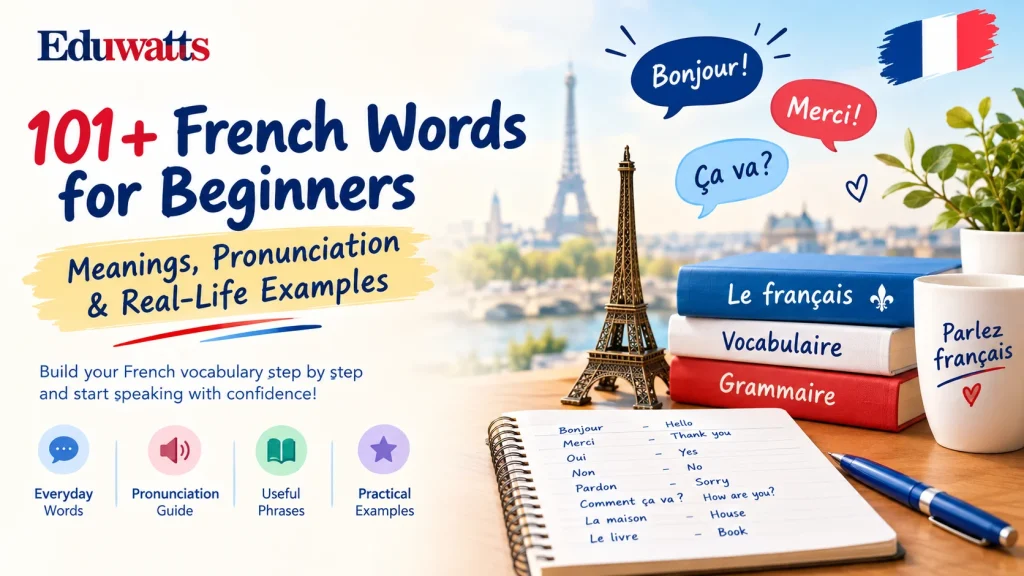
What Are the First French Words Beginners Should Learn?
Important words in the French language to learn at the beginner level would be: salutations like Bonjour (Hello); polite words like Merci (Thank you); pronouns like Je (I); verbs like Être (To Be); and common nouns like Maison (House).
Learning vocabulary by category and using it in short sentences is a good way of memorising it.
1. Common French Words for Greetings and Introductions
Salutations are some of the earliest words in the French language that one must learn. They allow you to greet other people and initiate interaction with them.
| French word or phrase | English meaning | Pronunciation guide |
| Bonjour | Hello / Good morning | Bon-zhoor |
| Salut | Hi / Bye | Sa-lu |
| Bonsoir | Good evening | Bon-swahr |
| Au revoir | Goodbye | Oh ruh-vwahr |
| Merci | Thank you | Mehr-see |
| Merci beaucoup | Thank you very much | Mehr-see boh-koo |
| S’il vous plaît | Please (formal) | Seel voo pleh |
| S’il te plaît | Please (informal) | Seel tuh pleh |
| Oui | Yes | Wee |
| Non | No | Nohn |
| Pardon | Sorry / Excuse me | Par-dohn |
| Excusez-moi | Excuse me | Ex-koo-zay mwah |
| Bienvenue | Welcome | Byan-vuh-nu |
| À bientôt | See you soon | Ah byan-toh |
| À demain | See you tomorrow | Ah duh-man |
| Ça va ? | How are you? / Is it going well? | Sah vah |
| Ça va bien | I am fine / It is going well | Sah vah byan |
| Enchanté(e) | Nice to meet you | On-shon-tay |
Example conversation:
- A: Bonjour ! Ça va?
- B: Bonjour ! Ça va bien, merci. Et vous ?
- A: Très bien, merci !
English translation:
- A: Hello! How are you?
- B: Hello! I am fine, thank you. And you?
- A: Very well, thank you!
Tip: Use Bonjour in formal and everyday situations during the day. Use Salut with friends and people you know well.
2. Common French Words for Everyday Conversations
These french language basic words help you to comprehend simple queries, state your requirements, and engage in day-to-day conversations.
| French word | English meaning |
| Comment | How |
| Pourquoi | Why |
| Quand | When |
| Où | Where |
| Qui | Who |
| Quoi | What |
| Quel / Quelle | Which / What |
| Combien | How much / How many |
| Comment ça va ? | How are you? |
| Parce que | Because |
| Peut-être | Maybe |
| Toujours | Always / Still |
| Jamais | Never |
| Aujourd’hui | Today |
| Demain | Tomorrow |
| Hier | Yesterday |
| Maintenant | Now |
| Ici | Here |
| Là | There |
| Aussi | Also / Too |
Example sentences:
- Où est la gare ? — Where is the train station?
- Pourquoi apprends-tu le français ? — Why are you learning French?
- Je suis ici aujourd’hui. — I am here today.
- Combien ça coûte ? — How much does it cost?
Early learning of question words assists in forming helpful sentences rather than memorising individual vocabulary words.
3. French Pronouns and Essential Grammar Words
The pronouns are important for helping you refer to yourself and others. Begin with personal pronouns and some basic connecting words.
| French word | English meaning |
| Je | I |
| Tu | You (informal, singular) |
| Il | He / It |
| Elle | She / It |
| Nous | We |
| Vous | You (formal or plural) |
| Ils | They (masculine or mixed group) |
| Elles | They (feminine group) |
| Mon | My (masculine singular noun) |
| Ma | My (feminine singular noun) |
| Mes | My (plural nouns) |
| Le | The (masculine singular) |
| La | The (feminine singular) |
| Les | The (plural) |
| Un | A / An (masculine) |
| Une | A / An (feminine) |
| Et | And |
| Mais | But |
| Avec | With |
| Sans | Without |
Example sentences:
- Je suis étudiant. — I am a student. (Masculine speaker)
- Elle est ma sœur. — She is my sister.
- Nous apprenons le français. — We are learning French.
- Un café et une baguette, s’il vous plaît. — A coffee and a baguette, please.
Important grammar tip: French nouns have grammatical gender. Learn each noun with its article, such as la maison (the house) or le livre (the book), to remember whether it is masculine or feminine.
Thinking About Learning French?
4. Basic French Words: Common Verbs
Verbs are words that show actions, conditions, and occurrences. Familiarity with commonly used verbs will make it easier for you to construct simple sentences and tell others about yourself.
| French verb | English meaning |
| Être | To be |
| Avoir | To have |
| Aller | To go |
| Faire | To do / To make |
| Parler | To speak |
| Manger | To eat |
| Boire | To drink |
| Aimer | To like / To love |
| Vouloir | To want |
| Pouvoir | To be able to / Can |
| Devoir | To have to / Must |
| Savoir | To know (a fact or how to do something) |
| Comprendre | To understand |
| Apprendre | To learn |
| Étudier | To study |
| Travailler | To work |
| Habiter | To live / Reside |
| Dormir | To sleep |
| Lire | To read |
| Écrire | To write |
Example sentences:
- Je suis heureux. — I am happy. (Masculine speaker)
- J’ai un livre. — I have a book.
- Je parle français. — I speak French.
- J’aime le chocolat. — I like chocolate.
- Je veux apprendre le français. — I want to learn French.
Learning tip: Practise verbs in their common forms, not just their dictionary forms. For example, learn être alongside je suis (I am), tu es (you are), and il est (he is).
5. French Words for Numbers
Among the most valuable words in the French language are French numbers since you require them when shopping, talking about prices, giving time and dates.
| French number | English number | French number | English number |
| Zéro | 0 | Six | 6 |
| Un | 1 | Sept | 7 |
| Deux | 2 | Huit | 8 |
| Trois | 3 | Neuf | 9 |
| Quatre | 4 | Dix | 10 |
| Cinq | 5 | Onze | 11 |
| Douze | 12 | Treize | 13 |
| Quatorze | 14 | Quinze | 15 |
| Seize | 16 | Vingt | 20 |
| Trente | 30 | Quarante | 40 |
| Cinquante | 50 | Soixante | 60 |
| Cent | 100 | Mille | 1,000 |
Example sentences:
- J’ai deux frères. — I have two brothers.
- Il est huit heures. — It is eight o’clock.
- Ça coûte dix euros. — It costs ten euros.
There are also some interesting patterns when counting in French. In France, for instance, seventy is written as “soixante-dix” (60 + 10), whereas eighty becomes “quatre-vingts” (4 x 20).
Ready to Start Learning French?
6. Common French Words for Food and Drinks
Knowledge of food terminology is very helpful while travelling to France, eating in restaurants, or going shopping in supermarkets.
| French word | English meaning |
| Eau | Water |
| Pain | Bread |
| Lait | Milk |
| Café | Coffee |
| Thé | Tea |
| Fromage | Cheese |
| Beurre | Butter |
| Riz | Rice |
| Poulet | Chicken |
| Poisson | Fish |
| Viande | Meat |
| Pomme | Apple |
| Banane | Banana |
| Orange | Orange |
| Légumes | Vegetables |
| Fruits | Fruits |
| Sucre | Sugar |
| Sel | Salt |
| Petit-déjeuner | Breakfast |
| Dîner | Dinner |
Useful food-related phrases:
- Je voudrais un café. — I would like a coffee.
- De l’eau, s’il vous plaît. — Some water, please.
- J’aime les fruits. — I like fruit.
- L’addition, s’il vous plaît. — The bill, please.
Use Je voudrais (I would like) when making polite requests in restaurants and cafés.
7. Words in French For Family and People
People’s names and related vocabulary can help you to discuss your family and relationships.
| French word | English meaning |
| Famille | Family |
| Mère | Mother |
| Père | Father |
| Parents | Parents |
| Frère | Brother |
| Sœur | Sister |
| Fils | Son |
| Fille | Daughter / Girl |
| Ami | Male friend |
| Amie | Female friend |
| Homme | Man |
| Femme | Woman / Wife |
| Enfant | Child |
| Personne | Person |
| Professeur | Teacher / Professor |
Example sentences:
- Voici ma famille. — Here is my family.
- J’ai une sœur. — I have a sister.
- Mon ami parle français. — My friend speaks French.
Take note of how ami and amie both mean “friend,” and how their spelling differs due to their gender in grammar, but their pronunciation does not necessarily change.
8. French Language Basic Words For Places and Travel
Before travelling to any Francophone nation, you should be aware of transportation terms, words regarding places, directions, and accommodations.
| French word | English meaning |
| Maison | House / Home |
| École | School |
| Gare | Train station |
| Aéroport | Airport |
| Hôtel | Hotel |
| Restaurant | Restaurant |
| Magasin | Shop / Store |
| Rue | Street |
| Ville | City / Town |
| Pays | Country |
| Banque | Bank |
| Hôpital | Hospital |
| Toilettes | Toilet / Restroom |
| Billet | Ticket |
| Train | Train |
| Bus | Bus |
| Métro | Metro / Subway |
| Gauche | Left |
| Droite | Right |
| Tout droit | Straight ahead |
Example sentences:
- Où est l’hôtel ? — Where is the hotel?
- La gare est à gauche. — The train station is on the left.
- Je cherche les toilettes. — I am looking for the restroom.
- Un billet pour Paris, s’il vous plaît. — One ticket to Paris, please.
These phrases will assist you in handling various scenarios without having to be fluent in French.
9. Famous Words in the French Language and Useful Descriptive Words
Certain French terms have gained international recognition because of their use in arts, fashion, food, and popular phrases. It will be fun learning them.
| French word | English meaning |
| Amour | Love |
| Bon appétit | Enjoy your meal |
| Merci | Thank you |
| Chic | Stylish / Elegant |
| Déjà vu | A feeling of having experienced something before |
| Rendez-vous | Appointment / Meeting |
| Joie de vivre | Joy of living |
| C’est la vie | That’s life |
| Magnifique | Magnificent |
| Belle / Beau | Beautiful / Handsome |
| Bon | Good |
| Mauvais | Bad |
| Grand | Big / Tall |
| Petit | Small |
| Heureux | Happy (masculine) |
| Heureuse | Happy (feminine) |
| Triste | Sad |
| Facile | Easy |
| Difficile | Difficult |
| Important | Important |
This is because the well-known French phrase has been used in international conversation, literature, movies, and lifestyle writing. There are also some expressions that have made their way into the English language, such as ‘déjà vu’ and ‘rendezvous’.
10. Basic French Words and Phrases for Daily Life
Knowledge of each word is beneficial; however, using words to form whole phrases will allow for better communication skills.
| French phrase | English meaning |
| Je m’appelle… | My name is… |
| Je suis débutant(e). | I am a beginner. |
| Je ne comprends pas. | I do not understand. |
| Parlez-vous anglais ? | Do you speak English? |
| Je parle un peu français. | I speak a little French. |
| Pouvez-vous m’aider ? | Can you help me? |
| Je ne sais pas. | I do not know. |
| C’est combien ? | How much is it? |
| Où habitez-vous ? | Where do you live? |
| Comment vous appelez-vous ? | What is your name? |
| Je voudrais ceci. | I would like this. |
| À quelle heure ? | At what time? |
| Je suis désolé(e). | I am sorry. |
| Pas de problème. | No problem. |
| Bonne journée ! | Have a nice day! |
Beginner conversation example:
- A: Bonjour ! Comment vous appelez-vous ?
- B: Bonjour ! Je m’appelle Marie. Et vous ?
- A: Je m’appelle Paul. Enchanté !
- B: Enchantée !
As shown by this short dialogue, even a few simple words in French are enough to make introductions and begin a conversation.
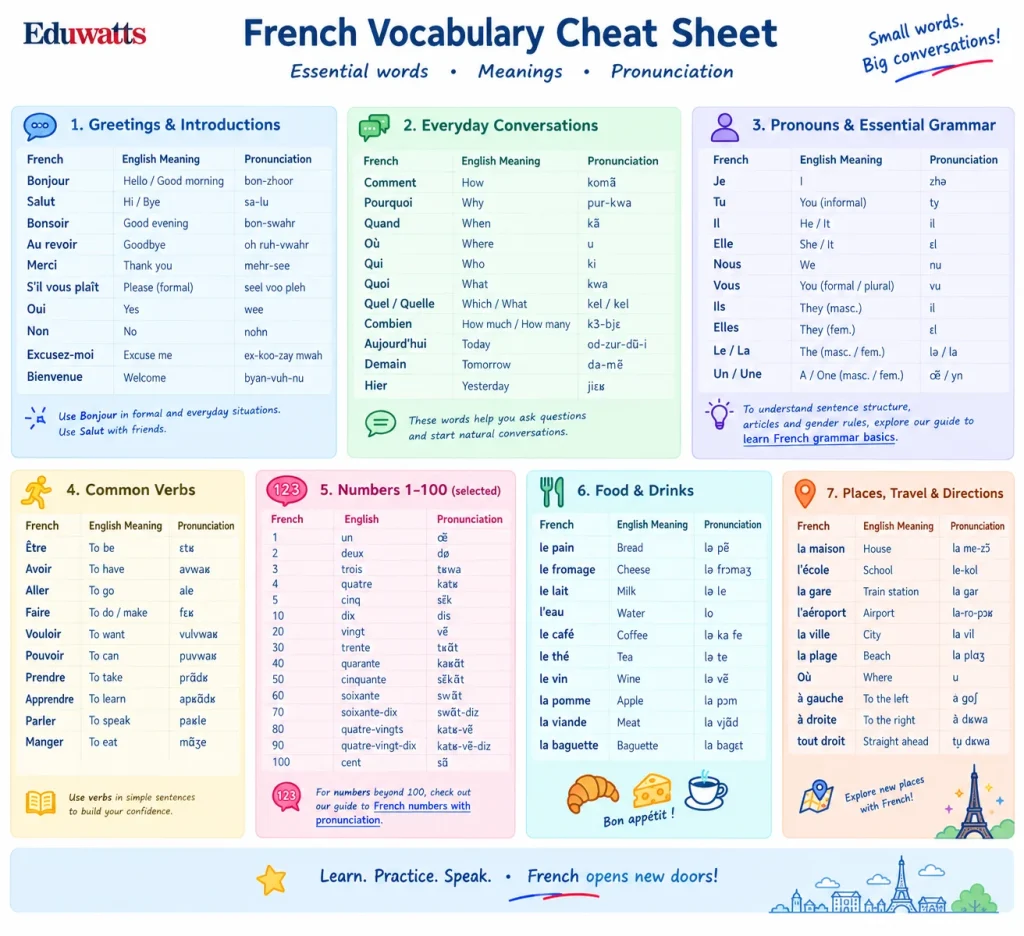
French vocabulary cheat sheet
How Many French Words Are There?
There is no universal agreement about the total number of words in French. This depends on whether a dictionary includes inflections, specialist terminology, regional terms, compound words, and old words.
Large dictionaries include tens of thousands of words, and specialist terminology and new words are constantly being added to the vocabulary of the language. However, normal day-to-day discourse uses a much more limited set of words.
It is not necessary for beginners to try to remember all the words in a dictionary. Start with commonly used words in French Language, learn them in context, and increase the vocabulary as you go along.
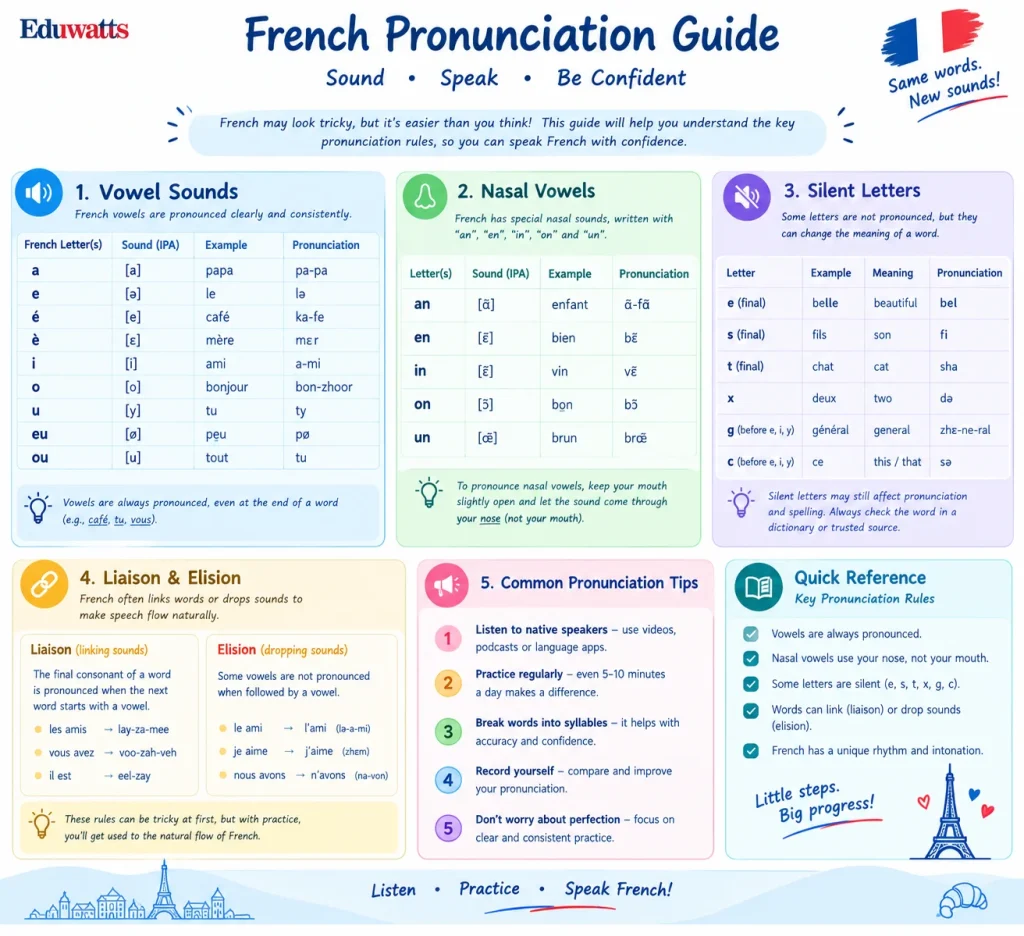
Quick Pronunciation Tips for Beginners
Pronunciation aids comprehension even when the vocabulary is limited.
- Silent final consonants: Many final letters are not pronounced, as in petit (puh-TEE) and grand (grahn).
- Nasal vowels: Sounds like on, an, and in are produced partly through the nose, as in bonjour and vin.
- The French “r”: Pronounced at the back of the throat, similar to a soft gargle.
- Liaison: A normally silent consonant is pronounced before a vowel, as in vous avez (voo-zah-VAY).
- Accents matter: Accents like é, è, and ê can change both pronunciation and meaning.
How to Learn French Vocabulary Faster?
French vocabulary can be easily acquired through a set routine in learning them. Here are some tips for acquiring new words and utilising them effectively.
1. Learning words by category
Group the vocabulary under categories such as greetings, food, traveling, family, and numbers, among others. This way, your brain will be able to link together words that have similarities.
2. Practice five to ten new words every day
Select a small number of words that you will practise every day. Frequency is more important than learning many words in one time.
3. Learn pronunciation of each word
Listen to native French speakers. Repeat the words you hear and observe the nasal pronunciations and silent letters at the end of a word. Pronunciation guidelines in English can be helpful but not accurate to every French sound.
4. Use the words in a sentence
Rather than learning maison as “house,” you should learn how to say C’est ma maison (This is my house).
5. Make flashcards and spaced repetitions
Make a French-English card where French vocabulary is written on one side and the English translation on the other. Practice difficult words often, while easy words are reviewed at intervals.
6. Have short conversations
Use greetings, questions, and expressions in your daily language practice with another learner or a teacher. Speaking will help you remember words faster in conversation.
7. Learn new words weekly
Take tests without referring to their meanings in English. Find words that you forgot.
A Four-Week French Vocabulary Learning Plan
- Week 1: Greetings, politeness, pronouns, and questions (30 words)
- Week 2: Important verbs and numbers (27 words)
- Week 3: Days of the week, family, and food (28 words)
- Week 4: Adjectives, places, and connectors (28 words), followed by review of all material
Learning five to six new words per day makes for a smooth process.
Learn French with the Eduwatts French Language Course

Learning the words in French is a good beginning, but learning French needs continuous practice in terms of vocabulary, grammar, pronunciation, listening, and speaking. The French language course of Eduwatts can be a good choice for those who wish to improve their French language for educational and professional reasons, travel or personal growth.
The French language course enables learners to go beyond the basics like memorising words in French and phrases and learn to use vocabulary in sentences.
What Can You Learn Through a French Language Course?
A complete French language learning program will teach you:
- French language vocabulary: Familiarize yourself with basic French words that pertain to greetings, numbers, family relations, food, travel, and other daily activities.
- French grammar: Grasp the concept of pronouns, articles, verb conjugation, sentence construction, and gender.
- French pronunciation and listening: Train your ear to hear the sound of words in French and comprehend French speech.
- French speaking: Learn how to confidently introduce yourself, ask and answer questions.
- French reading and writing: Master the art of comprehending French text and constructing sentences.
Eduwatts Reviews
Who Should Take a French Language Course?
- There are many types of people who would be interested in a French language course: students, professionals, travellers to French-speaking countries and beginners.
- As a beginner, start with the basics of French words and phrases; practice some words daily and then proceed to grammar and conversation drills.
- Begin your French language learning process with Eduwatts. Discover all that the Eduwatts website can offer you as a language learner.
French Language Courses Available at Eduwatts
The following table summarises the French language programmes listed on the official Eduwatts website, including course levels, durations, and published fees.
| French course | Suitable for | Duration | Listed fee* |
| French A1 Course | Beginners with no prior French knowledge | 56+ hours | ₹9,500 |
| French A2 Course | Learners with basic French skills | 56+ hours | ₹9,500 |
| French B1 Course | Intermediate learners | 66+ hours | ₹12,500 |
| French B2 Course | Learners developing stronger fluency | 66+ hours | ₹12,500 |
| French C1 Course | Advanced French learners | 66+ hours | ₹15,500 |
| French C2 Course | Learners aiming for advanced proficiency | 66+ hours | ₹15,500 |
| French Language Course for Kids | Children learning French | 240+ hours | ₹44,000 |
Talk to a French Course Expert
Conclusion
Learning words in the French Language is the initial phase of comprehending French and interacting in a normal setting. Learn greetings, common verbs, numbers, pronouns, foods, and basic phrases. Learn a few words on a daily basis, make sentences using them and revise them.
The point here is not to learn all words in the French language in one shot. Rather, it is to acquire a useful vocabulary bit by bit.
Looking to advance your French language abilities? Take advantage of the Eduwatts French Language Courses for better vocabulary building, grammatical knowledge, and speaking skills. Contact Eduwatts Now! to sign up for French Language Course and start your journey to speak French confidently!
Recommended Reads
- French Translator Jobs in 2027: Salary, Skills & Career Guide
- 80+ Common French Slang Words Every Learner Should Know
- 9 Best Languages to Learn in the Upcoming Years for Your Career Growth
- Scope of French Language Course in India
- 7 Best French Language Online Classes In Delhi
FAQs
The words that beginners should start with include Bonjour (Hello), Merci (Thank you), Oui (Yes), Non (No), Au revoir (Goodbye), S’il vous plaît (Please), and Je m’appelle… (My name is…). The words will enable you to greet people, answer in a polite manner, and introduce yourself.
The 10 most used words for a beginner include the (le), of/from (de), a/an (un), to be (être), and (et), to/at (à), he/it (il), to have (avoir), not (ne), and I (je). However, there are slight variations in the ranking depending on the text corpus being used.
One should begin by learning 100–300 words in French and phrases.
Some well-known words in the French language and expressions include amour (love), chic (fashionable), déjà vu (feeling of familiarity), rendez-vous (meeting), joie de vivre (joy of living), and c’est la vie (that’s life).
There is no clear number. It depends on the dictionary, how words are defined, and whether it includes technical jargon and regional slang. French is a language that develops as people invent new words.
It is quite possible to learn french language basic French words in seven days by learning five to ten words per day, reviewing old vocabulary, listening to their pronunciation and forming simple sentences with these words.
Ready to Start Your Learning Journey?
Join thousands of learners and build your future with expert-led courses and 100% practical training.

Nidhi Gupta
I am an experienced content writer who knows how to create compelling, clear, and search engine optimized content for different digital channels. My specialization includes blogging, article, website content, and other types of content that will be useful for you in terms of improving your company’s online presence. All my work is based on extensive research, attention to details, and knowledge of various industries. Apart from content creation, I have knowledge about Medical Coding and SAP principles, and this allows me to create relevant and valuable content for the health care and enterprise technology industries. In addition, I know several foreign languages such as German, French, and Chinese, and this is beneficial in order to create global-oriented content. I like making complicated information more understandable.
View all articles