 Nidhi Gupta
Aug 5, 2026
1,694 views
16 min read
Nidhi Gupta
Aug 5, 2026
1,694 views
16 min read
Medical Coding Course is one of the quickest ways to get into the fast-growing healthcare BPO and revenue cycle management industry without a medical qualification. Indeed, it is one of the fastest-growing healthcare training courses for people seeking to build a stable career in the medical and healthcare industry. With hospitals, insurers and healthcare organisations generating large amounts of data every day, the need for professionals who can code patient diagnoses, procedures and treatments using standardised alphanumeric codes has exploded.
For those of you who have graduated from any life sciences, nursing, pharmacy, or paramedical background and want to seek a stable, high-paying, and mostly remote working career, a medical coding training course could be your way forward.
In this blog, you will learn all about medical coding program, including the duration, eligibility criteria, syllabus, fees, certification, career prospects, and salary potential.
What Is Medical Coding?
Before we jump into discussing the Medical Coding program, it might be a good idea to have a basic understanding of medical coding itself. Medical coding involves the assignment of universal alphanumeric codes to healthcare diagnoses, procedures, services, and equipment according to classification systems such as ICD-10-CM, CPT, and HCPCS. The coding system enables billing and reimbursement activities for hospitals and insurance firms, as well as research activities. The job of a medical coder is to go through the documentation, maintain accuracy, and assign codes.
Since the process of billing in healthcare can be rather complicated, it also becomes important from a legal point of view. Therefore, certified coders are in demand everywhere, including countries such as India and the USA.
What is a Medical Coding Course?
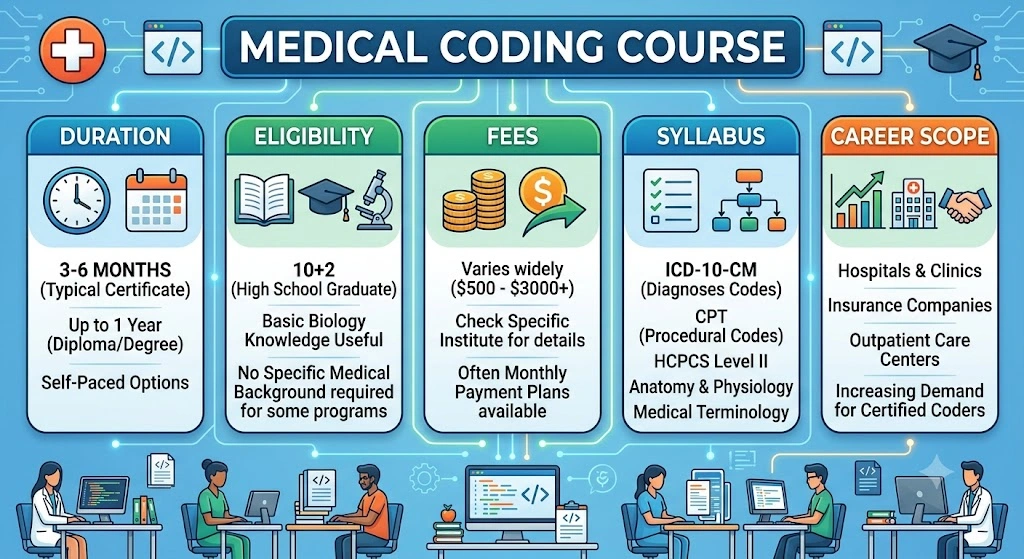
Through a medical coding program, students are taught how to code diseases, procedures, treatments and various health care services using alphanumeric codes. The alphanumeric codes make it easier for health care professionals to keep records of patients and handle their insurance claims effectively. Some of the coding systems used by medical coders include:
- ICD-10-CM
- CPT
- HCPCS Level II
The course includes all the aspects of medical terminology, anatomy, physiology, healthcare documentation, coding guidelines, and coding practice.
Why Choose Medical Coding as a Career?
One of the most promising careers in healthcare but outside clinical practice is that of medical coding due to the necessity of correct coding in any organisation dealing with healthcare services.
The main advantages of this profession include the following:
- Demand in India and abroad
- Opportunities in hospitals and healthcare organisations
- Home-based work possibilities in many organisations
- Salary increment
- International certification
- Job security
- Suitable for graduates of life sciences and healthcare professionals
Since healthcare services are growing all around the world, there will always be a need for competent coders.
Medical Coding Course Duration
The first question students ask about is Medical Coding Course Duration, and this is where the good news comes; as it does not take much time as other healthcare careers. Typically, depending on the institution and type of certification one opts for, it lasts between 6 weeks and 6 months.
|
Course Type |
Duration |
Description |
|
Short-term Certificate Program |
6 to 12 weeks |
A great option for individuals who already possess a degree in life sciences or the health care field and need to get specialised training in coding of medical documents. |
|
Comprehensive Diploma Program |
3 to 6 months |
Includes medical terminology, anatomy, physiology, coding rules, ICD-10-CM, CPT, HCPCS, and practical training based on case studies. |
|
2 to 4 months |
Specifically designed for students to get ready for the Certified Professional Coder (CPC) test organised by AAPC. |
It is a lot shorter than studying for several years to earn a degree in medicine, and thus it is not surprising that many students choose this career option to start working in a matter of months rather than years after graduation. As you see, longer courses do not equal more knowledge or more chances to pass the certification test; the key point is how thorough the practical training is, and how close the course is to the actual exam content.
Medical Coding Course Eligibility
It is very important to know about the eligibility criteria for the Understanding Medical Coding program, as you need to spend time and money on your career.
Educational Qualifications:
- It is highly recommended that a bachelor’s degree in Life Sciences, Biology, Nursing, Pharmacy, Physiotherapy, Microbiology, Zoology, or an allied health sciences subject be obtained.
- However, there are certain institutes that would also accept people with a background in Biotechnology, BDS, BAMS, BHMS, or even general science students interested in healthcare.
- In some short courses, it might be sufficient to have 10+2 (with biology) educational qualifications.
Additional Qualifications:
- Knowledge about the human body is highly desired, as there is a lot of interpretation involved in terms of coding.
- English language proficiency, as most documentation and clients from other countries prefer good written communication skills.
- Analytical skills and attention to detail, as coding mistakes may result in rejection of claims or non-compliance with policies.
There is usually no upper age limit for admission, and hence this course is ideal for anyone willing to change the career path irrespective of age. Several institutes provide flexibility in timings to cater to those aspirants who are already working somewhere else and wish to move into healthcare BPO/RCM industry without leaving their existing profession.
Medical Coding Course Syllabus
The Medical Coding training Syllabus has been designed to lay down a good knowledge base of medical terminologies before starting on coding systems. Though the syllabus may differ depending upon the institutes, a reputable one generally includes the following topics:
1. Introduction to Medical Coding
- Brief description of the healthcare industry and the revenue cycle management process
- Responsibilities of a medical coder
- Introduction to HIPAA regulations and confidentiality guidelines
2. Anatomy and Physiology
- Functioning of different body systems such as cardiovascular, respiratory, musculoskeletal, nervous, digestive and others
- Different diseases and disorders related to these body systems
3. Medical Terminology
- Various prefixes, suffixes and root words used in clinical documentation
- Common abbreviations used in patient records
4. ICD-10-CM Coding
- Structure and organisation of the ICD-10-CM coding system
- Guidelines on how to code diagnoses correctly
- Practical exercises based on sample medical records
5. CPT and HCPCS Coding
- Current Procedural Terminology (CPT) coding for procedures and services
- Supplies, equipment, drugs: Healthcare Common Procedure Coding System (HCPCS)
- Using modifiers correctly
6. Reimbursement Concepts
- Basics of the process of insurance claims processing
- Medicare, Medicaid, and private payers’ guidelines
- Denial management and appeals process
7. Compliance and Auditing
- Fraud, waste, and abuse regulations
- Improving documentation practices
- Standards of internal audits for coding compliance
8. Practical Training and Case Studies
- Case studies from the following specialties: cardiology, orthopedics, oncology, and radiology
- Mock coding exams and preparation for certification exams
At the end of the syllabus, students will be ready to take internationally recognized certification examinations such as CPC or CCS.
Medical Coding Course Fees & Career Scope
While assessing Medical Coding training Fees & Career Scope, it is necessary to take into account the investment versus future earning prospects since it is primarily the basis on which most individuals choose the course or not.
Structure of Fees
Medical Coding program Fee in India can vary between ₹15,000 and ₹60,000 based on factors such as institute prestige, duration of the program, and whether certification exam fees have been included or not. These include:
- Institute Prestige: Institutes known for providing placements usually charge higher fees.
- Mode of study: Online self-paced courses cost less than classroom-based or hybrid mode.
- Inclusion of Certification: Programs that include the CPC certification exam fee of AAPC will definitely cost more than just training.
- Other resources: Availability of coding software, mock exams, etc., also affects the fees.
Although the fees seem substantial, it is a relatively small investment when compared with conventional degrees and the fees is mostly recovered by most students in their first few months on the job.
Typical fee structure:
Course Level | Approximate Fees |
|
Basic Certificate |
₹20,000 – ₹35,000 |
|
Professional Program |
₹35,000 – ₹60,000 |
|
Advanced Training with Placement |
₹60,000 – ₹1,20,000 |
Some institutes also provide:
- EMI options
- Placement assistance
- Certification guidance
- Internship opportunities
- LMS access
- Mock interviews
Skills Required to Become a Medical Coder
Medical coders who are successful are those who have both technical knowledge and analytic skills.
The essential skills that must be possessed include:
- Attention to details
- Medical terminologies
- Knowledge of anatomy
- Analytic skills
- Documentation
- Time management skills
- Computer literacy
- Accuracy
- Coding guidelines
- Communication skills
Practice can enhance all the above skills.
Tips to Succeed in Medical Coding
There are some strategies that students can employ in order to enhance their learning process as follows:
- Study Anatomy completely.
- Learn medical terminology.
- Code regularly.
- Be aware of all coding guidelines.
- Do mock certification tests.
- Be good at reading documentation.
- Prioritise accuracy over speed.
- Think analytically.
- Keep on learning the latest coding updates.
- Get yourself certified as a professional coder.
Constant practice will make you successful in coding.
Certifications in Medical Coding
Professional certifications enhance job prospects and add credibility to the candidate’s profile.
Some popular certifications are:
- Certified Professional Coder (CPC)
- Certified Coding Associate (CCA)
- Certified Coding Specialist (CCS)
Medical Coding Careers Scope
The scope for a career in a medical coding training is truly remarkable, especially since this field deals with clients across the globe, mainly from the United States healthcare system, which ensures that the salary scale and growth prospects are better compared to many other entry-level positions in healthcare.
Some common positions in this field include:
- Medical Coder/Junior Coder
- Certified Professional Coder (CPC)
- Coding Auditor
- Coding Quality Analyst
- Clinical Documentation Specialist
- Coding Team Lead/Manager (for experienced candidates)
- Fields employing medical coders:
- Hospitals/healthcare systems
- Health Insurance Companies
- Medical Billing and RCM companies
- BPO firms specializing in Healthcare
- Independent Physician Practices and Specialty Clinics
Industries Hiring Medical Coders
Medical coders are hired by:
- Multispecialty Hospitals
- Diagnostic centers
- Medical coding agencies
- BPOs in Healthcare
- Insurance companies
- Revenue Cycle Management companies
- Medical research firms
- Telehealth service providers
- Healthcare software companies
Outsourcing has created even more job opportunities.
Medical Coding Salary in India
Salary depends on qualifications, certification, organization, and experience.
Experience | Average Annual Salary |
|
Fresher |
₹2.8–4.5 LPA |
|
2–4 Years |
₹4.5–7 LPA |
|
5–8 Years |
₹7–10 LPA |
|
Senior Professionals |
₹10–18+ LPA |
Candidates with international certifications often receive better compensation.
Why Choose a Medical Coding Course Over Other Healthcare Careers?
Unlike careers where several years of clinical training are required, this path will provide you with a much quicker way to join the healthcare industry. The career combines stability provided by the healthcare sector with the flexibility of office-based, non-clinical jobs. Science graduates who might not wish to continue their clinical training but to work in a field related to healthcare find it usually very suitable.
The additional advantage is that due to the high demand being in US-based healthcare companies, professionals working in this field usually have the opportunity to work in a corporate setting with a well-defined structure of career progress, bonuses for achievements, and the possibility to receive international certificates. In addition, many companies pay for their employees’ advanced certification after some time spent at the entry level.
However, it is important to mention that the bar for entry into this profession is relatively low as compared to that of other corporate health care professions. There is no requirement of years of professional experience or costly equipment or even a specific license for this profession. The only thing required is your willingness to stay updated about annual coding guidelines.
Future Scope of Medical Coding
Medical coding continues to grow within hospitals, clinics, insurance companies, and telemedicine. Therefore, the need for qualified medical coders will remain high.
The new trends that exist are:
- AI-powered medical coding
- Clinical Documentation Improvement (CDI)
- Risk Adjustment Coding (RAC)
- Healthcare Analytics
- Coding Quality Auditing
- International Healthcare Outsourcing
Individuals who constantly improve their qualifications and obtain industry-approved certificates have a bright future ahead.
AI in Medical Coding
Artificial intelligence (AI) is revolutionising the coding field by making the process more efficient, effective, and fast. The AI-based solutions are employing advanced technologies such as machine learning (ML) and natural language processing (NLP) that allow analysis of clinical notes and identification of diagnoses and procedures performed on patients, and then suggest the right ICD-10-CM, CPT, and HCPCS codes for the procedure.
Medical coders are no longer required to examine each and every patient chart. Coders use the AI systems to complete the routine tasks of coding, and the systems automatically find the right information from the EHRs and then suggest the codes.
Benefits of AI in Medical Coding
- Increases accuracy in code generation by avoiding manual errors.
- Increases efficiency in the coding and billing process.
- Increases productivity by automating repetitive tasks.
- Detects missing or inconsistent information in the clinical documentation.
- Helps in processing the insurance claims more quickly.
- Aids health care providers in adhering to the coding guidelines.
- Decreases the administrative work of coders.
Will AI Replace Medical Coders?
Absolutely not. The objective of artificial intelligence is to aid medical coders and not replace them. Although AI technology can take over certain repetitive and routine coding jobs, it cannot comprehend the complex clinical situations, inconsistencies in documentation, and evolving coding policies. Certified medical coders are essential in validating the codes generated using AI technology.
Future of AI in Medical Coding
As the healthcare industry continues to embrace technological innovation, more AI-driven coding systems will be used. Medical coders that are familiar with AI-enabled coding software, health records documentation, coding standards, and quality audits will always be needed. The future of medical coding will depend on the relationship between AI technology and professional medical coders.
Tips to Choose the Right Medical Coding Training Course
While opting for a particular Medical Coding program before enrollment, take note of the following tips:
- Seek for an accredited course: Make sure the course will train you for certifications such as CPC (AAPC) or CCS (AHIMA).
- Inquire about placement assistance: Institutes that have good industry contacts can immensely help you in job hunting after the certification process.
- Consider the background of the instructors: It is highly recommended to opt for a course where the trainers have practical industry experience in coding or RCM.
- Make comparisons between cost and benefits: The total cost of a course does not always guarantee its value; it’s important to find out what is offered with the course, such as training materials, practice tests, etc.
Why Choose the Eduwatts Medical Coding Course?

Eduwatts Medical Coding Training Course aims at equipping candidates with the knowledge necessary to embark on a rewarding career in the healthcare sector through thorough industry-based training. The program entails a blend of theoretical and practical lessons that enable the learners to acquire all the necessary skills to practice in hospitals, healthcare BPOs, insurance companies, and RCM firms.
Medical Coding Training course includes vital concepts in healthcare such as medical terminology, anatomy and physiology, ICD-10-CM, CPT, HCPCS level 2 coding, healthcare documentation, insurance processes, and coding compliance, among other vital concepts.
Key Features of the Eduwatts Medical Coding Training Course
- Curriculum designed to meet industry standards
- Live online classes delivered by instructors
- Trainers who are experts in the healthcare sector
- Coding assignments and case studies
- Access to Learning Management System (LMS) along with recordings and study materials
- Periodic evaluations and coding test practice exams
- Preparation for certification and examination
- Resume building and interview preparation
- Assistance with placement at top healthcare companies
- Flexible scheduling for learners and working professionals

Career Support
In addition to providing classroom instruction, Eduwatts also offers career assistance. The students are assisted in resume writing, interview preparation, and job placement, thus enabling them to make a seamless entry into the healthcare profession. This ensures that the learners are equipped to handle medical coding tasks in the actual world.
Be it a life science graduate, a nurse, a pharmacy graduate, or any other healthcare professional, the Eduwatts PG Course in Medical Coding will assist you in making a career in medical coding.
Conclusion
Medical Coding Training is ideal for students who wish to get into the healthcare sector without going into a clinical route. This training gives you a perfect blend of knowledge about medicine, coding and practical training that helps you gain good opportunities in hospitals, insurance companies, healthcare BPO firms, and revenue cycle management companies.
While taking the decision to take this training, compare institutes on the basis of their curriculum, trainer’s knowledge, placement services, certification advice, and practical training.
If you are seeking practical training with industry-oriented learning and placement services, then choose Eduwatts’ Medical Coding Training program that provides you all the required knowledge to excel in the current healthcare industry.
Recommended Reads
- Medical Billing Jobs in India: Eligibility, Salary & Career Path (2026)
- What is Medical Coding? Definition, Salary & Career Opportunities in 2026
- Top 9 Paramedical Courses After 12th With High Salary
- Eduwatts Reviews
FAQs
Science graduates in life sciences, pharmacology, nursing, physiotherapy, biotechnology, and allied health professionals are usually eligible.
Yes, because it promises secure employment with good earnings growth as well as chances to work in hospitals, insurance organisations, and healthcare outsourcing organisations.
No, most introductory courses in coding begin with learning medical terms and anatomy before proceeding to coding.
Although not necessary in all cases, professional certifications increase your employment and earning opportunities.
This is possible for many experienced medical coders and even some organisations.
The majority of professional courses include ICD-10-CM, CPT, and HCPCS Level II coding systems.
Practice on a daily basis using actual cases makes one faster and more accurate in their work.
Yes. Eduwatts provides placements, interview coaching, resume writing, etc.
Hospitals, Healthcare BPOs, Insurance Companies, RCMs, Diagnostic Centres, and Healthcare Technology companies hire qualified medical coders.
Yes. After having adequate training and practical experience, one can begin their career as a medical coder.
Ready to Start Your Learning Journey?
Join thousands of learners and build your future with expert-led courses and 100% practical training.

Nidhi Gupta
I am an experienced content writer who knows how to create compelling, clear, and search engine optimized content for different digital channels. My specialization includes blogging, article, website content, and other types of content that will be useful for you in terms of improving your company’s online presence. All my work is based on extensive research, attention to details, and knowledge of various industries. Apart from content creation, I have knowledge about Medical Coding and SAP principles, and this allows me to create relevant and valuable content for the health care and enterprise technology industries. In addition, I know several foreign languages such as German, French, and Chinese, and this is beneficial in order to create global-oriented content. I like making complicated information more understandable.
View all articles


Recent Comments (15)
Thanks for sharing this guide. Helped me understand medical coding better prior to committing to the career path.
Really enjoyed reading this. Stepwise explanation simplified topic in very easy way.
Very detailed article. I like the fact that instead of over selling it — it has practical information.
Everything is elaborated in simple language, which I like. What to take from this was read all the way through
While researching healthcare careers I discovered this blog. It included all the relevant things I wanted to know.
Thank you for compiling such a valuable resource! Definitely, it will assist the students to find opportunities concerning career opportunities in healthcare.
Excellent explanation! It is simplistic and easy to read, but it also feels good in terms of reliability. Keep posting such educational content.
This article helped you to have some confidence in pursuing medical coding career. Can wait to read more blogs like this.
A bit of an article on medical coding that I have read It resolved a lot of doubts which I could not find answers anywhere else.
This blog is done in an informative and well structured way. It gave me a good understanding on the extent of medical coding in India.
Very clear explanations and useful content. I have added this page to my Favorites so I can return to it later.
Which was great for beginners such as myself. It was organized brilliantly and very readable.
Did what I was looking for about medical coding and gave most of the information that I needed from a reliable source as of October 2023. So informative yet pretty easy to read.
Great write-up! Details pertaining to the courses and career prospects are covered in a straightforward way.
We had provided a very simple explanation for the medical coding course. Coming back to it, I now know what the course is about. You have been detoxified up until October 2026.