 Nidhi Gupta
Sep 14, 2026
1,343 views
15 min read
Nidhi Gupta
Sep 14, 2026
1,343 views
15 min read
If you have been reading about enterprise software jobs, then you must have certainly entered “SAP course full form” into a search engine to find out what SAP means and if SAP training is worth the effort and expense.
SAP is one of the most popular ERP systems in the world, and many organisations in the banking sector, manufacturing, retail, healthcare, and IT sector recruit SAP experts. An SAP course enables candidates to know more about SAP modules and acquire skills useful for jobs in both the business and technical realm.
Be it a graduate, a working professional, an IT professional, or a finance professional, all of you can benefit from an SAP course by acquiring specialist skills applicable to different industries.
This article will help you understand the full form of SAP, what an SAP course includes, the SAP course syllabus, how to get an SAP certification, and also help you get realistic salary expectations from an SAP course.
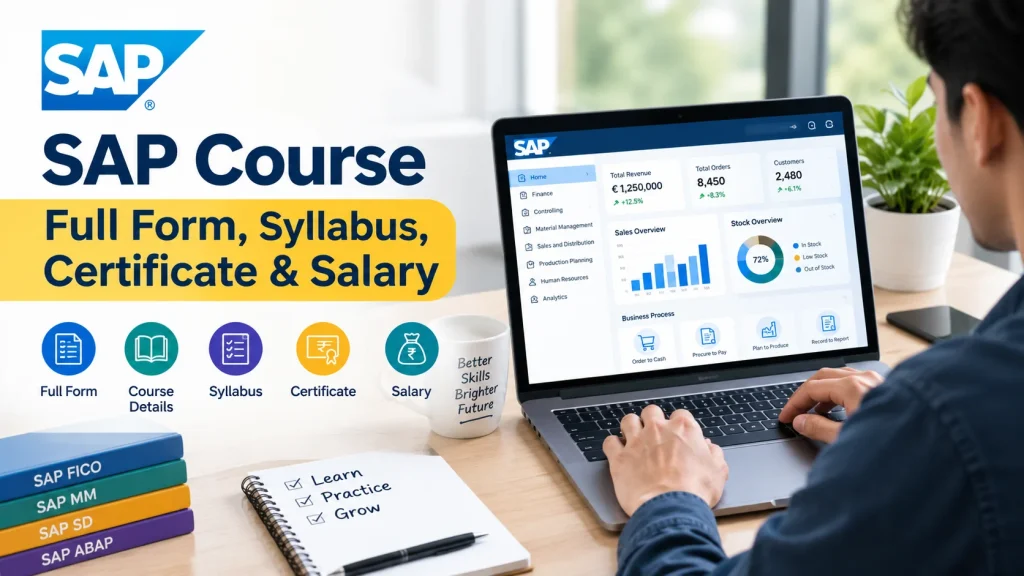
What Is the Full Form of SAP Course?
SAP is an acronym for Systems, Applications, and Products in Data Processing. SAP was formed in 1972 in Germany by five ex-IBM employees who sought to develop software capable of handling real-time data processing in all departments within a company, such as accounting, sales, HR and logistics.
In the present day, SAP is not just a single program but a suite of software applications that is employed by big companies, medium-sized firms, and governmental institutions to operate their internal processes through a single platform. Since SAP covers almost every area of business, SAP-trained specialists are highly sought after in any industry, not only in IT.
The term SAP Course Full Form is not just limited to any particular one course. Rather, it involves training in various modules of SAP. Students can choose a module depending upon their education and profession.
Some of the popular SAP modules are:
| SAP Module | Area of Specialisation |
| SAP FICO | Finance and Controlling |
| SAP MM | Materials Management |
| SAP SD | Sales and Distribution |
| SAP PP | Production Planning |
| SAP HCM | Human Capital Management |
| SAP SuccessFactors | Human Resources |
| SAP ABAP | SAP Programming |
| SAP Basis | SAP System Administration |
| SAP S/4HANA | Enterprise Resource Planning |
| SAP EWM | Warehouse Management |
Choosing the right module is important because each module leads to different job roles and career paths.
SAP Course Details
After discussing the SAP Course Full Form, let’s discuss about the course details. Understanding the SAP Course Details can help you decide whether the program matches your career objectives.
SAP training generally combines theoretical concepts with practical exercises. Depending on the institute and module, learners may work with business scenarios, transactions, configuration activities, reports, and case studies.
Key SAP Course Details
| Feature | Details |
| Course Type | Professional/Technical Training |
| Popular Modules | FICO, MM, SD, PP, HCM, ABAP, Basis, S/4HANA |
| Eligibility | Varies by module |
| Duration | Usually a few weeks to several months |
| Learning Mode | Online, classroom, or hybrid |
| Certification | Available depending on certification pathway |
| Practical Training | Depends on the institute |
| Career Areas | Finance, IT, HR, sales, supply chain, operations |
| Experience Required | Not always mandatory |
| Suitable For | Graduates, professionals, IT and business learners |
It all depends on the module, level of the course, training company, and mode of learning.
An introductory-level course may be based on basics, while an advanced-level course may cover implementation, configurations, and project-based learning.
Why Should You Learn SAP?
Skills obtained through SAP courses can be valuable as companies require individuals who possess knowledge about processes in business as well as about enterprise software.
The following are some reasons why people decide to train in an SAP course:
- Variety of Career Paths
SAP involves different processes in business. One can select among finance, human resources, logistics, sales, production, IT and other specialisations.
- Skills Relevant for the Industry
Business processes in companies are coordinated with the help of enterprise resource planning systems. SAP courses help learners gain knowledge about these processes in the integrated system.
- Specialisation
SAP enables one not to have general information about IT but to specialise in a certain module.
For instance, a specialist in finance may think about SAP FICO, and a specialist in supply chain about SAP MM or SAP EWM.
- Career Progression
Certainly, SAP professionals who already have some experience may get promoted from the associate position to the position of consultant, senior consultant, project manager or solution architect.
- International Career Opportunities
SAP is used in businesses all over the world and this enables to create career opportunities for professionals.
SAP Course Syllabus
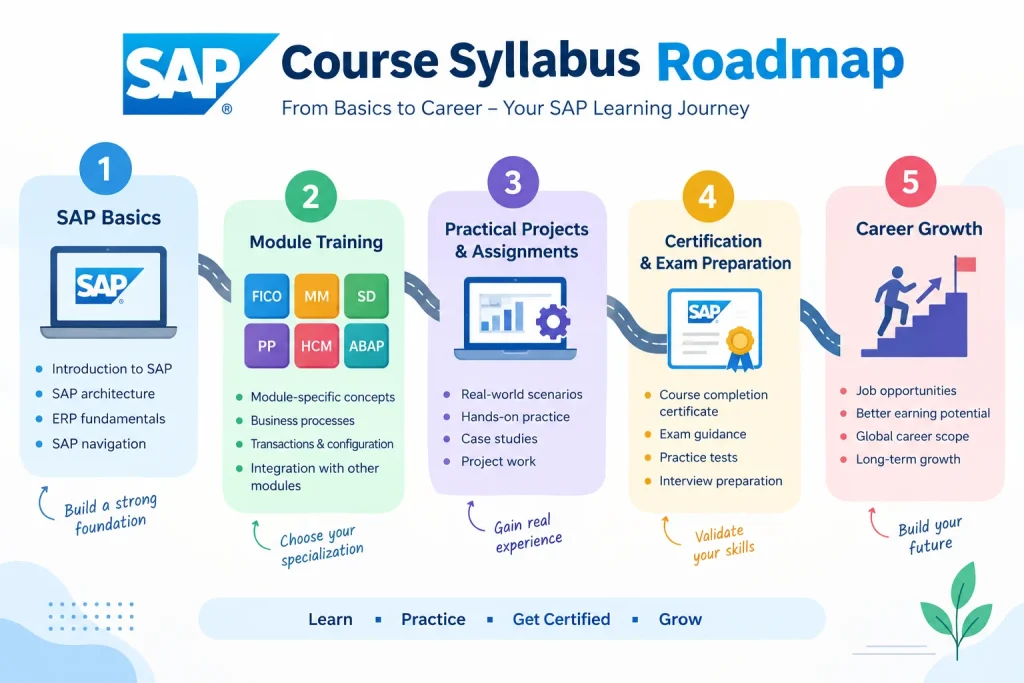
The SAP Course Syllabus is entirely based on the module you have chosen. There is no single syllabus that can apply to all SAP courses.
But in most cases, the learners are taught about SAP basics first before going to the concept of their respective modules.
Basic SAP Course Syllabus
A basic syllabus can include:
- Introduction to SAP
- SAP architecture & environment
- ERP basics
- SAP navigation
- SAP modules & integration
- Master data
- Transactions
- Workflow processes
- Reporting & analysis
- Exercises
- Case study
- Introduction to SAP S/4HANA
- Troubleshooting basics
After learning about basics, the learners usually go for the module concepts.
SAP FICO Course Syllabus
SAP FICO Course is one of the most favored options in commerce and finance.
Thinking About Learning SAP?
The curriculum can include the following:
Financial Accounting
- General Ledger
- Accounts Payable
- Accounts Receivable
- Asset Accounting
- Bank Accounting
- Tax Configuration
- Financial Statements
- Accounts and Documents
- Financial Transactions
Controlling
- Cost Center Accounting
- Profit Center Accounting
- Internal Orders
- Product Costing
- Profitability Analysis
- Cost Management
- Management Reporting
Indeed, SAP FICO course can be perfect for those having an experience in accounting, finance, commerce, or any related domain.
SAP MM Course Syllabus
Certainly, SAP MM Course deals with procurement and materials management.
This may cover:
- Enterprise structure
- Material master
- Vendor master
- Purchasing
- Purchase requisition
- Purchase orders
- Goods receipt
- Invoice verification
- Inventory management
- Stock movements
- Procurement process
- Material valuation
- Vendor evaluation
Indeed, SAP MM is useful for those working in procurement, purchasing, inventory, logistics, and supply chain domains.
SAP SD Course Syllabus
Furthermore, SAP SD Course concentrates on sales-oriented business processes.
Examples of such subjects are:
- Company Structure
- Customer Master
- Material Master
- Sales Processes
- Inquiry and Quotation
- Sales Orders
- Delivery Processing
- Shipping
- Billing
- Pricing
- Credit Management
- Sales Reporting
- Interoperability with other SAP applications
This application can be suitable for people who want to work in sales operations, order management, distribution, etc.
SAP Course Eligibility
SAP does not have a standard eligibility criterion, as the criterion differs from one module to another depending on the type of training program.
In general, the candidates can be any of the following:
- Graduates
- Postgraduates
- IT professionals
- Finance professionals
- Commerce graduates
- HR professionals
- Supply chain professionals
- Working professionals
- Students who are interested in enterprise technology
It is important that your education profile must be relevant to the module that you choose.
For instance, those who have a background in accounts or finance would find SAP FICO easy whereas programmers may prefer SAP ABAP.
But even novices can learn SAP.
SAP Course Duration
Time required for SAP course depends on the modules and level of training involved:
- Short-term/functional courses: 2-3 months for a single module
- Full-fledged/certification oriented courses: 4-6 months
- Advanced courses or those having two modules: 6 months to 1 year
Most institutes have weekend/evening batches that cater to professionals.
Ready to Start Learning SAP?
Format of Courses
The following options are available for SAP training:
- Classroom-based training offered by authorised training institutes
- Live online classes
- Self-study via e-learning through sites like SAP Learning Hub
SAP Certificate: What Is It?
After completing your training, the next natural step is getting certified. An SAP certificate will prove your qualification in working on a particular module. It can act as a great differentiator in job applications.
Types of SAP Certification
- Associate Level: Beginner’s certification confirming basic understanding of a module
- Specialist Level: Certifies professionals who have real-life project experience
- Professional Level: Certification for seasoned consultants with complex implementation experience
How to Get SAP Certified?
- Train in your preferred module through an authorized institution or SAP Learning Hub
- Register for the test at SAP’s authorized SAP Training & Certification website
- Use the SAP certified official guide and sample question to prepare
- Write the exam, generally comprising of multiple choice questions to be solved within a limited time frame
- Collect your certificate after passing the cutoff marks, which remain relatively high always
Is SAP Certification Mandatory?
It may not always be compulsory for someone, but getting certified will add value to your resume, particularly if you lack any practical work experience. For many companies, the certification proves that you have undergone a systematic learning process and are serious about what you are learning, and hence it may make you different from others. Practical exposure to any project is equally important.
Benefits of an SAP Certificate
An SAP Certificate could be useful for:
- Showing your training to employers
- Improving your professional portfolio
- Verifying your module-specific knowledge
- Facilitating career changes
- Enhancing your resume
- Preparing for SAP-oriented jobs
Just getting a certificate doesn’t mean you will get a job. Employers value not only theoretical knowledge but also practical knowledge and communication skills.
SAP Course Fees
There is huge variability in SAP course fee structure.
The course fee may vary due to the following factors:
- SAP module
- Training institute
- Course duration
- Certification program
- Learning method
- Practical training
- Trainer experience
- Project Work
- Study material
Introductory courses generally are less costly than professional training programs.
While deciding upon a course, do not go by cost alone. Look at curriculum, trainer experience, practical experience, certification process, placements, etc., before making your choice.
Career Opportunities After SAP Course
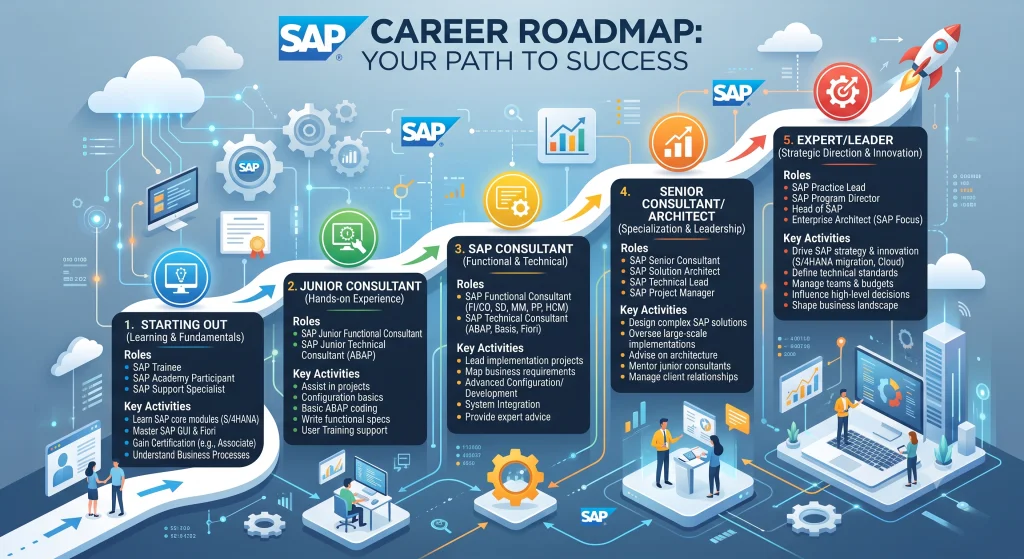
SAP training can provide you with various career opportunities in both technical and business aspects.
Depending upon the SAP module that you have selected, you could pursue the following careers:
| SAP Specialization | Possible Job Roles |
| SAP FICO | SAP FICO Consultant, Finance Consultant |
| SAP MM | SAP MM Consultant, Procurement Specialist |
| SAP SD | SAP SD Consultant, Sales Operations Specialist |
| SAP PP | SAP PP Consultant, Production Planning Specialist |
| SAP HCM | SAP HCM Consultant, HR Systems Specialist |
| SAP ABAP | SAP ABAP Developer |
| SAP Basis | SAP Basis Administrator |
| SAP EWM | SAP EWM Consultant |
| SAP SuccessFactors | SAP SuccessFactors Consultant |
| SAP S/4HANA | SAP S/4HANA Consultant |
The exact position and responsibilities will vary depending upon your experience and technical expertise.
SAP Salary in India
The salary of SAP professionals can differ significantly according to the experience level, area of specialisation, place, company, and technical skills.
An entry-level SAP professional will get paid differently from an experienced SAP consultant.
Some general career steps are as follows:
| Experience | Potential Career Level |
| 0–2 years | Junior SAP Professional |
| 2–5 years | SAP Consultant |
| 5–8 years | Senior SAP Consultant |
| 8–12 years | Lead Consultant/Manager |
| 12+ years | Solution Architect/Project Manager |
Rather than being occupied with the idea of how much an average salary is, one should think about the earning potential of their chosen specialisation in the long term.
Technical skills in SAP S/4HANA, integration, analytics, cloud technologies, implementation, and particular business processes will make the resume more appealing.
Factors That Affect SAP Salary
The following are some of the elements affecting SAP Salary.
- Experience
The more experienced you are, the better the positions you would be able to get.
- SAP module
Different modules might carry different requirements and salary structures.
- Technical Skillset
Some additional technical skill set could help you widen your career choices.
- Industry
Consulting companies, MNCs, manufacturers, IT services firms and other industries might pay differently.
- Place
Pay scales could vary from place to place and city to city.
- Certification
Appropriate certification could help you enhance your career prospects, but not necessarily determine your pay.
- Domain Expertise
SAP professionals with domain expertise bring more value to their organizations.
SAP Consultant vs SAP Developer
There are some confusions between the SAP Consulting and SAP Development career paths among learners.
An SAP Consultant would mostly deal with the business process, configuration of the system, implementation, optimization, and customer needs.
Whereas an SAP Developer deals with programming and technical development of the system. ABAP is one of those specializations in SAP.
Choose your career path based on what interests you.
Is SAP a Good Career Option?
SAP could make a great choice of profession for those candidates who like technology, processes, data, and enterprise systems.
However, having finished an SAP course will not mean that you have secured yourself a job.
To have a successful career, you need to combine SAP with:
- Hands-on projects
- Domain knowledge
- Communication skills
- Problem-solving skills
- Certification when necessary
- Internship or practical experience
- Learning
- Knowledge of modern SAP technologies
Professionals also need to update their knowledge since technology is always evolving.
How to Choose the Right SAP Course?
It is important to choose the Best Institute for SAP program through proper research.
Talk to a SAP Course Expert
Step 1: Analyse Your Background
Assess your educational background and work experience.
Step 2: Choose a Module
Select a module that suits your career plans.
Step 3: SAP Course Syllabus
Ensure that the syllabus offers theoretical as well as practical information.
Step 4: Practical Training
Find out about the assignments and projects associated with the program.
Step 5: Certification Details
Determine whether the program will provide course completion certification or prepare you for a recognised SAP certification.
Step 6: Comparing Training Providers
Compare the training providers in terms of faculty members, syllabus, duration, cost, testimonials, placement help, etc.
Step 7: Career Guidance
Career counselling may be needed if you are a fresher.
Why Is Eduwatts One of the Best SAP Training Institutes?

After knowing the SAP Course Full Form, its important you know about the best Institute for SAP training. Eduwatts is one such SAP training institute where you can get both live classroom training, practical projects, exam assistance, certification, and career services under one roof. Some of the SAP courses offered at Eduwatts include SAP FICO, MM, PP, SD, SuccessFactors, EWM, ABAP, BASIS, MDG, EHS, HCM.
5-in-1 SAP Training Program
In the SAP FICO training program of Eduwatts, you get a 5-in-1 course that includes:
- Training
- Projects
- Exam Assistance
- Certification
- Assignments
With this model of SAP training program, you will be provided with an expanded learning experience rather than limiting your experience to classroom training only.
Reasons to Join Eduwatts for SAP Training Programs
- Multiple SAP Courses: SAP FICO, MM, SD, PP, EWM, HCM, ABAP, BASIS, and many more.
- Hands-On Training: Learn using live projects, assignments, and scenarios.
- Expert Instructors: Learn from SAP experts.
- Flexibility: Take live online classes with recorded lectures and LMS access.
- Certification: Receive course completion certificate and exam assistance.
- Career Services: Get placement and interview preparation help.
- Modern SAP Knowledge: Learn about SAP S/4HANA and cloud platforms.
- All Levels: Freshers, graduates, and working professionals.
Courses offered by Eduwatts
- SAP HANA Training Course
- SAP ABAP Training Course
- SAP GRC Course
- SAP BW Training Course
- SAP HCM Training Course
and many more SAP courses are available on Eduwatts. You can Explore Eduwatts for SAP Training.
Conclusion
Knowledge about SAP Course Full Form is the initial point for considering SAP as one of the careers. SAP means Systems, Applications, and Products in Data Processing, and it has a whole range of products related to different areas, like finance, procurement, sales, human resources, production, supply chain, technology and others.
Choosing the right SAP course is related to the education and personal interests of the candidate. If he/she is a professional in finance, he/she might want to choose SAP FICO; in procurement – SAP MM or EWM and so on.
A good career in the SAP industry needs not only an SAP Certificate but also knowledge, skills, experience, etc. They will allow you to develop in this career and earn a better SAP Salary.
If you are going to start your career in the SAP industry, the first things you need to do are to choose the right module and then review SAP Course Details, SAP Course Syllabus and Training Programs.
Recommended Reads
- Top 10 Institutes Offering SAP Courses in Bangalore
- How To Become An SAP Consultant: A Step-by-Step Guide
- What is SAP FICO? Modules, Features & Career Growth
- What is SAP Course? A Complete Guide for Beginners
- SAP Ariba Course: Details, Eligibility, Fees, Syllabus, Career, Scope
FAQs
The SAP Course Full Form is Systems, Applications, and Products in Data Processing.
It is a course that helps to teach users about certain SAP modules and enterprise business processes.
Yes, an SAP Course is suitable for freshers, but some practical knowledge and domain-specific knowledge can be helpful.
SAP FICO is chosen by many finance professionals who have a background in finance, accounting, or commerce.
Depending on the module, the syllabus will include some basic things related to SAP.
The SAP Certificate means that it is a completion certificate for the course, or it can be an SAP certification.
It depends on the modules, level of the course, training provider, and mode of learning.
The Income of an SAP professional depends on experience, modules, skills, location, company, and job profile.
Yes. There are many SAP modules that are directly related to business processes and thus will attract many individuals like finance, commerce, HR, etc.
Not really. One can gain skills through an SAP course, but success in getting a job depends on various factors.
Ready to Start Your Learning Journey?
Join thousands of learners and build your future with expert-led courses and 100% practical training.

Nidhi Gupta
I am an experienced content writer who knows how to create compelling, clear, and search engine optimized content for different digital channels. My specialization includes blogging, article, website content, and other types of content that will be useful for you in terms of improving your company’s online presence. All my work is based on extensive research, attention to details, and knowledge of various industries. Apart from content creation, I have knowledge about Medical Coding and SAP principles, and this allows me to create relevant and valuable content for the health care and enterprise technology industries. In addition, I know several foreign languages such as German, French, and Chinese, and this is beneficial in order to create global-oriented content. I like making complicated information more understandable.
View all articles


Recent Comments (29)
Get an idea of sap and its modules.
this was literally helpful.
Article is so perfect for carrer
Article is written in such a way that complex sap concepts can be made easy
SAP course structure and job paths, explained
sap course made more easy as a blueprint
The certification details are great
The certification details resolved a few common questions
easy and best for sap beginners
Some good insights from the salary factors.
The article has explained each SAP Module individually and I enjoyed that.
It gives a clear understanding of SAP course fundamentals.
The distinction of consultant and developer is helpful
Good coverage of SAP course duration and learning options
SAP career information’ was told in layman terms.
The eligibility section was something I used a lot.
Guide to read something about SAP certification
i love the way of explanation
helpful article and informative
this article clear my concept about sap
this article cleared a lot of basic doubts regarding SAP
Guide to read something about SAP certification
The module 1,2 were detailed and weighted the topics easily.
This article cleared a lot of basic doubts regarding SAP.
Useful website on SAP courses and job opportunities.
The SAP syllabus was quite clear and helpful.
I liked the relatively simple overview of various SAP modules.
This really an helpful article for novices starting with SAP learning.
This simplified the SAP full form a lot.