 Vinit Monga
Oct 13, 2026
766 views
18 min read
Vinit Monga
Oct 13, 2026
766 views
18 min read
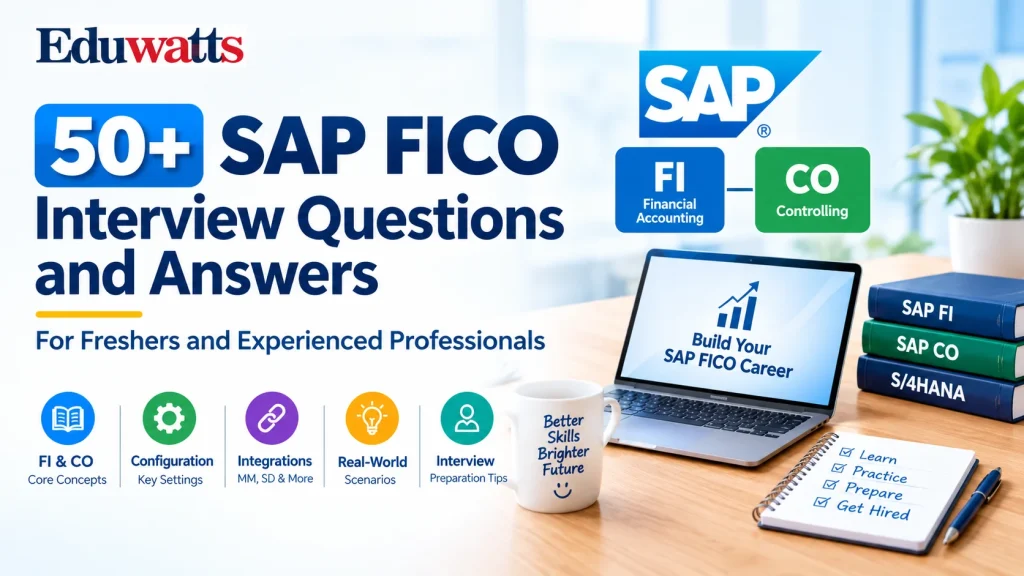
SAP FICO interview questions enable an employer to test the candidate’s knowledge regarding financial accounting, controlling, SAP configuration, and business process flows. Whether you are a fresher looking for your first job in SAP FICO or an experienced consultant searching for growth opportunities in your career, knowing all these aspects can help you prepare well for your technical interview sessions.
Following is the list of top 50+ SAP FICO interview questions and answers, including general ledger accounting, accounts payable, accounts receivable, asset accounting, cost centres, SAP configuration, SAP integration, SAP S/4HANA Finance, etc.
Now, let us go through some of the Top SAP FICO Interview Questions & Answers, which will help you prepare for your interview, increasing your probability of getting your desired job.
List of the most common SAP FICO interview questions
Part A: Generic SAP FICO Interview Questions
Q1) Define SAP briefly?
Ans: SAP is a German Software company that developed its Enterprise Resource Planning (ERP) Software. At the same time, people commonly use “SAP” to describe the software platform and business applications that the company develops.
Certainly, an SAP Course helps you understand SAP and its components in detail.
Q2) So what is Enterprise Resource Planning (ERP) Software?
Ans: Enterprise Resource Planning (ERP) Software is an integrated computer software system that enables organizations to integrate their various business functions on a single unified platform, eliminating duplication, saving time, improving efficiency and productivity and enabling organisations to take real-time decisions.
Q3) Explain SAP FICO simply.
Ans: SAP FICO is a collective term for two integrated components of SAP’s ERP system for financial management: Financial Accounting (FI) and Controlling (CO)
Q4) How would you briefly differentiate between FI and CO?
Ans: While there are many differences, simply put in the macro sense, FI focuses on external financial reporting, whereas CO focuses on internal management reporting
Q5) So what all does FI cover
Ans: Financial Accounting, or FI, covers the following major areas:
- General Ledger Accounting
- Account Receivable
- Account Payable
- Asset Accounting
- Bank Accounting
Travel Management and Fund Management can equally be part of the SAP FICO software, considering an organization’s need for it.
Q6) How does this help the Organization?
Ans: FI helps the organisation record and prepare all statutory and external financial reporting and quarter-end, half-year-end and year-end closing activities
Q7) What does CO cover
Ans: Controlling, or CO, covers the following areas:
- Cost Centre Accounting
- Internal Orders
- Product Cost Controlling
- Profitability Analysis
- Profit Centre Accounting
- Activity-Based Costing
Q8) How does CO help the Organization?
Ans: CO facilitates monitoring costs, supports planning and enables informed internal management decisions in real time.
Q9) How do you access the various SAP FICO sub-modules?
Ans: Specific tasks in SAP can be accessed using a short alphanumeric code called a Transaction Code, or T-Code. A T-Code acts as a shortcut to access a particular transaction or task directly, thereby avoiding the need to navigate through the SAP menu.
Q10) Can you elaborate on this with an example?
Ans: Let us say a vendor invoice has to be entered into the system. This comes under Accounts Payable, and the T-Code commonly used for this purpose is FB60. Likewise, a customer invoice under Accounts Receivable can be entered using FB70. In SAP CO, KE51 can be used to create a profit center where this transaction is available. These codes provide direct access to the specific task, eliminating the need to navigate through the SAP menu.
Q11) Is there any code for sub-modules too?
Ans: Yes. There are codes for sub-modules too, depending on whether they are part of FI or CO. For eg. the code for Accounts Receivable is FI-AR, and for Profitability Analysis it is CO-PA.
The questions so far gave a general overview of SAP FICO. Let us now begin with SAP FI and then move on to SAP CO
Part B: SAP FICO Interview Questions Based on SAP FI or Financial Accounting
Q12) What does the term Company mean in SAP FICO?
Ans: In SAP, a Company is a group-level organisational unit used primarily for consolidation purposes. It can represent a single legal entity or a group of legally independent entities for which consolidated financial statements are prepared.
Q13) Does a Company also have a Code?
Ans: Yes. A Company has a unique identification code, generally referred to as the Company ID. However, this should not be confused with the Company Code, which is a separate organizational unit used for financial accounting.
Q14) So what is a Company Code?
Ans: A Company Code is the smallest organizational unit in SAP for which a complete set of financial statements can be prepared. It is generally assigned to a legal entity for external accounting purposes.
Q15) How does the Company ID differ from the Company Code?
Ans: A Company ID can contain up to six characters, whereas a Company Code is a four-character alphanumeric code. A Company can have multiple Company Codes, allowing several legal entities to be represented within the same group structure.
Q16) Can you demonstrate this with an example?
Ans: Let us say a group has a Company ID of XYZ007 and operates through three separate legal entities in India, Norway and Peru. The three entities could be represented by Company Codes 1000, 2000 and 3000, respectively, while XYZ007 represents the group-level Company.
Q17) What is a Chart of Accounts?
Ans: A Chart of Accounts is a structured list of General Ledger accounts used by an organization to record and classify its financial transactions. A single Chart of Accounts can be assigned to one or more Company Codes.
Q18) Tell us about General Ledger Accounting?
Ans: General Ledger, or G/L Accounting, is the central component of Financial Accounting where an organization’s financial transactions are recorded and summarized under various G/L accounts. It forms the basis for preparing financial statements and other financial reports.
Q19) What is a G/L Account?
Ans: A G/L Account is used to record transactions belonging to a particular financial category, such as assets, liabilities, income or expenses. In simple terms, it helps classify and track financial transactions under the appropriate accounting head.
Q20) Distinguish between Balance Sheet and Profit and Loss Account?
Ans: The Balance Sheet consists of assets, liabilities, and equity whose balances are taken to the next accounting period. The Profit and Loss Account, on the other hand, consists of income and expenses earned/expended during a particular accounting period. The net effect of income and expenses during an accounting period is taken into the retained earnings account.
Q21) Is there something called a Posting Key in SAP FICO?
Ans: Yes. A Posting Key is a two-digit key that determines whether a line item is posted as a debit or credit and also controls the type of account that can be posted.
Q22) Define a Document Type?
Ans: A Document Type classifies accounting documents and controls certain document characteristics, including the permitted account types and document number range.
Q23) Explain the Fiscal Year Variant?
Ans: A Fiscal Year Variant defines the accounting periods and special periods used by an organization for financial reporting. It determines how the organization divides the fiscal year into posting periods.
Q24) Define a Posting Period?
Ans: A Posting Period is an accounting period during which organizations can record financial transactions in the SAP system. Organizations can open or close posting periods according to their accounting requirements.
Q25) Explain Accounts Payable in SAP FI?
Ans: Accounts Payable, or FI-AP, deals with financial transactions relating to vendors. It includes activities such as recording vendor invoices, processing credit memos, making outgoing payments and monitoring outstanding liabilities.
Q26) Explain Accounts Receivable in SAP FI?
Ans: Accounts Receivable, or FI-AR, deals with customer-related financial transactions. It includes activities such as recording customer invoices, processing credit memos, receiving payments and monitoring outstanding receivables.
Q27) Explain what a Reconciliation Account is?
Ans: A Reconciliation Account is a G/L account that automatically receives postings from a subsidiary ledger such as Accounts Payable, Accounts Receivable or Asset Accounting. In general, SAP does not permit direct postings to reconciliation accounts.
Q28) Tell us about the Vendor Master Record?
Ans: A Vendor Master Record contains the information required to conduct transactions with a vendor. It includes details such as the vendor’s name and address, payment terms, bank details and accounting information.
Q29) Explain what a Customer Master Record is?
Ans: A Customer Master Record contains the information required to conduct and manage transactions with a customer. It includes general information, company-code data and other relevant information required for business transactions.
Q30) What is the concept of Asset Accounting?
Ans: Asset Accounting, or FI-AA, helps organisations manage their fixed assets throughout their lifecycle. It covers activities such as asset acquisition, depreciation, transfer and retirement.
Q31) Is there Depreciation in SAP?
Ans: Yes. In SAP, depreciation represents the portion of a fixed asset’s value that an organisation recognises as an expense over the asset’s useful life.
Q32) So what is a Depreciation Area?
Ans: A Depreciation Area helps organisations calculate and manage an asset’s depreciation according to specific accounting or reporting requirements. For example, organisations may use different depreciation areas for book, tax or group reporting.
Q33) Tell us about Bank Accounting in SAP FI?
Ans: Bank Accounting deals with an organization’s bank-related financial transactions. It includes activities such as managing bank accounts, recording incoming and outgoing payments, and carrying out bank reconciliation.
Q34) Define Payment Term?
Ans: Payment Terms define the conditions under which a customer or vendor must make payment. They specify details such as the payment due date and any applicable cash discount.. They specify details such as the payment due date and any applicable cash discount.
Q35) How does SAP FI integrate with other SAP modules?
Ans: SAP FI integrates closely with other SAP modules, including Materials Management (MM), Sales and Distribution (SD), Production Planning (PP) and Controlling (CO). Transactions originating in these modules can automatically generate corresponding financial postings. In fact, these programs have their own certification too for they reverse integrate with SAP FI.
Part C: SAP FICO Interview Questions Based on SAP CO or Controlling
Q36) Tell us about SAP CO?
Ans: SAP Controlling, or CO, helps organizations manage their internal accounting activities. It enables an organization to monitor and analyze costs, plan expenditures, analyze profitability and provide relevant information for management decision-making.
Q37) What is the meaning of Controlling Area in SAP CO?
Ans: A Controlling Area in SAP CO provides a framework for managing and monitoring costs and other internal accounting activities within an organization. It can include one or more Company Codes, subject to compatible configuration.
Q38) What purpose does CCA serve in SAP CO?
Ans: Cost Center Accounting helps organizations collect, monitor, allocate and analyze the costs that different organizational units or areas of responsibility incur.
Q39) Explain a Cost Center?
Ans: A Cost Center is an organizational unit where an organization incurs and monitors costs. For example, an HR department, production department or administrative department can serve as a Cost Center.
Q40) So what is a Cost Element?
Ans: A Cost Element represents the nature or type of a cost or revenue for controlling purposes. In SAP S/4HANA, G/L accounts represent cost elements within Controlling.
Q41) Briefly tell us about the difference between Primary and Secondary Cost Elements?
Ans: Primary costs originate from transactions involving external business activities, such as salaries, electricity or purchases. Secondary costs arise from internal CO processes such as allocations and settlements.
Q42) Explain an Internal Order?
Ans: An Internal Order is a cost object that helps organizations plan, collect, monitor and settle costs associated with a specific activity, event or project. It provides a way of tracking costs separately for a particular purpose.
Q43) Tell us about an Activity Type?
Ans: An Activity Type represents a specific activity performed by a Cost Center, such as machine hours, labor hours or consulting hours. It measures and allocates the corresponding activity costs.
Q44) Explain what Profit Center Accounting is?
Ans: Profit Center Accounting helps organizations analyze the financial performance and profitability of different profit centers. It helps management evaluate revenues, costs and results for different areas of the business.
Q45) Define a Profit Center?
Ans: A Profit Center represents an organisational unit that enables an organisation to evaluate the revenues, costs and profitability of a specific business area or segment.
Q46) Why do businesses use Product Cost Controlling in SAP?
Ans: Product Cost Controlling helps organizations calculate, analyse, and monitor the costs associated with manufacturing or providing a product or service. It helps organizations understand the various components that make up product costs.
Q47) What role does the Standard Cost Estimate play in SAP CO?
Ans: A Standard Cost Estimate calculates the planned or standard cost of a product based on components such as materials, activities, overheads and production processes. It provides a basis for comparing planned or standard costs with actual costs.
Q48) In SAP CO, what is Profitability Analysis or CO-PA?
Ans: Profitability Analysis, or CO-PA, helps organizations assess profitability across different characteristics, such as customers, products, sales regions and market segments. It helps management identify the sources of revenue and the areas where the organization incurs costs.
Q49) Explain an Assessment in SAP CO?
Ans: Assessment involves allocating costs internally from one or more sender Cost Centers or cost objects to receiving objects according to defined allocation rules. Companies generally record this allocation using a secondary cost element.
Q50) Tell us about Distribution in SAP CO?
Ans: Distribution is a method of allocating primary costs from a sender Cost Center to one or more receiving Cost Centers while retaining the original cost element.
Q51) Define Settlement in SAP CO?
Ans: Settlement is the process of transferring costs collected on an object, such as an Internal Order or production order, to one or more appropriate receivers according to predefined settlement rules.
Q52) What does Variance Analysis in SAP CO involve?
Ans: Variance Analysis involves comparing planned, target or standard costs with actual costs to identify differences. It helps management understand where and why such differences have occurred and supports corrective or managerial action.
Real-Time SAP FICO Scenario-Based Interview Questions
Q 53. There is a problem in the posting of the invoice in SAP. How will you troubleshoot it?
Begin with the error message that comes along with the posting failure and identify the transaction or application where the message comes from. Then, find out about the posting period, required fields, G/L account setup, taxes, account assignment, authorisations, and configuration.
Not all posting errors have the same reason for occurring. Use the error details to limit the investigation to one area and then perform the troubleshooting as per the company policies.
Q54. Two vendor invoices appear in SAP. How will you handle the situation?
Firstly, check if both invoices belong to the same vendor invoice. Check the details such as vendor name, invoice number, date, amount, currency, and purchase order number. Also, check duplicate invoice checking rules and history of the document.
Q55. An entry from a customer payment does not settle a pending invoice. How will you troubleshoot this problem?
Start by analysing the customer record, amount paid, currency, references, and details of the open invoice. Identify any discrepancies, any remaining entries, payment against the account, and incorrect allocations.
Then clear the transaction using the relevant clearing method that matches the payment and the invoice.
How to Prepare for an SAP FICO Interview?
It is important to have a proper preparation plan in order to revise the concepts that are often tested by the interviewers.
Step 1: Revise basic accounting principles. Understand debit and credit, journalizing, balance sheet, profit and loss account, and reconciliation.
Step 2: Study FI and CO in SAP. Revise company codes, general ledger accounts, accounts payable, accounts receivable, asset accounting, cost center, profit center, and internal orders.
Step 3: Understand configuration concepts. Revise organisational structure, posting periods, document types, automatic account determination, and integration settings.
Step 4: Prepare practical scenarios. Practise explaining how you will identify failed postings, unmatched GR/IR balances, payment exceptions, and wrong financial entries.
Step 5: Understand SAP S/4HANA Finance. Study the Universal Journal, integrated cost elements, financial reporting, and the difference between SAP ECC and S/4HANA.
Step 6: Explain concepts clearly. Have a clear structure for your answers: state what it is, explain the process, and provide examples. For experienced candidates, mention only projects and responsibilities that were truly yours.
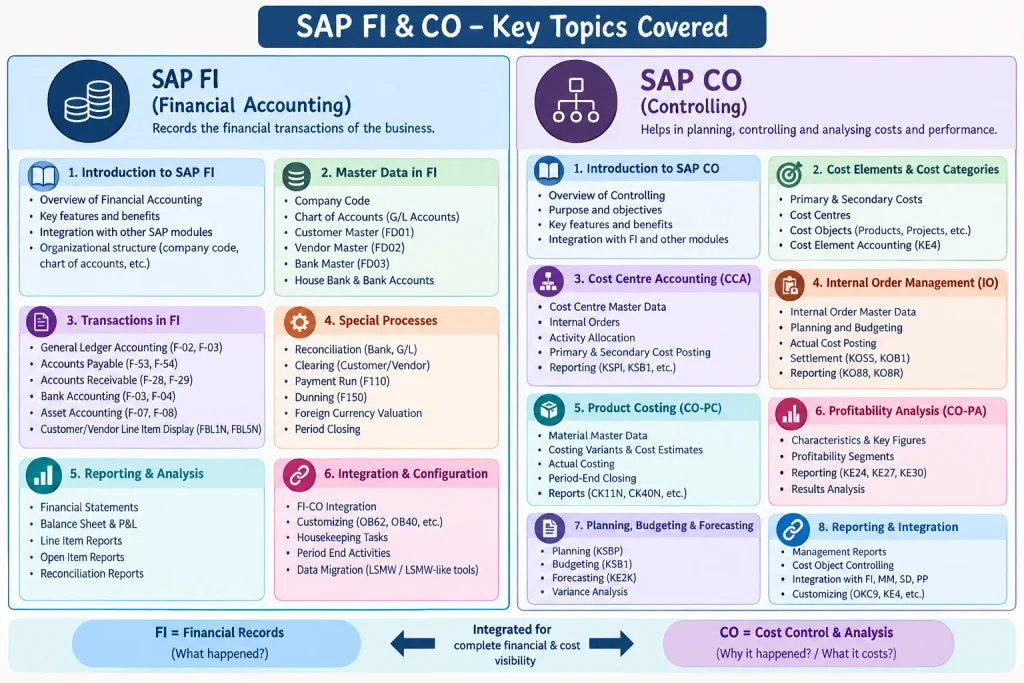
Topics covered under SAP FICO Training Course
The diagram below provides an overview of the key topics covered in the FI and CO modules:
Why should one learn SAP FICO?
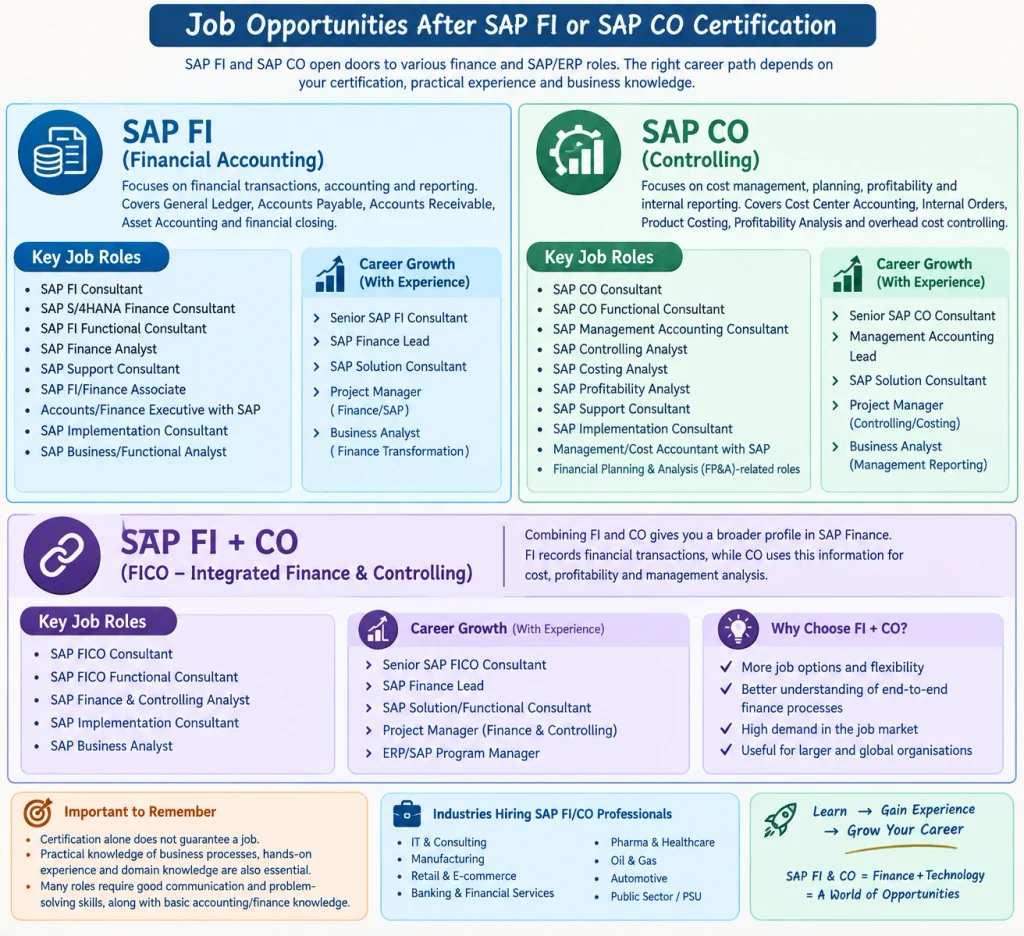
SAP FICO expertise can be used for job opportunities such as SAP functional consulting, financial systems, SAP support, finance transformation, and management accounting. The types of jobs open to the individual are based on his/her accounting expertise, SAP skills, and experience.
A planned course will assist the student in understanding SAP processes and gaining hands-on experience. Prior to the selection of any course, one should check out the curriculum, the experience of the trainer, practical exercises, system access, and career assistance.
To enrich yourself with SAP FICO knowledge, try the Eduwatts SAP FICO training course. You may also refer to SAP FICO modules and career options and also compare the fee structure of SAP FICO courses.
Job Opportunities after SAP FICO Interview Questions
The chart below shows the job opportunities after doing the SAP FICO Course
Salary Scope After SAP Training
The table below shows the indicative salaries for SAP consultants and other roles as per experience after doing the SAP FICO Course
| Experience | Career Stage | Possible Roles | Key Responsibilities | Indicative Salary (₹ LPA) |
| 0–2 years | Entry Level | SAP FICO Trainee, Junior Consultant, SAP Support Executive | SAP fundamentals, support, testing, documentation and basic configuration | ₹3–7 LPA |
| 2–4 years | Early Career | SAP FICO Consultant, SAP Functional Consultant | Configuration, business-process mapping, implementation and issue resolution | ₹5–10 LPA |
| 4–7 years | Mid Career | Senior SAP FICO Consultant, SAP FICO Lead | Complex configuration, integration, client interaction and mentoring | ₹8–15 LPA |
| 7–10 years | Advanced Career | Lead Consultant, Solution Architect, Project Lead | Solution design, workstream/project leadership and stakeholder management | ₹12–22 LPA |
| 10–15 years | Senior Leadership | Finance Solution Architect, Practice Lead, Program Manager | Enterprise solutions, transformation initiatives and strategic consulting | ₹18–30 LPA |
| 15+ years | Leadership / Advisory | Principal Consultant, SAP Advisory Consultant, Finance Transformation Lead | Enterprise architecture, advisory, transformation and executive-level consulting | ₹25–40+ LPA |
Prepare for SAP FICO Interviews with Eduwatts

SAP FICO interview preparation will demand a thorough knowledge of financial accounting, controlling, SAP configuration, and business processes in the real world. In case you wish to improve your skills in these areas, you may consider Eduwatts SAP FICO Training Course as one of the learning choices.
The course will prove useful for candidates wishing to pursue a career in SAP consulting or for people working in finance. You can get more information about the curriculum, learning mode, and support provided to students by reviewing the course details.
Why Choose Eduwatts?
You enjoy the following advantages with Eduwatts when you do the SAP FICO Course with them:
- 44 hours of intensive training
- Updated industry-oriented curriculum
- Monthly master class sessions by industry experts
- Hands-on training through live industry projects
- Regular assignments to test students
- Regular exams to check student progress
- Support for internship opportunities with leading Organizations
- Placement support
- Acclaimed SAP FICO Certification
- They offer a SAP ERP Masterclass Course
- Rated 4.7/5 by more than 2000 students
Conclusion
For an SAP FICO job aspirant preparing for an SAP Interview, it is imperative to have a clear understanding of the fundamentals. Knowing what SAP FICO is, understanding the difference between FI and CO, and being familiar with their key components, concepts, and functionalities can provide a strong foundation for tackling interview questions with confidence.
However, interview preparation is not just about memorising definitions or transaction codes. It is equally important to understand how these concepts work in a real business environment and how FI and CO work together to support an organization’s financial and managerial requirements.
Last but not least, interviews are also how you present yourself. Your grooming, confidence, communication and articulation.
We hope these 50+ SAP FICO Interview Questions & Answers help you reinforce your fundamentals and approach your upcoming interviews with greater confidence. With the right knowledge, preparation and confidence, you can take the next step towards your desired career.
Recommended Reads
FAQs
Your chances of getting a job improve significantly when you do well in your interview and convince the employer why you are the right fit.
Companies look at soft skills too – people who are team players, take ownership and accountability, and have problem-solving and decision-making skills
Yes. Freshers can enter SAP FICO entry-level roles, provided you fare well in your interview.
The possible Jobs that you may get after doing SAP FICO course are
SAP FICO consultant, Functional Analyst, SAP Support Consultant or
Finance Transformation Specialist.
Eduwatts is the Best Institute for SAP FICO Course.
Ready to Start Your Learning Journey?
Join thousands of learners and build your future with expert-led courses and 100% practical training.
Vinit Monga
With 37 years of professional experience and a passion for learning new technologies, I have maintained a keen interest in the evolving world of SAP. I first heard about SAP three decades ago, and that initial curiosity has continued to grow over the years. Since then, I have made a consistent effort to stay updated on SAP’s developments, advancements, and changing business applications. My long-standing interest in technology and commitment to continuous learning inform my approach to SAP concepts and interview preparation.
View all articles