 Pallavi Saxena
Oct 12, 2026
1,959 views
19 min read
Wondering how to learn the Chinese Language from beginner to conversational level? Start with Pinyin, Mandarin’s four tones, and regular Chinese language skill practice. Gradually move to simple short sentences, Chinese characters, listening exercises and speaking practice. You can use language-learning apps to practise daily conversation in Chinese. This builds confidence to speak in Chinese, and gradually you will speak in Chinese with fluency. With consistent effort and the right learning path, you can communicate in Chinese during visits, higher studies, and job opportunities in Chinese-speaking countries.
In this blog, you will walk through tips for how to learn the Chinese Language. We will explore Online Mandarin Language Courses for beginners to advanced levels from leading institutes like Eduwatts that align well with today’s job market demand.

How to Learn Chinese Language Easily?
Learning Chinese does not need to be difficult. The key is to cultivate positive learning habits and practice consistently. Here are some tips that can make your Chinese Learning Journey smoother.
- Ahead of time, be clear about what you want to learn.
- Practice daily for at least 15–20 minutes.
- Explore new words and common phrases daily.
- Focus on pronunciation and tones.
- Regularly watch Chinese videos and listen to Mandarin podcasts
- Read children’s books and beginner novels in Mandarin Chinese so you can broaden your Mandarin Vocabulary.
- Talking to native speakers or classmates in Mandarin will boost your confidence to speak in Mandarin.
- Daily Revision Using Language-Learning Apps.
- Enrol in an online Mandarin Language Course from a top institute like Eduwatts. The institute is known for the quality of training and globally recognised Certification in the Mandarin language.
Thinking About Learning Chinese?
11 Easy Tips to Learn Chinese for Beginners
Mastering Mandarin is more about daily practice and consistency. Slow and steady progress from an elementary to an advanced level is the key to having a good command of Mandarin. Soon you will speak fluently in Mandarin. Here is a list of easy tips that you must follow to master Mandarin quickly.

1. Start with Basic Chinese Vocabulary
To get started, become familiar with basic Chinese words such as greetings, numbers, family members, colours, days of the week, and common expressions before proceeding to advanced topics. Learn 10–15 new words every day, and recall the words daily. Flashcards, vocabulary notebooks and even mobile applications are very effective ways to memorise new words.
2. Master Mandarin Chinese Pronunciation and Tones
There are four tones in Mandarin Chinese, including one neutral tone. One word can mean different things depending on how we say it.
A few tips for Mastering Mandarin Chinese Pronunciation:
- Practice listening and reproducing the sounds by imitating native speakers.
- Say words out loud a few times until you are confident.
- You learn the correct pronunciation early on, so you avoid picking habits that would become hard to break later.
- Doing speaking exercises and audio lesson practice will really help your speaking.
3. Learn Chinese Characters Step by Step
Learn Chinese characters one at a time. Now, rather than attempting to remember hundreds of characters at once, focus on the highest-frequency ones first. Write them down every day, understand their meaning and how to pronounce them. The more you learn, the easier it becomes to recognise Mandarin characters.
4. Practice Listening Every Day
Listening is one of the quickest ways to level up your Chinese. Make use of Chinese cartoons, movies, television shows, YouTube videos and news channels with subtitles. The more you listen, the more your brain gets used to the sentence structure of the language pronunciation and use of day-to-day expressions. As a result, your ability to listen to Mandarin Chinese will automatically get better as you are continuously exposed.
5. Speak Without Fear of Making Mistakes
Several language learners cannot bring themselves to talk because they fear slipping up. No one is perfect, and remember that mistakes are normal when learning any language! Speak with the trainer, classmates, friends or native speakers as much as you can. The more you talk, the more confident and fluent you will be. Each conversation polishes your pronunciation, vocabulary and communication skills. You will soon be speaking in Mandarin fluently.
6. Read Simple Chinese Texts Regularly
A reading habit develops new words! And correct use of Mandarin Chinese Grammar and enhances quick sentence formation. You can begin with kids’ books, short stories, dialogues and reading materials targeting an advanced level. Slowly transition to reading newspapers, blogs and articles when you feel a little bit more confident.
7. Write Chinese Characters Every Day
One of the most effective methods to memorise Chinese characters and a wonderful approach to enhance your language proficiency is writing. Write the character multiple times and pronounce its sounds. This will reinforce the stroke order. Keep a small notebook where you write practice with vocab every day. You can even use your new vocabulary to arrange straightforward sentences. As you practice, writing becomes simpler and more rapid, allowing for quicker character recognition while reading. It helps reinforce your memory and general grip on the language.
8. Use Chinese Language Learning Apps
Learning Mandarin Chinese is easier than ever thanks to technology. Using Chinese Language Learning Apps will give you lessons, quizzes, practice exercises for enhancing Mandarin Vocabulary and Pronunciation, and some games to have fun while learning.
9. Learn About Chinese Culture
We learn language in a cultural context. Learning about Chinese traditions, festivals, customs, food and history adds much more value to your study of Mandarin and makes it more enjoyable! You can celebrate festivals like Chinese New Year, eat foods from China and learn everyday etiquette stuff. Familiarity with culture gives you the real, natural voice to be a fluent speaker. This creates confidence and helps you get familiar with Mandarin Chinese conversations that go hand in hand with Chinese traditions and lifestyle.
10. Enroll in a Chinese Language Course
While self-study shines, training under professional Mandarin trainers boosts Mandarin language proficiency. For instance, top online Mandarin Language Courses from Eduwatts are designed with a structured learning approach. The institute offers quality education with the latest online Mandarin language courses from HSK1 level to HSK6 level, well aligned with industry standards.
11. Practice Consistently and Stay Motivated
Every person who learns a new language must practise each day for about 20-30 minutes. This will be more effective learning than studying for hours on the weekend. Develop a study schedule and create realistic weekly goals. Celebrate small successes like being able to use a new vocabulary word, or speaking your very first sentence in Mandarin. Be patient and continue to practice. Every step you take is another step toward achieving success in learning a second language.
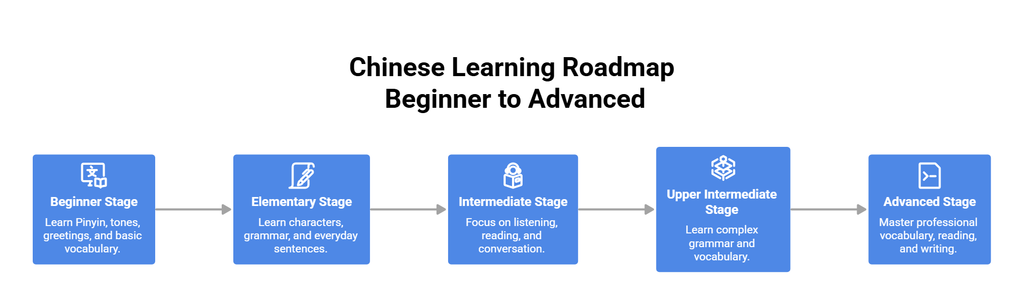
Chinese Learning Roadmap: Beginner to Advanced
| Stage | What to Learn | Main Goal |
| Beginner | Pinyin, tones, greetings, and basic vocabulary | Hold simple conversations |
| Elementary | Chinese characters, basic grammar, and everyday sentences | Communicate in daily situations |
| Intermediate | Listening, reading, and conversational practice | Communicate independently |
| Upper Intermediate | Complex grammar, advanced vocabulary, and expressions | Communicate confidently in workplace and social settings |
| Advanced | Professional vocabulary, advanced reading, and writing | Achieve advanced Mandarin proficiency for academic and professional purposes |
Let us walk through a week-by-week 30-day program for beginners to develop a basic knowledge base. This program will help you learn the fundamentals of the language, create a large vocabulary, practice your listening skills, and begin speaking with native speakers.
30-Day Chinese Learning Plan for Beginners
| Week | Learning Focus | What to Learn | Expected Outcome |
| Week 1: Days 1–7 | Pronunciation and Basics | Pinyin, four tones, greetings, numbers, and basic pronunciation | Recognise Pinyin, practise tones, and introduce yourself using simple Chinese phrases. |
| Week 2: Days 8–14 | Vocabulary and Sentences | Learn 50–100 common words, basic sentence patterns, pronouns, questions, and everyday phrases | Build simple sentences, ask basic questions, and understand common expressions. |
| Week 3: Days 15–21 | Reading and Listening | Learn basic Chinese characters, practise listening exercises, engage in short conversations, and try basic reading | Recognise common characters, understand familiar words, and follow simple conversations. |
| Week 4: Days 22–30 | Speaking and Revision | Practise speaking, write short paragraphs, improve listening comprehension, revise previous lessons, and complete a self-assessment | Communicate in familiar situations, understand basic spoken Chinese, and identify areas for improvement. |
Daily Routine for Learning Chinese
Practise for 40 minutes every day to develop Chinese language skills.
- Vocabulary — 10 minutes
- Learn new words, revise meanings, and use flashcards.
- 10 min
- Listening — 10 minutes
- Listen to beginner Chinese audio and repeat familiar phrases.
- 10 min
- Speaking — 10 minutes
- Practise pronunciation, introduce yourself, and answer simple questions aloud.
- 10 min
- Reading and Writing — 10 minutes
- Read Pinyin or simple sentences and practise writing Chinese characters.
- 10 min
- Total daily practice
- 40 minutes
- 30-day total
- 20 hours
Commit to consistency instead of trying to learn everything at once. At the end of 30 days, you must be able to use common terms, introduce yourself, ask some very basic questions, comprehend some simple phrases, and engage in a short beginner-level conversation. Your progress in learning Chinese will depend on your commitment, daily practice, and exposure to Chinese conversations.
What Is Pinyin and Why Should Beginners Learn It First?
Pinyin is the Romanised system for Mandarin Chinese pronunciation. It helps beginners to recognise Chinese sounds, pronounce words correctly with a clear accent, and understand tones when learning Chinese Characters.
- Learn correct pronunciation: Pinyin helps you understand how words sound and how to pronounce Mandarin Chinese words accurately.
- Master the four tones: Tones change word meanings in Mandarin, so learning the four tones is essential to prevent misunderstandings.
- Build vocabulary faster: Understanding Pinyin makes it easier to learn and recall Chinese words.
- Improve listening and speaking: Correct pronunciation helps you recognise spoken words. This will help you enhance listening and speaking skills in Chinese.
- Avoid Common Mistakes: Understanding pronunciation will reduce your mistakes while learning the language.
Pro Tip: Learn Pinyin and practise the four tones first. Then gradually combine pronunciation with vocabulary building and Chinese character recognition.
How to Memorise Chinese Characters and Vocabulary Faster?

- Learn characters by radicals: Understand common components to recognise patterns and memorise characters more easily.
- Use spaced repetition: Use flashcards to revise words every day.
- Practise Writing Characters: Write each character several times while focusing on its stroke order.
- Connect words with images: Associate Chinese characters with images.
- Learn vocabulary in context: Practise new words used in simple sentences instead of memorising isolated meanings.
- Group related words: Organise vocabulary by themes such as food, greetings, shopping, and everyday activities.
- Listen and speak regularly: Speak new words aloud and listen to native Mandarin speakers for correct pronunciation and understanding.
- Revise consistently: Spend 10–15 minutes daily reviewing previously learning and make a strong hold on the language skills.
Eduwatts: No. 1 Institute for Mandarin Language Training

Eduwatts is the top institute for Mandarin language learning. The institute has well-experienced and langauge expert trainers delivering high-quality Mandarin language training and Certification programs. These online courses are updated as per the industry requirements and follow the HSK standards. Moreover, the course includes live projects, flexibility in terms of classes, doubt sessions, and conversation classes to gain confident on the language. One-on-one guidance and assessment on an ongoing basis empower learners to become confident speakers, readers, writers and listeners. Eduwatts train students, working professionals, and entrepreneurs to advance their levels. Master Mandarin Chinese to an expert level with Eduwatts and achieve your goals.

Best Mandarin Language Courses from Eduwatts
With the advent of digital technology today, there are numerous online learning platforms available to help people learn a foreign language and gain certification. Eduwatts is the leading online educational platform that provides the globally recognised Mandarin Language Certification Courses. Learners gain Mandarin Language Training from an expert trainer. Earn certification from Eduwatts, a key to a successful career with global job opportunities.
Talk to a Chinese Language Expert
1- Mandarin Language Course– HSK1 Level
The Mandarin Language Course — HSK1 Level is perfect for complete beginners without prior knowledge of Chinese. The course familiarises learners with key vocabulary and simple sentences, daily conversation, greetings, numbers, dates and popular phrases. By reaching this level, students get a solid start, which allows them to move smoothly on to higher levels of proficiency.
Career Opportunities after HSK1
Eduwatts features extensive Online Mandarin Langauge courses developed in alignment with globally established HSK standards. Every class is interactive and based on the skills of Speaking, Listening, Reading, and writing. Whether you are a beginner learning the basics of Mandarin for the first time, or an advanced learner who wants to practice for academic or career opportunities, Eduwatts offers structured training that allows you to develop your language skills step-by-step. Our courses are ideal for students, professionals, business owners, travellers and career-switchers seeking to improve their Mandarin and broaden their international employment opportunities.
- Customer Support Executive
- Travel and Tourism Assistant
- Front Desk Executive
- Beginner Chinese Language Learner
- International Student Preparation
2- Mandarin Language Course– HSK2 Level
This course is intended for learners after basic learning in the previous course, HSK1, allowing learners more confidence in speaking in daily situations. Mandarin Language Course– HSK2 Level incorporates new characters and grammar topics while also providing additional speaking practice, which develops pronunciation and tone with the use of guided speech. HSK2 lays the foundation for useful and functional communication, while also being a great bridge to the intermediate level.
Career Opportunities after HSK2
- Customer Relationship Executive
- International Sales Assistant
- Tourism Coordinator
- Office Administration Executive
- Chinese Language Teaching Assistant
3- Mandarin Language Course– HSK3 Level
HSK3: This level is meant for those who wish to speak comfortably in daily life and the workplace. Learn to speak better, use more advanced grammatical structures, have a greater range of vocabulary and understand how to read in English.
Mandarin Language Course– HSK3 Level primarily emphasises communication and gives you ample opportunities to develop this skill through discussions, role-plays, listening activities, and writing. Learners become able to express opinions, follow longer conversations and cope with day-to-day interactions in business. HSK3 shows an intermediate level of Mandarin skills and allows for a more advanced study of the language.
Career Opportunities after HSK3
- Mandarin Language Trainer (Junior Level)
- Import-Export Executive
- International Business Coordinator
- BPO Language Specialist
- Travel Consultant
4- Mandarin Course–HSK4 Level
The Mandarin Language Course – HSK4 Level is suitable for a learner with a solid understanding of spoken and written Mandarin, covering both conversational skills and terminology required in academic, social or professional situations.
Mandarin Course–HSK4 Level focuses on complicated grammar, a bigger vocabulary, reading comprehension and listening practice, thus enabling confident speaking. From discussing a range of topics, articulating points of view clearly across time frames and understanding spoken Chinese in greater length or writing out fully formed and long passages. Unlocking this level showcases your upper-intermediate Chinese proficiency.
Career Opportunities after HSK4
- Mandarin Translator
- Chinese Language Trainer
- International Business Executive
- Export-Import Coordinator
- Chinese Customers Customer Success Specialist
5- Mandarin Course–HSK5 Level
The Mandarin Language Course – HSK5 Level is great for learners looking to achieve an advanced level of competence with Mandarin. This course provides perspective in understanding Chinese newspapers, magazines, television programming, and business discussions as well as professional communication. Students learn advanced vocabulary and grammatical structures, making them better readers, writers, listeners and speakers. Formal communication, presentation skills and language for use in higher education and international careers are also part of the curriculum. Once learners finish the Mandarin Language Course – HSK5 Level, they can communicate freely and easily with native speakers, both personally and professionally.
Career Opportunities after HSK5
- Chinese Language Interpreter
- International Marketing Manager
- Business Development Executive
- Foreign Trade Manager
- Overseas Education Consultant
6- Mandarin Course–HSK6 Level
The Mandarin Language Course – HSK6 Level is for high-level learners who need near-native command of the language. The course allows students to easily understand complex written and spoken Chinese. Advanced literacy, critical reading skills, professional writing practices and fluent conversation are cultivated in learners. Mandarin Course–HSK6 Level is an advanced-level test, and completing it shows that the non-native speaker has a very good command of the language.
Career Opportunities after HSK6
- Senior Mandarin Interpreter
- Chinese Language Professor or Trainer
- International Relations Specialist
- Localisation and Translation Manager
- Global Business Consultant
Benefits of Learning the Chinese Language
With China becoming an economic powerhouse in the world, Chinese has become one of the most valuable languages to learn. There are lots of personal and professional benefits in learning Mandarin Chinese.
Key Benefits
- Improved career prospects with corporations worldwide.
- Increased likelihood of international trade and business-related jobs
- Enhanced communication when travelling to Mandarin-speaking countries.
- Study abroad opportunities in top Chinese universities.
- Improved knowledge about Chinese culture, history and traditions.
- Higher earning opportunities in tourism, education, healthcare, IT, manufacturing and the import-export sector.
- Better networking opportunities with people around the world.
- Boosted cognitive abilities: Enhanced Memory and problem-solving skills.
- Whether you want career development, further study, business development or personal improvement, learning Mandarin is a choice for the future.
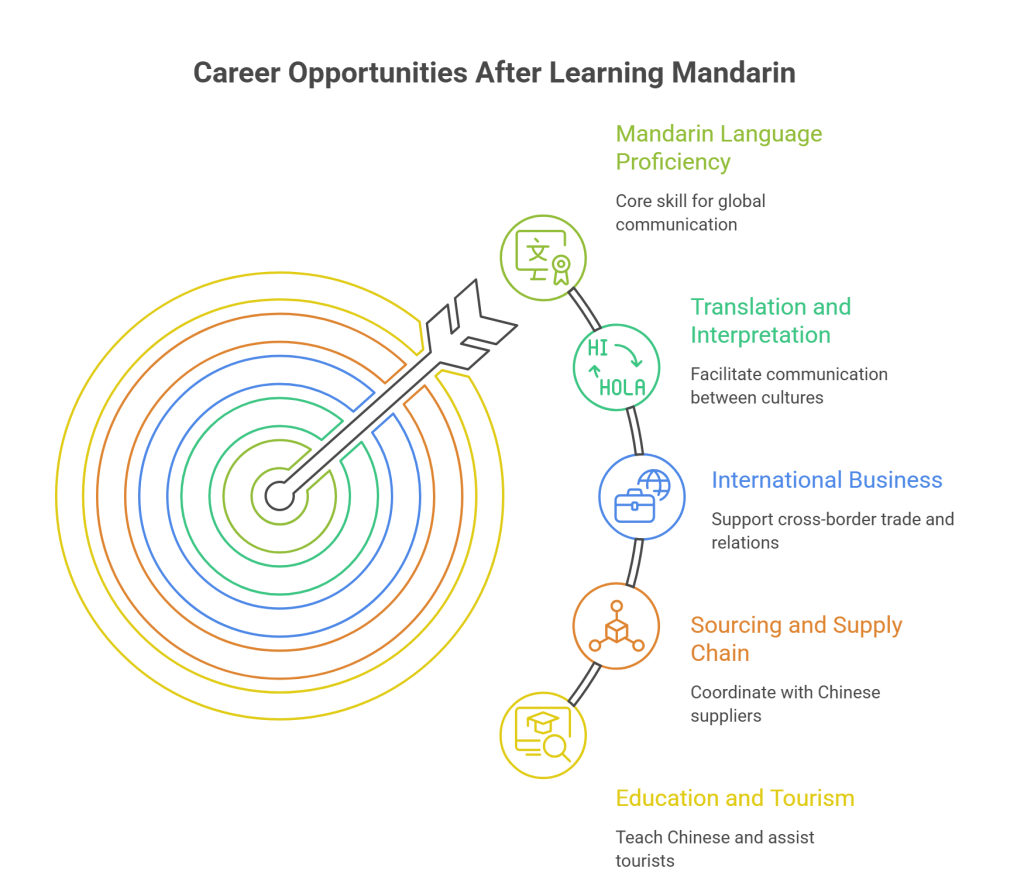
Top Career Opportunities after Mastering the Chinese Langauge
- Translator: Translate Chinese documents, emails, reports, and business materials into English or other languages.
- Interpreter: Facilitate real-time communication during meetings, conferences, and trade in Chinese Markets.
- International Business Executive: Support cross-border trade, client communication, and business development.
- Sourcing and Supply Chain Coordinator: Communicate with Chinese suppliers, coordinate orders, and assist with procurement activities.
- Mandarin Language Trainer: Teach Chinese pronunciation, vocabulary, grammar, and conversation to students and professionals.
- Bilingual Customer Support Specialist: Help Mandarin-speaking customers resolve queries and communicate with service teams.
- Localisation Specialist: Adapt websites, applications, games, and digital content for Chinese-speaking audiences.
- Tourism and Travel Professional: Assist Chinese-speaking tourists with travel arrangements, interpretation, and cultural guidance.
Top Chinese Language Job Roles
| Top Job Roles | Key Responsibilities | Annual Salary in India |
| Chinese Translator | Translate documents, reports, emails, and business content | ₹3–6 LPA |
| Mandarin Interpreter | Interpret conversations, meetings, and business discussions | ₹4–8 LPA |
| International Business Executive | Manage client communication, trade coordination, and business development | ₹4–10 LPA |
| Sourcing and Supply Chain Coordinator | Coordinate with Chinese suppliers, track orders, and support procurement | ₹6–14 LPA |
| Mandarin Language Trainer | Teach Chinese vocabulary, grammar, pronunciation, and conversation | ₹3–7 LPA |
| Bilingual Customer Support Specialist | Resolve customer queries and provide Mandarin-language support | ₹2.5–6 LPA |
| Localization Specialist | Adapt digital content, software, and websites for Chinese audiences | ₹6–12 LPA |
| Tourism and Travel Professional | Support Chinese-speaking travellers and provide language assistance | ₹2.5–6 LPA |
Salary figures are indicative estimates, not guaranteed averages. Actual earnings vary by proficiency, experience, location, employer, and industry expertise.
How Long Does It Take to Learn Chinese?
- Basic Understanding(1-3 Months): At this stage, you will begin to learn pinyin, the four tones of Chinese, greetings, numbers and basic vocabulary to help you make introductions and express yourself on a day-to-day basis.
- Beginner’s Communication(3 to 6 Months): Develop your vocabulary, learn the fundamentals of grammar and sentence structure, and engage in simple, brief conversations with consistent practice.
- Conversational Mandarin(6-12 months): Listen to people talk about everyday things, and be able to tell others what you think about those everyday things. Be able to communicate with people in a way that feels natural to you in your daily life.
- Intermediate Proficiency: Improve your ability to speak, read and write at a more advanced level; begin to understand longer conversations; be able to express more detailed thoughts.
- Advanced level (2 to 4 years +): Become fully fluent in Mandarin. You can have complex conversations and use language skills at your workstation.
Factors that affect learning time
- Daily practice and consistency.
- Quality of learning materials and teaching.
- Opportunities to speak with Mandarin speakers.
- Familiarity with other languages and writing systems.
- Individual learning goals and the time invested.
Tip: Make consistent progress by practising for 30-60 minutes each day, and through regular listening and speaking practice. The length of time required to achieve your desired level of fluency will be based on your current level of ability.
Ready to Start Learning Chinese?
Conclusion
Learning how to learn the Chinese Language becomes easier with consistent practice and the right guidance. Eduwatts offers structured online Mandarin training to help you build vocabulary, improve pronunciation, and develop speaking confidence. Whether you are a student, working professional, business owner, or career switcher, Mandarin can unlock international career opportunities and deepen your understanding of Chinese culture. HSK-based courses and expert trainers make your learning journey organised and effective.
Ready to boost your career and explore global opportunities? Contact Eduwatts Mandarin Expert and start professional Mandarin Language Training. Take your first step towards a brighter, globally connected future!
Recommended Reads
- The Best Online Mandarin Language Courses: Flexible Learning Options
- Top 8 Mandarin Language Courses in India
- A Beginner’s Guide to Chinese Culture, Religion & Festivals
- Latest Mandarin Language Blogs, Tips & Guides
- Most Spoken Language in the World: Facts, Rankings & Native Speakers
FAQs
Ans. A true mastery of Chinese comes from tones and characters, which may seem intimidating but can be easily accommodated with the help of regular, constant practice, correct guidance and determination to succeed. I think it is much easier and more fun to learn starting with common vocabulary, pronunciation and dialogues.
Ans. It takes time depending on what you are going to learn and how often you study. Having trained with 30–60 minutes a day of focused study for months, learners can pick up basic conversational skills in a few short months and eventually develop beginner to advanced skills through the HSK.
Ans. Mandarin Chinese is the most common and globally recognised form of Chinese. The best option for most people is that it is the standard language in China and Taiwan, used in areas such as business and educational environments, tourism, and international communication.
Ans. Multinational corporations and global businesses are very keen on hiring Mandarin. It opens the scope in international trade, tourism, education, customer service, translation, diplomatic and import-export sectors. Mandarin can make you more employable and, in the long run, help with your career advancement.
Ans. Selecting the right institute with experienced trainers, a fixed HSK-based curriculum, and real-time speaking sessions in an easily accessible learning environment is important. Eduwatts provides Mandarin lessons for beginner students and also for advanced learners, which prepare the students with confidence that they can achieve their goals in academics and their careers.
Ready to Start Your Learning Journey?
Join thousands of learners and build your future with expert-led courses and 100% practical training.

Pallavi Saxena
With more than 15 years of experience, I dedicatedly writing informative content for my audience. With extensive experience in content writing and digital publishing, I specialize in creating informative, engaging, and industry-focused content that helps readers make informed career and business decisions. My expertise includes developing high-quality content on foreign language learning, global career opportunities, ERP solutions and enterprise technologies. By staying updated with emerging trends, technological advancements, and industry best practices, I craft content that educates, inspires, and delivers lasting value to readers across diverse sectors.
View all articles


Recent Comments (15)
An article that is based on extensive study, and skilfully written. Really, the type of resource that I would be comfortable recommending to anyone interested in learning Chinese.
The recommendations provided here are relevant to students and working professionals alike for efficiently learning Chinese.
This article has been interesting for me, as it tells about the issues frankly, and at the same time offers practical ways to work around them.
This has encouraged me to actually start learning Mandarin. Thanks for giving such a well-structured and helpful content.
It makes for a captivating read from start to finish. Its informative without being either too technical or complicated.
The article highlights the importance of consistency over speed which I really like. Note: this is a great lesson for anybody who learns any language.
Many of the questions I had before learning Chinese were addressed in this blog. Its data is one of the simplest to read.
I especially liked the advice on improving speaking and listening. Hope to turn them into practice soon.
Very thorough compendium, with plenty of thanks! This combines motivation and the how to learn.
The learning strategies that you shared here appear to be very effective I’m going to implement some of these myself in my day to day.
This was a refreshing read. Nonetheless, the content is more detailed than overwhelming — it was actually pleasant to read through.
Explanations are simple and easy to understand for a beginner. I learnt many tips which I have never thought of.
I love that this blog is about developing great study habits and not fast results. Very realistic and encouraging.
The article provided me specific direction on where to start. Very simple and comprehensible advice for novices
To me, I like how this guide divides the learning process into bite-sized steps. That makes Chinese seem a whole lot more doable.