Pallavi Saxena
Nov 4, 2026
766 views
15 min read
Learning basic Chinese words becomes easier when you organise words into familiar categories such as greetings, people, numbers, food, places, and everyday actions. You can begin learning a few words each day, then practice making short sentences with those words. These 100 Chinese Words and Example Sentences are intended to provide a Solid Foundation for your use of everyday Chinese Conversation.

The following 102 essential Chinese words and phrases are organised into eight beginner-friendly categories. Each entry includes Simplified Chinese, Pinyin, its English meaning, a simple Mandarin sentence, and the English translation. Learning vocabulary by category makes it easier to remember words and use them in everyday conversations.
1. Common Chinese Greetings and Polite Expressions
| Chinese Words | Pinyin | English Meaning | Sentence in Chinese | English Translation |
| 你好 | Nǐ hǎo | Hello | 你好,我叫安娜。 | Hello, my name is Anna. |
| 您好 | Nín hǎo | Hello (polite) | 老师,您好! | Hello, teacher! |
| 早上好 | Zǎoshang hǎo | Good morning | 早上好,妈妈! | Good morning, Mom! |
| 下午好 | Xiàwǔ hǎo | Good afternoon | 下午好,王先生。 | Good afternoon, Mr. Wang. |
| 晚上好 | Wǎnshang hǎo | Good evening | 晚上好,朋友! | Good evening, friend! |
| 谢谢 | Xièxie | Thank you | 谢谢你的帮助。 | Thank you for your help. |
| 不客气 | Bú kèqi | You’re welcome | 不客气! | You’re welcome! |
| 对不起 | Duìbuqǐ | Sorry | 对不起,我迟到了。 | Sorry, I am late. |
| 没关系 | Méi guānxi | It is okay | 没关系。 | It is okay. |
| 再见 | Zàijiàn | Goodbye | 再见,明天见! | Goodbye, see you tomorrow! |
| 请 | Qǐng | Please | 请坐。 | Please sit down. |
| 晚安 | Wǎn’ān | Good night | 晚安,爸爸。 | Good night, Dad. |
2. Basic Chinese Pronouns
| Chinese Words | Pinyin | English Meaning | Sentence in Chinese | English Translation |
| 我 | Wǒ | I / Me | 我是学生。 | I am a student. |
| 你 | Nǐ | You | 你是我的朋友。 | You are my friend. |
| 您 | Nín | You (polite) | 您好吗? | How are you? |
| 他 | Tā | He / Him | 他是老师。 | He is a teacher. |
| 她 | Tā | She / Her | 她很高兴。 | She is happy. |
| 它 | Tā | It | 它是一只猫。 | It is a cat. |
| 我们 | Wǒmen | We / Us | 我们学习中文。 | We study Chinese. |
| 你们 | Nǐmen | You (plural) | 你们是学生吗? | Are you students? |
| 他们 | Tāmen | They (male or mixed group) | 他们在学校。 | They are at school. |
| 她们 | Tāmen | They (female group) | 她们是朋友。 | They are friends. |
3. Common Chinese Verbs
| Chinese Words | Pinyin | English Meaning | Sentence in Chinese | English Translation |
| 是 | Shì | To be | 我是老师。 | I am a teacher. |
| 有 | Yǒu | To have | 我有一本书。 | I have a book. |
| 吃 | Chī | To eat | 我吃米饭。 | I eat rice. |
| 喝 | Hē | To drink | 我喝水。 | I drink water. |
| 去 | Qù | To go | 我去学校。 | I go to school. |
| 来 | Lái | To come | 请进来。 | Please come in. |
| 看 | Kàn | To see / Watch | 我看电视。 | I watch television. |
| 听 | Tīng | To listen | 我听音乐。 | I listen to music. |
| 说 | Shuō | To speak / Say | 我说中文。 | I speak Chinese. |
| 学习 | Xuéxí | To study / Learn | 我学习中文。 | I study Chinese. |
| 工作 | Gōngzuò | To work | 我在公司工作。 | I work at a company. |
| 读 | Dú | To read | 我读中文书。 | I read Chinese books. |
| 写 | Xiě | To write | 我写汉字。 | I write Chinese characters. |
| 买 | Mǎi | To buy | 我要买水果。 | I want to buy fruit. |
| 喜欢 | Xǐhuan | To like | 我喜欢音乐。 | I like music. |
4. Chinese Numbers
| Chinese Numbers | Pinyin | English Meaning | Sentence in Chinese | English Translation |
| 一 | Yī | One | 我有一个苹果。 | I have one apple. |
| 二 | Èr | Two | 我有两个朋友。 | I have two friends. |
| 三 | Sān | Three | 我买了三个苹果。 | I bought three apples. |
| 四 | Sì | Four | 我们四个人。 | There are four of us. |
| 五 | Wǔ | Five | 现在五点。 | It is five o’clock. |
| 六 | Liù | Six | 我有六本书。 | I have six books. |
| 七 | Qī | Seven | 今天是七号。 | Today is the seventh. |
| 八 | Bā | Eight | 我八点起床。 | I wake up at eight. |
| 九 | Jiǔ | Nine | 他九岁。 | He is nine years old. |
| 十 | Shí | Ten | 我有十元。 | I have ten yuan. |
5. Common Chinese Food Words
| Chinese Words | Pinyin | English Meaning | Sentence in Chinese | English Translation |
| 水 | Shuǐ | Water | 我要一杯水。 | I want a glass of water. |
| 茶 | Chá | Tea | 我喜欢喝茶。 | I like drinking tea. |
| 咖啡 | Kāfēi | Coffee | 我要一杯咖啡。 | I want a cup of coffee. |
| 米饭 | Mǐfàn | Cooked rice | 我喜欢吃米饭。 | I like eating rice. |
| 面条 | Miàntiáo | Noodles | 我想吃面条。 | I want to eat noodles. |
| 苹果 | Píngguǒ | Apple | 这个苹果很甜。 | This apple is sweet. |
| 水果 | Shuǐguǒ | Fruit | 我喜欢水果。 | I like fruit. |
| 蔬菜 | Shūcài | Vegetables | 我每天吃蔬菜。 | I eat vegetables every day. |
| 肉 | Ròu | Meat | 我不吃肉。 | I do not eat meat. |
| 鸡肉 | Jīròu | Chicken | 我喜欢吃鸡肉。 | I like eating chicken. |
| 牛肉 | Niúròu | Beef | 他不吃牛肉。 | He does not eat beef. |
| 鱼 | Yú | Fish | 我喜欢吃鱼。 | I like eating fish. |
| 鸡蛋 | Jīdàn | Egg | 我早上吃鸡蛋。 | I eat eggs in the morning. |
| 面包 | Miànbāo | Bread | 我买了面包。 | I bought bread. |
| 牛奶 | Niúnǎi | Milk | 孩子喜欢喝牛奶。 | The child likes drinking milk. |
6. Chinese Family Words
| Chinese Words | Pinyin | English Meaning | Sentence in Chinese | English Translation |
| 家 | Jiā | Home / Family | 我在家。 | I am at home. |
| 家人 | Jiārén | Family members | 我爱我的家人。 | I love my family. |
| 爸爸 | Bàba | Father / Dad | 我爸爸在家。 | My father is at home. |
| 妈妈 | Māma | Mother / Mom | 我妈妈很好。 | My mother is well. |
| 父亲 | Fùqīn | Father (formal) | 我的父亲是医生。 | My father is a doctor. |
| 母亲 | Mǔqīn | Mother (formal) | 我的母亲喜欢茶。 | My mother likes tea. |
| 哥哥 | Gēge | Older brother | 我哥哥在北京。 | My older brother is in Beijing. |
| 弟弟 | Dìdi | Younger brother | 我弟弟是学生。 | My younger brother is a student. |
| 姐姐 | Jiějie | Older sister | 我姐姐会说中文。 | My older sister can speak Chinese. |
| 妹妹 | Mèimei | Younger sister | 我妹妹喜欢音乐。 | My younger sister likes music. |
| 孩子 | Háizi | Child | 孩子在学校。 | The child is at school. |
| 朋友 | Péngyou | Friend | 他是我的朋友。 | He is my friend. |
Tips for Learning Chinese Words Faster
- Learn 5-10 words per day: It is better to focus on learning a few words each day than to try and remember all of them at the same time.
- Practise Pinyin and tones: Listen to native Chinese speakers and say each word aloud to practice your Pinyin and tone skills.
- Write Chinese Characters: Practice stroke order to get used to the way we write.
- Write some of your own sentences. Use new vocabulary to talk about your family, food, daily activities, and hobbies.
- Regularly review: use flashcards, short tests, and vocabulary books to increase memory.
- Practice speaking: Speak out loud, and speak to your partner in very basic Chinese.
Learning Goal: Begin by learning how to greet people and refer to them with appropriate pronouns, then move on to learning basic verbs and common everyday words. As you continue to practice, you’ll be able to create short conversations. Consistent practice will also allow you to speak Mandarin more comfortably and with greater confidence.
How do you say hello, thank you, and goodbye in Chinese?
When starting to learn to communicate in Chinese, one of the initial tasks for beginners should be practising the use of greetings and polite language. The purpose of using these types of expressions is to provide a way for individuals to initiate conversations with others, to show respect to those they are speaking with, and to help people gain confidence in communicating with native speakers.

Common Chinese Greetings
| Chinese Greeting | Pinyin | English Meaning | Example |
| 你好 | Nǐ hǎo | Hello | 你好,我叫安娜。 (Hello, my name is Anna.) |
| 您好 | Nín hǎo | Hello (polite) | 老师,您好! (Hello, teacher!) |
| 早上好 | Zǎoshang hǎo | Good morning | 早上好,妈妈! (Good morning, Mom!) |
| 下午好 | Xiàwǔ hǎo | Good afternoon | 下午好,王先生。 (Good afternoon, Mr. Wang.) |
| 晚上好 | Wǎnshang hǎo | Good evening | 晚上好,朋友! (Good evening, friend!) |
| 你好吗? | Nǐ hǎo ma? | How are you? | 你好,你好吗? (Hello, how are you?) |
How to Say Thank You in Chinese
| Chinese Phrase | Pinyin | English Meaning | Example |
| 谢谢 | Xièxie | Thank you | 谢谢你的帮助。 (Thank you for your help.) |
| 非常感谢 | Fēicháng gǎnxiè | Thank you very much | 非常感谢你。 (Thank you very much.) |
| 不客气 | Bú kèqi | You’re welcome | 不客气! (You’re welcome!) |
| 请 | Qǐng | Please | 请坐。 (Please sit.) |
| 对不起 | Duìbuqǐ | Sorry | 对不起,我迟到了。 (Sorry, I am late.) |
| 没关系 | Méi guānxi | It is okay / No problem | 没关系。 (It is okay.) |
How to Say Goodbye in Chinese
| Chinese Phrase | Pinyin | English Meaning | Example |
| 再见 | Zàijiàn | Goodbye | 再见,明天见! (Goodbye, see you tomorrow!) |
| 明天见 | Míngtiān jiàn | See you tomorrow | 好的,明天见。 (Okay, see you tomorrow.) |
| 回头见 | Huítóu jiàn | See you later | 我们回头见。 (See you later.) |
| 晚安 | Wǎn’ān | Good night | 晚安,妈妈。 (Good night, Mom.) |
| 拜拜 | Báibái | Bye-bye | 拜拜,朋友! (Bye-bye, friend!) |
Beginner Tip: Practice each of these daily greetings out loud at the start of every day. Instead of using English right after you greet a friend, thank someone or say goodbye to them, use Chinese instead.
Essential Chinese Phrases for Daily Conversations
Moving from memorising basic Chinese words to daily conversation phrases is an essential step moving forward in your Chinese Learning Journey. With these phrases, you will start conversations in the Chinese Langauge. You can ask simple questions, respond politely, and participate in basic conversations.
Everyday Chinese Phrases
| Chinese Phrase | English Meaning | Example Sentence |
| 你叫什么名字? | What is your name? | 你好,你叫什么名字? (Hello, what is your name?) |
| 我叫…… | My name is… | 我叫安娜。 (My name is Anna.) |
| 你来自哪里? | Where are you from? | 你来自哪里? (Where are you from?) |
| 我来自印度。 | I am from India. | 我来自印度。 (I am from India.) |
| 我不明白。 | I do not understand. | 对不起,我不明白。 (Sorry, I do not understand.) |
| 请再说一遍。 | Please say it again. | 请再说一遍,好吗? (Please say it again, okay?) |
| 请说慢一点。 | Please speak slowly. | 请说慢一点。 (Please speak slowly.) |
| 你会说英语吗? | Can you speak English? | 请问,你会说英语吗? (Excuse me, can you speak English?) |
| 这是什么? | What is this? | 请问,这是什么? (Excuse me, what is this?) |
| 多少钱? | How much does it cost? | 这个多少钱? (How much is this?) |
| 我不知道。 | I do not know. | 对不起,我不知道。 (Sorry, I do not know.) |
| 没问题。 | No problem. | 好的,没问题。 (Okay, no problem.) |
| 我很高兴。 | I am happy. | 今天我很高兴。 (I am happy today.) |
| 请帮帮我。 | Please help me. | 请帮帮我,好吗? (Please help me, okay?) |
| 我想学习中文。 | I want to learn Chinese. | 我想学习中文。 (I want to learn Chinese.) |
Idea for Practice: Select three expressions per day to include in a brief discussion. To illustrate, tell others who you are, find out what they are called, and describe the place from which you arrived.
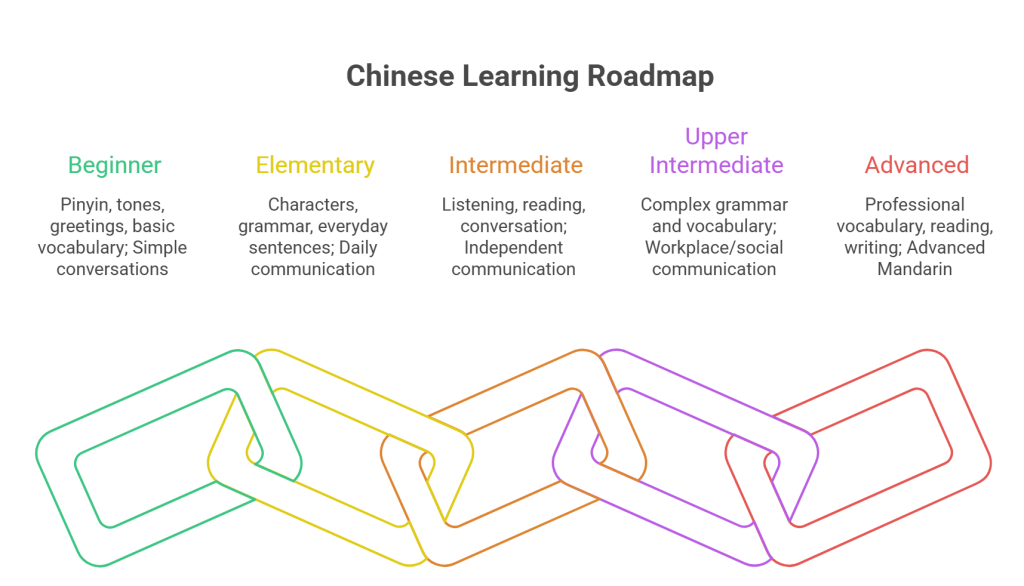
Chinese Learning Roadmap: Beginner to Advanced
| Stage | What to Learn | Main Goal |
| Beginner | Pinyin, tones, greetings, basic vocabulary | Simple conversations |
| Elementary | Characters, grammar, everyday sentences | Daily communication |
| Intermediate | Listening, reading, conversation | Independent communication |
| Upper Intermediate | Complex grammar and vocabulary | Workplace/social communication |
| Advanced | Professional vocabulary, reading, writing | Advanced Mandarin |
What Chinese Words and Phrases Should I Know Before Travelling to China?
Mastering common Chinese words and phrases used while travelling to Chinese-speaking countries will make your visit enjoyable. Learning Chinese travel vocabulary will help you interact with local people in Chinese-speaking countries. Learning basic Chinese phrases helps you to communicate with the staff at hotels, drivers, order food in restaurants and local people while shopping.

1. Airports and Transport
| Chinese Word or Phrase | Pinyin | English Meaning |
| 机场 | Jīchǎng | Airport |
| 飞机 | Fēijī | Aeroplane |
| 机票 | Jīpiào | Air ticket |
| 护照 | Hùzhào | Passport |
| 火车 | Huǒchē | Train |
| 地铁 | Dìtiě | Metro |
| 出租车 | Chūzūchē | Taxi |
| 车站 | Chēzhàn | Station |
| 入口 | Rùkǒu | Entrance |
| 出口 | Chūkǒu | Exit |
Useful sentence: 请问,机场在哪里? (Qǐngwèn, jīchǎng zài nǎlǐ?) — Excuse me, where is the airport?
2. Hotels and Accommodation
| Chinese Word or Phrase | Pinyin | English Meaning |
| 酒店 | Jiǔdiàn | Hotel |
| 房间 | Fángjiān | Room |
| 预订 | Yùdìng | Reservation |
| 订单 | Dìngdān | Booking / Order |
| 前台 | Qiántái | Reception |
| 钥匙 | Yàoshi | Key |
| 退房 | Tuìfáng | Check out |
| 入住 | Rùzhù | Check in |
| 早餐 | Zǎocān | Breakfast |
| 卫生间 | Wèishēngjiān | Bathroom |
Useful sentence: 我预订了一个房间。 (Wǒ yùdìng le yí ge fángjiān.) — I have booked a room.
3. Restaurants and Food Ordering
| Chinese Word or Phrase | Pinyin | English Meaning |
| 餐厅 | Cāntīng | Restaurant |
| 菜单 | Càidān | Menu |
| 水 | Shuǐ | Water |
| 米饭 | Mǐfàn | Rice |
| 面条 | Miàntiáo | Noodles |
| 素食 | Sùshí | Vegetarian food |
| 鸡肉 | Jīròu | Chicken |
| 牛肉 | Niúròu | Beef |
| 不辣 | Bú là | Not spicy |
| 结账 | Jiézhàng | Pay the bill |
Useful sentence: 请给我菜单。 (Qǐng gěi wǒ càidān.) — Please give me the menu.
4. Shopping and Payments
| Chinese Word or Phrase | Pinyin | English Meaning |
| 商店 | Shāngdiàn | Shop |
| 价格 | Jiàgé | Price |
| 多少钱 | Duōshao qián | How much? |
| 便宜 | Piányi | Cheap |
| 贵 | Guì | Expensive |
| 钱 | Qián | Money |
| 现金 | Xiànjīn | Cash |
| 信用卡 | Xìnyòngkǎ | Credit card |
| 支付 | Zhīfù | Payment |
| 收据 | Shōujù | Receipt |
Useful Sentence: 可以刷卡吗? (Kěyǐ shuākǎ ma?) — Can I pay by card?
5. Asking for Directions
| Chinese Word or Phrase | Pinyin | English Meaning |
| 哪里 | Nǎlǐ | Where |
| 左边 | Zuǒbian | Left |
| 右边 | Yòubian | Right |
| 直走 | Zhí zǒu | Go straight |
| 附近 | Fùjìn | Nearby |
| 远 | Yuǎn | Far |
| 近 | Jìn | Near |
| 街道 | Jiēdào | Street |
| 地图 | Dìtú | Map |
| 在哪里? | Zài nǎlǐ? | Where is it? |
Useful sentence: 请问,地铁站在哪里? (Qǐngwèn, dìtiě zhàn zài nǎlǐ?) — Excuse me, where is the metro station?
6. Emergencies and Important Help
| Chinese Word or Phrase | Pinyin | English Meaning |
| 救命! | Jiùmìng! | Help! |
| 帮助 | Bāngzhù | Help |
| 警察 | Jǐngchá | Police |
| 医院 | Yīyuàn | Hospital |
| 医生 | Yīshēng | Doctor |
| 药店 | Yàodiàn | Pharmacy |
| 急救 | Jíjiù | First aid |
| 我需要帮助。 | Wǒ xūyào bāngzhù. | I need help. |
| 我生病了。 | Wǒ shēngbìng le. | I am sick. |
| 请叫警察。 | Qǐng jiào jǐngchá. | Please call the police. |
Save important phrases to your phone before travel. Always have access to your hotel address, emergency contact numbers, and all of your travel documentation. If you need assistance in an emergency, contact either the local authorities or the hotel staff.
Thinking About Learning Chinese?
Moving ahead of learning Chinese, explore top Mandarin Language Certification courses from top institute like Eduwatts and advance your career!
Eduwatts: No.1 Institute for Professional Mandarin Language Course

For students and working professionals who want to master Mandarin language skills, Eduwatts provides Certification Mandarin Language Courses to effectively communicate in a professional environment. Then check out the Post Graduate Diploma Professional in Mandarin Language available from Eduwatts in collaboration with Dunster Business School of Switzerland. This program emphasises Mandarin Grammar and Vocabulary. Enhance Mandarin spoken and written skills. Eduwatts serves as the admissions partner; Dunster Business School Switzerland will award the diploma upon meeting the criteria for eligibility and completing the assessment process.
Key Highlights of the Course
- Advanced Mandarin learning: Covers HSK 5 and HSK 6 proficiency levels.
- 308+ hours of training: The course page lists 308+ hours of learning.
- Live Interactive Classes: Real-time online training with instructors.
- Advanced Grammar and Vocabulary: The development of complex sentences, as well as a more extensive use of vocabulary.
- Speaking & Listening Practice: Build self-assurance to understand and participate in conversation.
- Reading and Writing Skills: The ability to read and write simplified and traditional Chinese characters.
- Chinese Culture: Introduces learners to Chinese culture and heritage.
- Learning Resource: Includes an online learning platform, artificial intelligence exercise programs and flashcards for vocabulary.
- Practical exposure: Gain practical internship experience with the use of a top-rated job search engine.
- Certification: On Completion of the Course, you will earn a dual Certification from Eduwatts and Dunster Business School Switzerland.

- Translator: Translate Chinese documents, emails, reports, and business materials into English or other languages.
- Interpreter: Facilitate real-time communication during meetings, conferences, factory visits, and business negotiations.
- International Business Executive: Support cross-border trade, client communication, and business development involving Chinese markets.
- Sourcing and Supply Chain Coordinator: Communicate with Chinese suppliers, coordinate orders, and assist with procurement activities.
- Mandarin Language Trainer: Teach Chinese pronunciation, vocabulary, grammar, and conversation to students and professionals.
- Bilingual Customer Support Specialist: Help Mandarin-speaking customers resolve queries and communicate with service teams.
- Localisation Specialist: Adapt websites, applications, games, and digital content for Chinese-speaking audiences.
- Tourism and Travel Professional: Assist Chinese-speaking tourists with travel arrangements.
Ready to Start Learning Chinese?
Exploring these easy ways to learn Chinese words must help you build confidence to learn the Chinese Language. Boost your language skills and advance your career.
30-Day Daily Chinese Words Study and Practice Plan
Consistency is better than learning all of the words in a long vocabulary list in one day. Dedicate 20-30 minutes each day to learn new words, practice pronunciation, review characters and write simple sentences. The 30-day Study Plan will help you develop from Simple Greetings to everyday conversation.
Study and Practice Plan
| Day | Learning Focus | Daily Practice |
| 1 | Greetings | Learn 你好, 再见, 谢谢, and 不客气. |
| 2 | Personal pronouns | Practise 我, 你, 他, 她, and 我们. |
| 3 | Numbers 1–10 | Write and speak the numbers from 一 to 十. |
| 4 | Family vocabulary | Learn words for mother, father, family, and child. |
| 5 | Common questions | Practise 谁, 什么, 哪里, and 为什么. |
| 6 | Food vocabulary | Learn words for rice, water, tea, fruit, and noodles. |
| 7 | Weekly revision | Revise Days 1–6 and write ten short sentences. |
| 8 | Everyday verbs | Practise 吃, 喝, 去, 来, and 看. |
| 9 | Time expressions | Learn today, tomorrow, yesterday, morning, and evening. |
| 10 | Describing people | Practise 好, 漂亮, 大, 小, and 忙. |
| 11 | Places | Learn school, home, hospital, shop, and restaurant. |
| 12 | Shopping words | Practise price, money, cheap, expensive, and buy. |
| 13 | Polite phrases | Learn please, sorry, thank you, and no problem. |
| 14 | Weekly revision | Create a short dialogue using 15–20 words. |
| 15 | Transport vocabulary | Learn airport, train, metro, taxi, and station. |
| 16 | Hotel vocabulary | Practise room, booking, reception, and check-in. |
| 17 | Restaurant phrases | Practise ordering food and asking for the menu. |
| 18 | Direction words | Learn left, right, straight, near, and far. |
| 19 | Question practice | Form five questions using 什么 and 哪里. |
| 20 | Pronunciation | Practise Pinyin initials, finals, and Chinese tones. |
| 21 | Weekly revision | Record yourself speaking a one-minute introduction. |
| 22 | Sentence building | Make ten sentences using 我, 你, 是, and 有. |
| 23 | Listening practice | Listen to a beginner Chinese dialogue and note familiar words. |
| 24 | Reading practice | Read 15–20 simple Chinese words aloud. |
| 25 | Writing practice | Write 15 characters and revise their meanings. |
| 26 | Daily conversation | Practise introducing yourself and asking simple questions. |
| 27 | Travel conversation | Role-play a hotel, restaurant, or taxi conversation. |
| 28 | Vocabulary revision | Revise all previously learned words using flashcards. |
| 29 | Speaking challenge | Speak for two minutes using familiar Chinese phrases. |
| 30 | Final assessment | Write a short introduction and hold a simple practice conversation. |
Daily Routine: Spend 10 minutes learning new vocabulary, 5 minutes practising pronunciation, 5 minutes writing characters and 5-10 minutes reviewing sentences. You can adjust the times based on your availability.
Conclusion
Learning Chinese words is a stepping stone to begin communicating confidently in Chinese. It is recommended that you learn basic Chinese vocabulary, such as greetings, polite expressions, and common phrases every day. You should practice with Pinyin, listen to native speakers and review what you have learned regularly. Both students and working professionals will be able to steadily improve their Chinese language skills if they follow a consistent study schedule. Use newly acquired Chinese skills in everyday life.
Talk to a Chinese Expert
Start learning Chinese now! Contact us to explore top Mandarin Language Courses and advance in your career.
Recommended Reads
- How to Learn the Chinese Language: 11 Easy Tips for Beginners
- A Beginner’s Guide to Chinese Culture, Religion & Festivals
- 9 Best Languages to Learn in the Upcoming Years for Your Career Growth
- How to Learn a New Language Online: A Complete Guide
- Top 10 Most Spoken Languages in the World (2027)
FAQs
Ans. Beginner words such as 你好 (hello), 谢谢 (thank you), 再见 (goodbye), 我 (I), 你 (you), and 好 (good) are all excellent choices.
Ans. Examples of daily-use words include 我 (I), 你 (you), 是 (to be), 不 (not), 好 (good), 有 (have), 谢谢 (thanks), and 什么 (what).
Ans. The Chinese character system represents written words or the smallest units of meaning in a word; however, Pinyin is based on the Roman alphabet and represents the sounds (tones) of each character.
Ans. Can you tell me if I should use “Nǐ hǎo ma?” when asking how people are? People will typically answer, “Wǒ hěn hǎo, xièxie”.
Ans. Practice every day with flashcards, pronunciation recordings, vocabulary notebooks, short dialogues, Chinese videos and sentence-writing practice. Review previously studied vocabulary often to increase your knowledge.
Ready to Start Your Learning Journey?
Join thousands of learners and build your future with expert-led courses and 100% practical training.

Pallavi Saxena
With more than 15 years of experience, I dedicatedly writing informative content for my audience. With extensive experience in content writing and digital publishing, I specialize in creating informative, engaging, and industry-focused content that helps readers make informed career and business decisions. My expertise includes developing high-quality content on foreign language learning, global career opportunities, ERP solutions and enterprise technologies. By staying updated with emerging trends, technological advancements, and industry best practices, I craft content that educates, inspires, and delivers lasting value to readers across diverse sectors.
View all articles