Pallavi Saxena
Nov 23, 2026
820 views
14 min read
Chinese names are reflections of culture, family values, traditions, and individual aspirations. Many have positive meanings derived from natural beauty, wisdom, strength, and prosperity. The following list contains 100+ of the most commonly used Chinese names for boys, girls, and unisex options. Each name includes the Chinese character(s), the English translation of the name, and the Mandarin Pinyin pronunciation to assist readers in selecting a name that has personal significance to them.
How to Choose the Right Chinese Name?
A Chinese name needs to be chosen with much more care than simply choosing a beautiful-sounding name. All of the elements of your Chinese name, including the characters used to form the name, the meaning of each character, how the name is pronounced and what cultural associations exist with the name, must fit together.
Consider these five factors before choosing a name:
- Pick Chinese characters that exemplify traits you respect (e.g., wisdom, kindness, bravery, etc.).
- Check the pronunciation: verify that the pinyin and tones are natural-sounding when you say them in Mandarin.
- Consider the ways that characters can combine to form a more significant message.
- Keep in mind how your selection reflects the culture and family values associated with each character.
- Consult with a fluent speaker of Mandarin Chinese to verify if your name translates properly, sounds natural, and is pronounced correctly.
What Are the Most Popular Chinese Names and Their Meanings?
The most popular Chinese names include characters that have significant meanings, cultural references, and positive wishes for the child’s future. These types of names may represent attributes such as intelligence, power, beauty, and joy. Other types of names can include symbols from nature, the concept of peace, and wealth. Typically, Chinese names are made up of two parts: the person’s family name and then their first (given) name. Although some names have the exact same Pinyin spelling, the meaning of each name is determined by which characters were chosen. Here is a quick-reference list of 20 popular Chinese names and their meanings.
20 Popular Chinese Names With Meanings
| Chinese Name | Chinese Characters | Pinyin | Gender | English Meaning |
| Wei | 伟 | Wěi | Boy | Great, extraordinary |
| Jun | 君 | Jūn | Boy | Noble, gentleman |
| Hao | 浩 | Hào | Boy | Vast, grand |
| Ming | 明 | Míng | Unisex | Bright, intelligent |
| Chen | 晨 | Chén | Unisex | Morning, dawn |
| Jie | 杰 | Jié | Boy | Outstanding, talented |
| Rui | 瑞 | Ruì | Unisex | Auspicious, fortunate |
| An | 安 | Ān | Unisex | Peace, safety |
| Mei | 美 | Měi | Girl | Beautiful |
| Li | 丽 | Lì | Girl | Lovely, graceful |
| Fang | 芳 | Fāng | Girl | Fragrant, virtuous |
| Xue | 雪 | Xuě | Girl | Snow |
| Ying | 莹 | Yíng | Girl | Bright, crystal-clear |
| Hua | 花 | Huā | Girl | Flower |
| Ling | 灵 | Líng | Unisex | Clever, spirited |
| Tian | 天 | Tiān | Unisex | Sky, heaven |
| Xin | 欣 | Xīn | Unisex | Joyful, happy |
| Yang | 阳 | Yáng | Unisex | Sunlight, positive energy |
| Bo | 博 | Bó | Boy | Broad knowledge |
| Ning | 宁 | Níng | Unisex | Peaceful, calm |
What Are the Most Common Chinese Names for Boys?
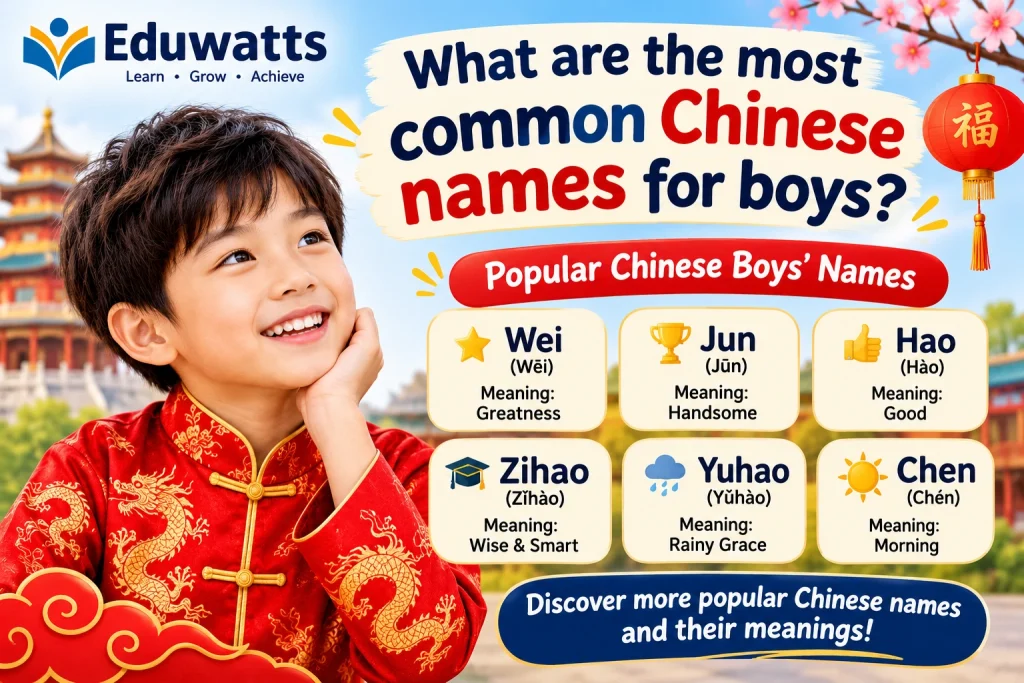
In China, parents typically choose male names that reflect values like courage, intelligence, leadership, success and strength. They usually find characters that indicate the type of person they want their son to become. Below are 30 traditional and contemporary Chinese male names (including Pinyin pronunciation) with the meaning of each character.
Popular Chinese Boy Names With Meanings
| No. | Chinese Name | Characters | Pinyin | English Meaning |
| 1 | Wei | 伟 | Wěi | Great, powerful |
| 2 | Hao | 浩 | Hào | Vast, magnificent |
| 3 | Jun | 君 | Jūn | Noble, gentleman |
| 4 | Ming | 明 | Míng | Bright, intelligent |
| 5 | Jie | 杰 | Jié | Outstanding, talented |
| 6 | Qiang | 强 | Qiáng | Strong, powerful |
| 7 | Yong | 勇 | Yǒng | Brave, courageous |
| 8 | Feng | 峰 | Fēng | Mountain peak |
| 9 | Lei | 磊 | Lěi | Strong, upright |
| 10 | Bo | 博 | Bó | Knowledgeable, broad-minded |
| 11 | Cheng | 成 | Chéng | Success, achievement |
| 12 | Guo | 国 | Guó | Country, nation |
| 13 | Jian | 健 | Jiàn | Healthy, strong |
| 14 | Kai | 凯 | Kǎi | Victory, triumph |
| 15 | Peng | 鹏 | Péng | Legendary giant bird |
| 16 | Tao | 涛 | Tāo | Great waves |
| 17 | Zhi | 志 | Zhì | Ambition, aspiration |
| 18 | Xuan | 轩 | Xuān | Grand, elegant |
| 19 | Rui | 瑞 | Ruì | Auspicious, fortunate |
| 20 | Chen | 晨 | Chén | Morning, dawn |
| 21 | Dong | 东 | Dōng | East |
| 22 | Guang | 光 | Guāng | Light, brightness |
| 23 | Hong | 宏 | Hóng | Vast, grand |
| 24 | Liang | 亮 | Liàng | Bright, clear |
| 25 | Sheng | 晟 | Shèng | Flourishing, bright |
| 26 | Tian | 天 | Tiān | Sky, heaven |
| 27 | Wen | 文 | Wén | Literature, culture |
| 28 | Yu | 宇 | Yǔ | Universe, space |
| 29 | Ze | 泽 | Zé | Kindness, grace |
| 30 | An | 安 | Ān | Peace, safety |
What Are the Most Common Chinese Names for Girls?
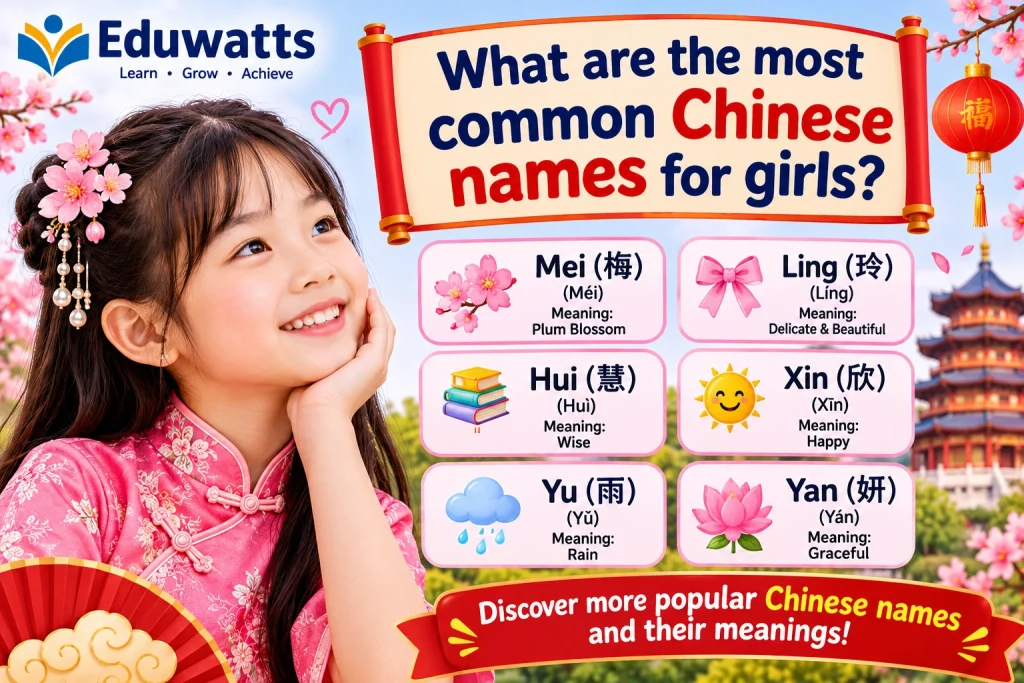
Chinese girls’ names are often based on beauty, gentleness, intelligence, elegance, and peace. They can be drawn from flowers, gemstones, the natural world, as well as the positive aspects of a person’s character. Parents also use characters that show their hope for their daughter to find happiness, self-assurance, and success. Below are 30 well-known Chinese girls’ names along with their characters, pinyin, and definitions.
Popular Chinese Girl Names With Meanings
| No. | Chinese Name | Characters | Pinyin | English Meaning |
| 1 | Mei | 美 | Měi | Beautiful |
| 2 | Li | 丽 | Lì | Lovely, graceful |
| 3 | Hua | 花 | Huā | Flower |
| 4 | Fang | 芳 | Fāng | Fragrant, virtuous |
| 5 | Xue | 雪 | Xuě | Snow |
| 6 | Ying | 莹 | Yíng | Bright, crystal-clear |
| 7 | Lan | 兰 | Lán | Orchid |
| 8 | Yue | 月 | Yuè | Moon |
| 9 | Jing | 静 | Jìng | Quiet, peaceful |
| 10 | Na | 娜 | Nà | Graceful, elegant |
| 11 | Xia | 夏 | Xià | Summer |
| 12 | Chun | 春 | Chūn | Spring |
| 13 | Lian | 莲 | Lián | Lotus |
| 14 | Zhen | 珍 | Zhēn | Precious, treasure |
| 15 | Yu | 玉 | Yù | Jade |
| 16 | Hui | 慧 | Huì | Intelligent, wise |
| 17 | Xin | 欣 | Xīn | Happy, joyful |
| 18 | Lin | 琳 | Lín | Beautiful jade |
| 19 | Qian | 倩 | Qiàn | Beautiful, graceful |
| 20 | Ting | 婷 | Tíng | Elegant, graceful |
| 21 | Rou | 柔 | Róu | Gentle, soft |
| 22 | Ai | 爱 | Ài | Love |
| 23 | Yan | 燕 | Yàn | Swallow bird |
| 24 | Qing | 晴 | Qíng | Clear, sunny |
| 25 | Xiao | 晓 | Xiǎo | Dawn, daybreak |
| 26 | Ning | 宁 | Níng | Peaceful |
| 27 | Ling | 灵 | Líng | Clever, spirited |
| 28 | Yun | 云 | Yún | Cloud |
| 29 | Dan | 丹 | Dān | Red, cinnabar |
| 30 | Rui | 瑞 | Ruì | Auspicious, fortunate |
What Are Some Popular Chinese Unisex Names?
Chinese unisex names can be given to both boys and girls; however, they typically represent common attributes like tranquillity, knowledge, joy, and power. The meaning of each name is dependent upon which character(s) are selected. Many parents choose Chinese unisex names because they are simple, elegant, have cultural significance, and convey meaning.
The naming example is a character-based list, and it doesn’t represent the most commonly registered names. Many Pinyin spellings may refer to more than one Chinese character with different meanings.
Elegant and meaningful names with cultural significance
| No. | Chinese Name | Characters | Pinyin | English Meaning |
| 1 | An | 安 | Ān | Peace, safety |
| 2 | Ming | 明 | Míng | Bright, intelligent |
| 3 | Chen | 晨 | Chén | Morning, dawn |
| 4 | Rui | 瑞 | Ruì | Good fortune |
| 5 | Xin | 欣 | Xīn | Happiness, joy |
| 6 | Ling | 灵 | Líng | Clever, spirited |
| 7 | Tian | 天 | Tiān | Sky, heaven |
| 8 | Yang | 阳 | Yáng | Sunshine, positive energy |
| 9 | Ning | 宁 | Níng | Peaceful, calm |
| 10 | Yu | 宇 | Yǔ | Universe, space |
| 11 | Jia | 嘉 | Jiā | Excellent, admirable |
| 12 | Wen | 文 | Wén | Culture, literature |
| 13 | Qing | 清 | Qīng | Clear, pure |
| 14 | Lin | 林 | Lín | Forest |
| 15 | Hai | 海 | Hǎi | Sea, ocean |
| 16 | Yue | 月 | Yuè | Moon |
| 17 | Xiao | 晓 | Xiǎo | Dawn, understanding |
| 18 | Chun | 春 | Chūn | Spring |
| 19 | Feng | 风 | Fēng | Wind |
| 20 | He | 和 | Hé | Harmony, peace |
| 21 | Yi | 逸 | Yì | Freedom, ease |
| 22 | Zhen | 真 | Zhēn | Truth, authenticity |
| 23 | Kai | 凯 | Kǎi | Victory, triumph |
| 24 | Bo | 博 | Bó | Knowledge, broad-mindedness |
| 25 | Shuang | 爽 | Shuǎng | Bright, refreshing |
| 26 | Le | 乐 | Lè | Happiness, joy |
| 27 | Guang | 光 | Guāng | Light, brightness |
| 28 | Yi | 怡 | Yí | Contentment, happiness |
| 29 | Ze | 泽 | Zé | Kindness, grace |
| 30 | Yuan | 元 | Yuán | Beginning, origin |
What Do Chinese Names Mean, and How Are They Chosen?
In China, names are more than just a way to identify an individual. They represent a person’s family history, culture, beliefs, wishes for their child, and the characteristics of that child. Parents typically look at the meaning, how it sounds (pronunciation), what it looks like (appearance), and the symbolic significance of each character in the Chinese language when choosing a name.
1. Cultural Significance of Chinese Names
Traditional Chinese names represent a person’s cultural background, family ties, and hopes for their own life. Many times the name represents the wish that they will be happy, successful, smart, healthy, and have a good future.
2. Importance of Chinese Characters
Chinese characters (Hanzi) represent the basis for all Chinese names. The characters themselves each have a specific meaning, and when you combine them together, you can create a name with a lot of depth.
3. Nature-Inspired Meanings
Many of the traditional Chinese names have been named after elements of the natural world (i.e., flowers, mountains, rivers, clouds, moons, suns) which represent qualities of beauty, peace, strength and harmony with the environment.
4. Family Traditions
Chinese families may have a tradition of using a shared character in the names of all family members of the same generation (i.e. siblings, cousins). Naming practices are often influenced by the family’s history and ancestry.
5. Auspicious Meanings and Symbolism
Parents typically choose names that represent prosperity, luck, long life, intelligence, and achievement. Good-omened names reflect parent’s positive expectations for their children’s futures.
6. How Pronunciation Influences Name Selection
Parents choose a child’s name with consideration of how the name sounds, whether the name’s tonal qualities fit the natural flow of speech in Mandarin (which is a tonal language), and whether the name can be misinterpreted by others or associated with negative things.
How Do You Pronounce Chinese Names in Mandarin?

Pronunciation in Mandarin is based on the use of Pinyin which is a Romanized alphabet that represents the sounds used in Chinese. A single syllable is made up of an initial, final, and a tone. It is important to learn to pronounce correctly since if you change the tone of a word it will change its definition. To improve your ability to correctly pronounce Chinese names you should start by learning Pinyin, listen to native speakers, and practice tones on a regular basis.
5 Key Points for Pronouncing Chinese Names
- Learn Pinyin: Understand how Roman letters represent Mandarin sounds.
- Mandarin has four distinct tones and an additional neutral tone. Practice each of the five tones.
- Listen closely: Listen to how native speakers pronounce words, so you can learn what natural-sounding speech is like.
- Avoid habits of English pronunciation: Vowel and consonant sounds of Mandarin can differ from those of English.
- Consistent Practice: Pronounce the name of each plant repeatedly aloud. You can also record yourself to help identify when you are making errors with your pronunciation.
Understanding Mandarin tones:
- First tone (ā): High and level.
- Second tone (á): Rising.
- Third tone (ǎ): Low, dipping tone.
- Fourth tone (à): Sharp falling tone.
- Neutral tone: Light and unstressed.
Popular Chinese Names With Pinyin and Tone Marks
| Chinese Name | Characters | Pinyin | Tone Pattern | Meaning |
| Wei | 伟 | Wěi | Third tone | Great |
| Ming | 明 | Míng | Second tone | Bright |
| Hao | 浩 | Hào | Fourth tone | Vast |
| Mei | 美 | Měi | Third tone | Beautiful |
| An | 安 | Ān | First tone | Peace |
| Rui | 瑞 | Ruì | Fourth tone | Auspicious |
| Xue | 雪 | Xuě | Third tone | Snow |
| Jun | 君 | Jūn | First tone | Noble |
| Xin | 欣 | Xīn | First tone | Joyful |
| Chen | 晨 | Chén | Second tone | Morning |
How Does Learning Chinese Names Help Students Learn Mandarin Faster?
The study of Chinese names provides an effective method for becoming acquainted with Chinese characters, Pinyin, tones, and vocabulary. In addition, studying Chinese names can introduce a student to Chinese culture and naming conventions.
Learning Benefits
- Students learn to recognise common Hanzi characters and their meanings.
- The practice of repeating names can improve a learner’s ability to identify the tone and structure of syllables in Mandarin.
- Students will learn many new words that relate to nature, feelings, families and personalities.
- Develops cultural awareness: Understanding names helps learners understand Chinese culture, tradition and values.
- Increases confidence when speaking Mandarin: Introducing yourself to someone, and addressing other people will give students the opportunity to use their knowledge of Mandarin to engage in daily conversations.
Eduwatts: No.1 Mandarin Language Training Institute

Eduwatts has developed structured Mandarin language education for students who wish to learn to communicate effectively in Chinese and pursue global employment options. The Master’s (MS) in Mandarin Language at Eduwatts is designed to cover HSK levels 1 through 6, and it provides students with over 750 hours of instruction, active learning opportunities, additional language practice, and cultural study. In addition, the MS program provides students with internship experience, access to a job search engine, and accreditation by Dunster Business School, Switzerland.
Key Highlights of the Master’s (MS) in Mandarin Language
| Course Feature | Details |
| Programme | Master’s (MS) in Mandarin Language |
| Institution | Eduwatts |
| Academic association | Dunster Business School, Switzerland |
| Course coverage | HSK 1 to HSK 6 |
| Total duration | 750+ hours |
| Certification | Yes, as specified by the programme |
| Learning format | Self-paced learning with interactive training |
| Language skills | Listening, speaking, reading, and writing |
| Practical learning | AI-powered exercises and vocabulary flashcards |
| Additional benefits | Internship experience and premium job portal |
Learning Benefits of the Master’s (MS) in Mandarin Language – 5 Key Points
- Advanced Level of Proficiency in Chinese: To develop the language from the beginning stage up to the HSK 6 advanced level.
- Improved communication: Engage in higher-level conversations, listening skills and professional communication.
- Academic Writing Skills: Master the use of advanced grammar, vocabulary, research methods and how to write in a structured format.
- Explore Mandarin literature, Chinese culture and how they communicate.
- Mandarin’s practical application in the world of work, politics, schools, and global affairs.
Career Benefits of Learning Mandarin – 5 Key Points
- An international job opportunity: Your knowledge of Mandarin may help you land jobs in areas that have a large number of people who speak Chinese.
- Business communication in this situation involves communicating with your Chinese clients, your Chinese suppliers, and your Chinese business partners.
- Professional translation and interpretation careers are open for exploration.
- Education and research: Seek out positions in language education, research within academia, and cultural studies.
- Build relationships with other organisations and professionals that operate in global markets through professional networking.
Job Roles After Mastering Mandarin Language
Learning Mandarin can open career opportunities in translation, interpretation, international business, education, tourism, and global trade. Professionals who combine Mandarin proficiency with industry-specific knowledge can explore opportunities in multinational companies, Chinese businesses, export-import organisations, and international institutions.
Top Job Roles and Salary
| Job Roles | Skills Required | Responsibilities | Average Salary in India |
| Mandarin Translator | Mandarin proficiency, grammar, writing, translation | Translate documents, reports, emails, and business materials | ₹3–8 LPA |
| Chinese Interpreter | Listening, speaking, cultural understanding | Interpret conversations, meetings, conferences, and negotiations | ₹4–8 LPA |
| Mandarin Language Teacher | Mandarin fluency, teaching, communication | Teach Mandarin grammar, vocabulary, pronunciation, and writing | ₹3–7 LPA |
| International Business Executive | Mandarin, negotiation, business communication | Manage Chinese clients, business partnerships, and international transactions | ₹4–10 LPA |
| China Market Research Analyst | Mandarin, research, analytical skills | Research Chinese markets, competitors, customer behaviour, and business trends | ₹4–9 LPA |
| Import-Export Coordinator | Mandarin, logistics, documentation | Coordinate with Chinese suppliers, manage shipments, and handle trade documentation | ₹3–8 LPA |
| Mandarin Localisation Specialist | Translation, editing, cultural adaptation | Adapt websites, applications, software, and marketing content for Chinese audiences | ₹4–10 LPA |
| International Relations Specialist | Mandarin, research, diplomacy, communication | Support international partnerships, cultural exchanges, and diplomatic activities | ₹5–12 LPA |
First-Hand Experience
Exploring popular Chinese names was an interesting educational exercise. Through it, I learned the importance of understanding the Chinese characters, English definitions, and Mandarin pronunciations in understanding how Chinese names express personal, familial, and cultural values. For me, Pinyin learning and developing tone discrimination were fun and engaging aspects of the exercise for anyone interested in the Chinese language.
In my work, exploring popular Chinese names was an interesting educational exercise. Through it, I learned the importance of understanding the Chinese characters, English definitions, and Mandarin pronunciations in understanding how Chinese names express personal, familial, and cultural values. For me, learning Pinyin and developing tone discrimination were fun and engaging aspects of the exercise for anyone interested in the Chinese language.
Conclusion
Chinese names provide an interesting view of the Mandarin language, Chinese culture, and traditional values. With a variety of different types of names available, such as meaningful boys’ and girls’ names and versatile unisex names, each Chinese character can express the desire for happiness, knowledge, prosperity, and achievement. Learning Chinese names is a great way to begin learning how to use Hanzi, Pinyin, and speak Mandarin correctly.
Contact Us to get Mandarin Expert Guidance on top Mandarin Language Courses. Start your Mandarin Language Student Journey from the basics of vocabulary to advanced communication and professional use.
Recommended Reads
- How to Learn the Chinese Language: 11 Easy Tips for Beginners
- A Beginner’s Guide to Chinese Culture, Religion & Festivals
- 9 Best Languages to Learn in the Upcoming Years for Your Career Growth
- How to Learn a New Language Online: A Complete Guide
- Top 10 Most Spoken Languages in the World (2027)
FAQs
Ans. The most popular Chinese names include Wei, Ming, Hao, Jun, Mei, Li, Xue, Rui, An, and Chen. These names have a variety of meanings, such as greatness, intelligence, beauty, peace, and good luck.
Ans. Mei (美) – Beautiful; Lan (兰) – Orchid; Xue (雪) – Snow; Yue (月) – Moon – Beautiful Chinese Girl Names.
Ans. Qiang (强) means strong; Yong (勇) means brave; Wei (伟) means great; Jian (健) means healthy. All four of these Chinese boy-name options have strong meanings.
Ans. Yes, depending upon the characters chosen for the name, as well as the parents’ preference for the sex of their child; names such as An (安), Ming (明), Rui (瑞), Xin (欣), and Chen (晨) are appropriate for either a boy or girl.
Ans. The Hanzi characters are used to write Chinese names. Typically, the family name precedes the given name. Usually, the given name is composed of either one or two characters.
Ans. The majority of Chinese names have a single character for the last name (family name) and either a one- or two-character first name (given name). There are many two-character first names.
Ans. Pinyin is a system of romanised spelling used to represent Chinese pronunciation. The purpose of Pinyin is to help students learn how to properly pronounce Chinese characters and therefore be able to effectively communicate with others in Chinese.
Ans. For beginners, it is recommended to begin by studying common Chinese names; identifying Hanzi characters; practising Pinyin and tone patterns; listening to native Mandarin speakers; and participating in structured language classes.
Ready to Start Your Learning Journey?
Join thousands of learners and build your future with expert-led courses and 100% practical training.

Pallavi Saxena
With more than 15 years of experience, I dedicatedly writing informative content for my audience. With extensive experience in content writing and digital publishing, I specialize in creating informative, engaging, and industry-focused content that helps readers make informed career and business decisions. My expertise includes developing high-quality content on foreign language learning, global career opportunities, ERP solutions and enterprise technologies. By staying updated with emerging trends, technological advancements, and industry best practices, I craft content that educates, inspires, and delivers lasting value to readers across diverse sectors.
View all articles